






Key Objectives and Benefits of Major Indian Government Schemes
Government schemes in India play a crucial role in the socio-economic development of the country. These schemes are launched by the Central Government and State Governments to address issues such as poverty, unemployment, education, healthcare, women empowerment, rural development, agriculture, and digital growth. For students preparing for competitive exams, understanding important government schemes launched in India is essential, as questions are frequently asked in exams like UPSC, SSC, Banking, Railways, State PSC, and other government exams.
What Are Government Schemes?
Government schemes are structured programs introduced by the Government of India to achieve specific developmental goals. These schemes are usually launched with a defined budget, target beneficiaries, and implementation strategy. They aim to improve the quality of life of citizens, promote inclusive growth, and strengthen the economy.
Objectives of Government Schemes
- Reduction of poverty and unemployment
- Promotion of education and skill development
- Improvement in healthcare facilities
- Women and child welfare
- Support to farmers and rural development
- Financial inclusion and digital empowerment
Important Government Schemes Launched In India
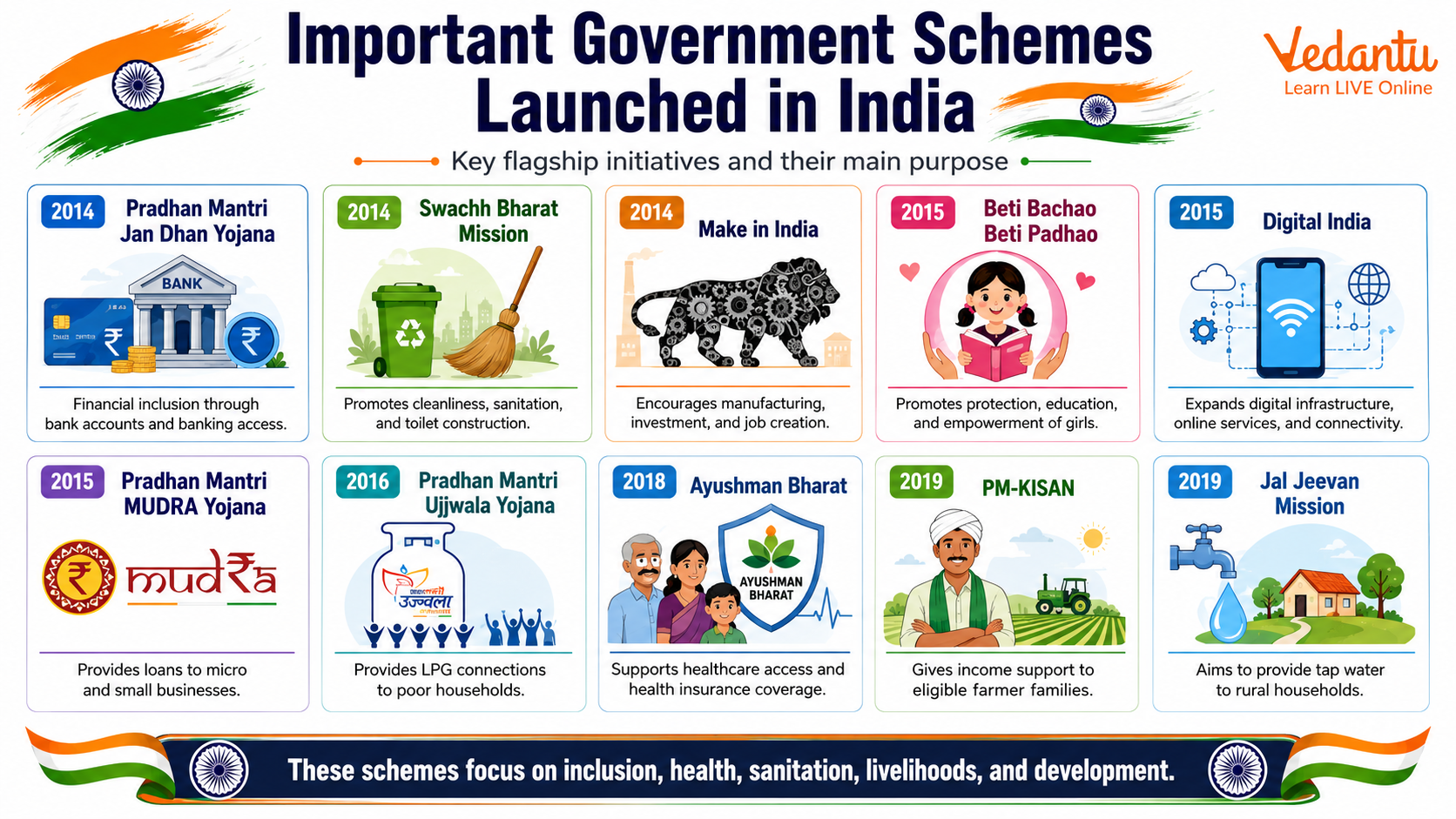
Major Government Schemes in India
| Scheme Name | Launched Year | Purpose |
|---|---|---|
| Pradhan Mantri Jan Dhan Yojana | 2014 | Financial inclusion and bank accounts for all |
| Swachh Bharat Mission | 2014 | Cleanliness and sanitation improvement |
| Make in India | 2014 | Boost manufacturing sector |
| Digital India | 2015 | Digital infrastructure and e-governance |
| Pradhan Mantri Ujjwala Yojana | 2016 | Free LPG connections to women |
| Ayushman Bharat Yojana | 2018 | Health insurance coverage for poor families |
| PM Kisan Samman Nidhi | 2019 | Income support to farmers |
The above schemes are among the most important initiatives launched by the Government of India in recent years. They target different sectors such as health, agriculture, sanitation, finance, and manufacturing.
Sector Wise Classification of Important Schemes
1. Social Welfare Schemes
- Ayushman Bharat Yojana
- Beti Bachao Beti Padhao
- Pradhan Mantri Ujjwala Yojana
- National Social Assistance Programme
2. Agriculture and Rural Development Schemes
- PM Kisan Samman Nidhi
- Pradhan Mantri Fasal Bima Yojana
- MGNREGA
- Soil Health Card Scheme
3. Financial Inclusion and Economic Schemes
- Pradhan Mantri Jan Dhan Yojana
- Mudra Yojana
- Stand Up India Scheme
- Startup India
4. Education and Skill Development Schemes
- Skill India Mission
- Samagra Shiksha Abhiyan
- National Apprenticeship Promotion Scheme
Why Government Schemes Are Important for Exams
Important government schemes launched in India are frequently asked in General Knowledge and Current Affairs sections. Questions may be based on the year of launch, objectives, target beneficiaries, ministries involved, and key features. Understanding these schemes helps aspirants score well in both prelims and mains examinations.
Preparation Tips for Students
- Make short notes of schemes along with launch year and ministry.
- Group schemes sector wise for better memory retention.
- Revise regularly using tables and charts.
- Practice previous year questions related to government schemes.
Conclusion
Important government schemes launched in India reflect the country’s efforts towards inclusive growth and sustainable development. From financial inclusion and healthcare to agriculture and digital transformation, these schemes aim to uplift various sections of society. For students and competitive exam aspirants, having a clear understanding of these schemes, their objectives, and their impact is essential for strong performance in General Knowledge and Current Affairs sections.
FAQs on Important Government Schemes in India for Students and Exams
1. What are the most important government schemes launched in India?
The most important government schemes in India focus on financial inclusion, healthcare, housing, and rural development.
Key schemes include:
• Pradhan Mantri Jan Dhan Yojana (PMJDY) – Financial inclusion scheme
• Ayushman Bharat Yojana – Health insurance scheme
• Pradhan Mantri Awas Yojana (PMAY) – Housing for all
• Make in India – Boost manufacturing sector
• Digital India – Digital empowerment initiative
These central government schemes are frequently asked in competitive exams and GK questions.
2. What is Pradhan Mantri Jan Dhan Yojana (PMJDY)?
The Pradhan Mantri Jan Dhan Yojana (2014) is a financial inclusion scheme aimed at providing banking services to every household in India.
Main features:
• Zero-balance bank accounts
• RuPay debit card facility
• Accidental insurance cover
• Direct Benefit Transfer (DBT)
PMJDY promotes financial inclusion, banking access, and social security for the poor and unbanked population.
3. What is the objective of Ayushman Bharat Yojana?
The Ayushman Bharat – Pradhan Mantri Jan Arogya Yojana (PM-JAY) aims to provide free healthcare coverage to economically weaker sections.
Key objectives:
• Health insurance cover up to ₹5 lakh per family per year
• Cashless treatment at empanelled hospitals
• Coverage for secondary and tertiary care
This flagship health insurance scheme improves access to affordable healthcare in India.
4. What is Pradhan Mantri Awas Yojana (PMAY)?
The Pradhan Mantri Awas Yojana (2015) is a housing scheme that aims to provide "Housing for All" by offering affordable homes to urban and rural poor.
Main components:
• Subsidized home loans under Credit Linked Subsidy Scheme (CLSS)
• PMAY-Urban and PMAY-Gramin divisions
• Financial assistance for house construction
PMAY supports affordable housing, rural development, and urban development initiatives.
5. What is the Make in India initiative?
The Make in India initiative, launched in 2014, aims to transform India into a global manufacturing hub.
Key goals:
• Encourage foreign direct investment (FDI)
• Boost manufacturing sector growth
• Generate employment opportunities
• Promote ease of doing business
This flagship economic development program strengthens India's industrial growth and global competitiveness.
6. What is the Digital India Programme?
The Digital India Programme, launched in 2015, aims to digitally empower citizens and improve online infrastructure.
Main pillars:
• Digital infrastructure as a utility
• Governance and services on demand
• Digital literacy and empowerment
It promotes e-governance, online services, and digital transformation across India.
7. What is the Swachh Bharat Mission?
The Swachh Bharat Mission (2014) is a nationwide cleanliness campaign to eliminate open defecation and improve sanitation.
Key highlights:
• Construction of household toilets
• Solid waste management initiatives
• Rural and urban sanitation programs
This mission supports public health, hygiene awareness, and clean India initiatives.
8. What is the objective of Skill India Mission?
The Skill India Mission (2015) aims to provide vocational training and skill development to youth.
Main objectives:
• Enhance employability skills
• Industrial training programs
• Entrepreneurship development
• Certification under Pradhan Mantri Kaushal Vikas Yojana (PMKVY)
This scheme promotes skill development, job creation, and workforce empowerment.
9. What is the Beti Bachao Beti Padhao scheme?
The Beti Bachao Beti Padhao (2015) scheme aims to improve the child sex ratio and promote girls' education.
Key features:
• Awareness campaigns against gender discrimination
• Support for girls’ education
• Welfare initiatives for girl child protection
This social welfare scheme focuses on women empowerment, gender equality, and girl child education.
10. Why are government schemes important for competitive exams and GK preparation?
Government schemes are important for General Knowledge (GK) and competitive exams because they reflect current affairs and public policy initiatives.
Reasons they are frequently asked:
• Questions in UPSC, SSC, Banking, Railways exams
• Focus on launch year, objectives, and ministries
• Link with economic and social development topics
Understanding important government schemes in India helps students score well in exams and stay updated with national policies.
