






Key Points and Legal Process of Filing a Police FIR in India
A Police FIR - First Information Report - is a written document prepared by the police when they receive information about the commission of a cognizable offence. It is one of the most important steps in the criminal justice system of India. Filing an FIR sets the criminal law in motion and allows the police to begin investigation. Understanding the concept, procedure, rights of citizens, and legal provisions related to FIR is essential for students, competitive exam aspirants, and general awareness.
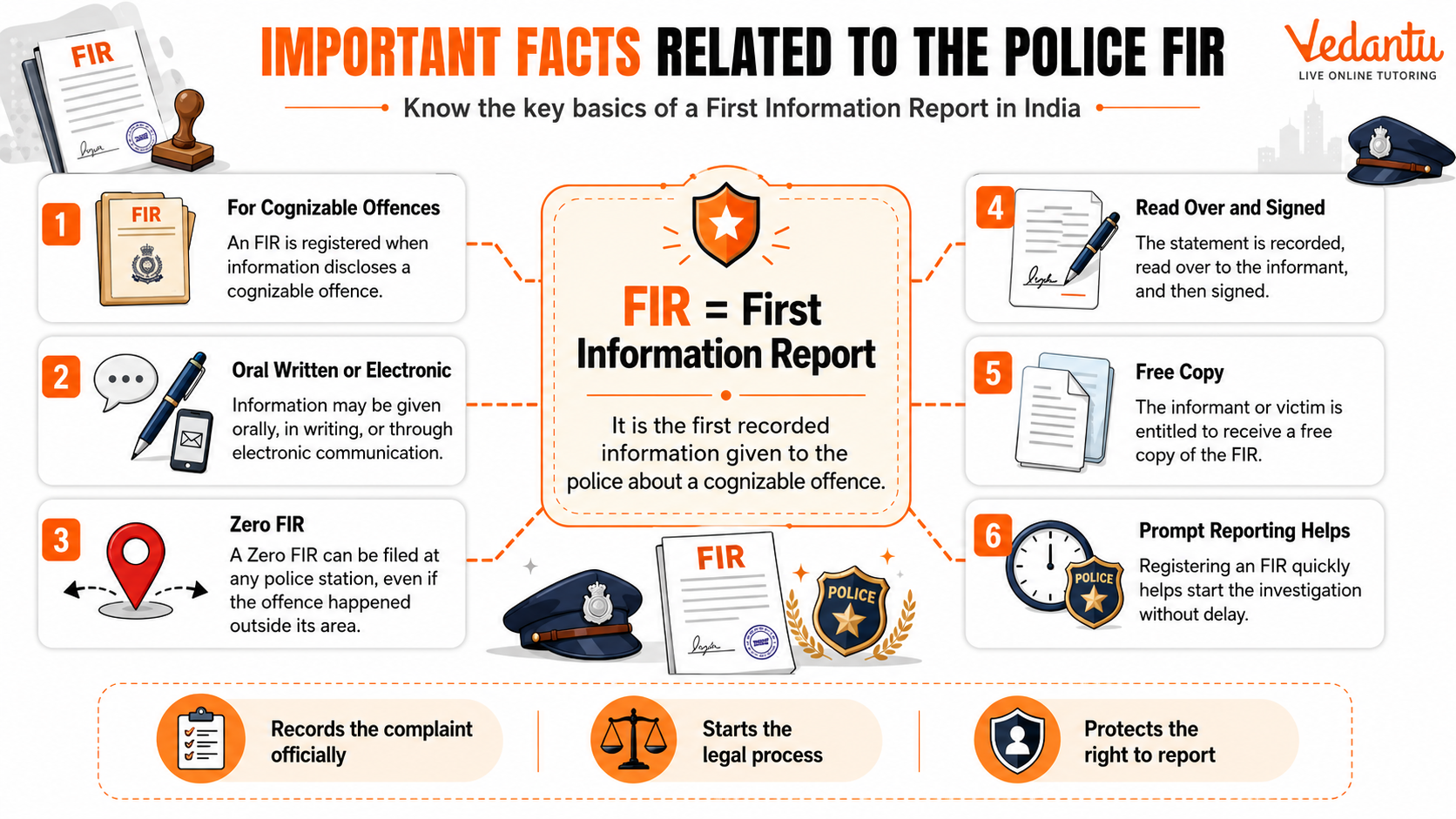
What is a Police FIR?
An FIR or First Information Report is the first formal information given to the police about the commission of a cognizable offence. It is recorded under Section 154 of the Criminal Procedure Code - CrPC, 1973. Once registered, it becomes the foundation of the criminal investigation process.
- It is recorded by the officer in charge of a police station.
- It can be given by the victim or any person who has knowledge of the offence.
- It must relate to a cognizable offence.
- A free copy of the FIR must be given to the informant.
Legal Provisions Related To FIR
Section 154 of CrPC
Section 154 of the Criminal Procedure Code, 1973 deals with the registration of FIR in cases of cognizable offences. It makes it mandatory for the police to register an FIR when information about a cognizable offence is received.
Cognizable vs Non-Cognizable Offence
A cognizable offence is one in which the police can arrest the accused without a warrant and start investigation without prior court approval. A non-cognizable offence requires a warrant and court permission for investigation.
Difference Between Cognizable and Non-Cognizable Offence
| Basis | Cognizable Offence | Non-Cognizable Offence |
|---|---|---|
| Police Power | Arrest without warrant | Cannot arrest without warrant |
| Examples | Murder, Rape, Theft | Defamation, Public nuisance |
FIR is generally registered only for cognizable offences. In case of non-cognizable offences, the police record the complaint in a separate register and seek court permission before investigation.
Procedure for Filing an FIR
- Visit the nearest police station.
- Provide complete and accurate information about the incident.
- The police officer records the information in writing.
- The information is read over to the informant.
- The informant signs the document.
- A free copy of the FIR is given to the informant.
Zero FIR
Zero FIR is an FIR that can be filed in any police station irrespective of jurisdiction. The police station where Zero FIR is registered transfers it to the appropriate police station for investigation. This concept ensures that urgent cases, especially serious offences, are not delayed due to jurisdictional issues.
Rights of the Informant
- Right to get a free copy of the FIR.
- Right to have the information recorded accurately.
- Right to approach higher police authorities if FIR is not registered.
- Right to approach a Magistrate under Section 156(3) of CrPC if police refuse to register FIR.
Importance of FIR in Criminal Justice System
The FIR is crucial because it officially starts the criminal investigation. It helps in documenting the time, date, place, and details of the alleged offence. It prevents manipulation of facts at a later stage and ensures transparency in the legal process. Courts often rely on FIR details to examine consistency in the prosecution case.
Important Facts for Competitive Exams
- FIR is defined under Section 154 of CrPC, 1973.
- It applies only to cognizable offences.
- Police are legally bound to register FIR in cognizable cases.
- Zero FIR can be filed in any police station regardless of jurisdiction.
- A free copy of FIR must be provided to the informant.
Conclusion
A Police FIR is a fundamental element of the Indian criminal justice system. It empowers citizens to report crimes and ensures that law enforcement agencies take necessary action. Understanding its legal basis, procedure, and significance helps individuals protect their rights and enhances general legal awareness. For competitive examinations and general knowledge preparation, knowing the provisions and key facts related to FIR is highly important.
FAQs on Important Facts About Police FIR Every Student Should Know
1. What is an FIR in police terms?
An FIR (First Information Report) is an official written document prepared by the police when they receive information about a cognizable offence.
• FIR is registered under Section 154 of the Criminal Procedure Code (CrPC).
• It marks the beginning of a criminal investigation.
• It contains details like date, time, place, and nature of the offence.
• It is commonly searched as: What is FIR?, Meaning of FIR, Police complaint vs FIR, First Information Report definition.
FIR is a crucial legal document in the Indian criminal justice system.
2. Who can file an FIR in India?
Any person who has knowledge of a cognizable crime can file an FIR in India.
• The victim of the crime
• A witness to the offence
• Any person aware of the crime
• Even a police officer on receiving information
There is no requirement that only the victim must file the FIR. This is often searched as: Who can lodge FIR?, Can a third person file FIR?, FIR rules in India.
3. What is the difference between a cognizable and non-cognizable offence?
The key difference lies in police authority to arrest and investigate without court approval.
• Cognizable offence: Police can register an FIR and arrest without prior court permission (e.g., murder, theft, rape).
• Non-cognizable offence: Police need court permission to investigate (e.g., defamation, minor assault).
This distinction is important for understanding when an FIR can be immediately registered under CrPC provisions.
4. What details are included in an FIR?
An FIR contains essential information about the alleged crime.
• Name and address of the complainant
• Date, time, and location of the incident
• Description of the offence
• Name of the accused (if known)
• Witness details (if available)
These details help initiate the police investigation process and form the base of the criminal case record.
5. Is it mandatory for police to register an FIR?
Yes, police are legally bound to register an FIR for cognizable offences.
• As per the Supreme Court of India judgment (Lalita Kumari vs Govt. of UP, 2013), FIR registration is mandatory.
• Police cannot refuse to record information about a cognizable crime.
• Refusal can be challenged before higher police authorities or a Magistrate.
This is commonly searched as: Can police refuse FIR?, FIR rights of citizens, Mandatory FIR rule.
6. What is a Zero FIR?
A Zero FIR is an FIR registered at any police station regardless of jurisdiction.
• It is later transferred to the appropriate police station.
• It ensures immediate action in urgent cases like rape or serious crimes.
• It prevents delay in justice due to jurisdiction issues.
Zero FIR is an important concept in women’s safety laws and emergency legal procedures.
7. Can an FIR be withdrawn or cancelled?
An FIR cannot be simply withdrawn by the complainant once registered.
• For compoundable offences, parties may settle with court approval.
• For serious offences, only a High Court can quash the FIR under Section 482 CrPC.
• Police may file a closure report if evidence is insufficient.
This is often searched as: How to cancel FIR?, Can FIR be taken back?, FIR quashing procedure.
8. What happens after an FIR is filed?
After an FIR is filed, the police begin the formal investigation process.
• Collection of evidence
• Recording witness statements
• Arrest of accused (if required)
• Filing of charge sheet in court
The FIR sets the criminal justice process in motion and may lead to trial in a court of law.
9. Is a copy of the FIR given to the complainant?
Yes, a free copy of the FIR must be provided to the complainant.
• It is the legal right of the informant under Section 154 CrPC.
• The copy contains the FIR number and police station details.
• It can also be accessed online in many states through police portals.
This ensures transparency in the police complaint registration process.
10. Why is an FIR important in the criminal justice system?
An FIR is important because it officially records the commission of a crime and starts legal proceedings.
• It acts as primary evidence of complaint.
• It safeguards citizens’ legal rights.
• It ensures accountability of police authorities.
• It forms the foundation of the prosecution case in court.
The First Information Report plays a vital role in maintaining law and order and delivering justice.
