






List of Important Articles in the Indian Constitution with Key Provisions and Meanings
The Important Articles of the Indian Constitution form the backbone of India’s legal and political system. These Articles define the structure of government, fundamental rights of citizens, powers of authorities, emergency provisions, and the functioning of constitutional bodies. For students and competitive exam aspirants, understanding these key Articles is essential for exams like UPSC, SSC, Banking, State PSC, Defence, and other government examinations. This page provides a structured and easy-to-understand explanation of the most important Articles of the Indian Constitution.
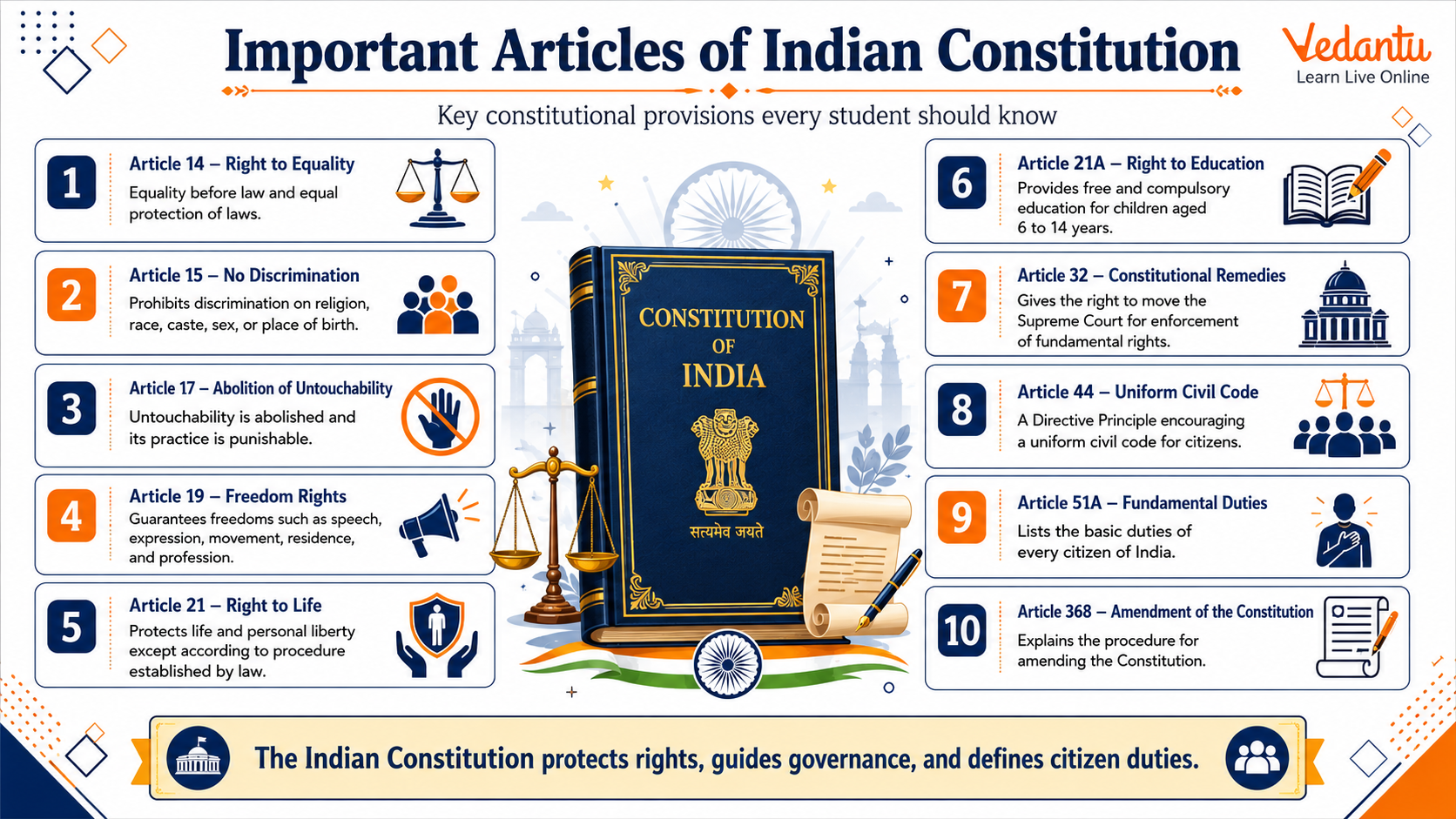
What Are Articles in the Indian Constitution?
The Constitution of India is divided into Articles and Parts. Each Article deals with a specific provision related to governance, rights, duties, or administration. Originally, the Constitution had 395 Articles divided into 22 Parts. After several amendments, the number of Articles has increased. Some Articles are frequently asked in competitive exams due to their constitutional importance.
Important Articles of Indian Constitution - Overview Table
| Article Number | Provision | Key Feature |
|---|---|---|
| Article 12-35 | Fundamental Rights | Basic rights guaranteed to citizens |
| Article 36-51 | Directive Principles | Guidelines for state policy |
| Article 51A | Fundamental Duties | Duties of Indian citizens |
| Article 72 | Pardoning Power of President | Power to grant pardon |
| Article 356 | President's Rule | Failure of constitutional machinery in states |
The above table highlights some of the most important constitutional Articles that are frequently asked in examinations. Detailed explanations of key Articles are provided below.
Important Articles Related to Fundamental Rights
Article 14 - Right to Equality
Article 14 guarantees equality before law and equal protection of laws within the territory of India. It ensures that no person is above the law and prohibits arbitrary discrimination.
Article 19 - Six Fundamental Freedoms
Article 19 provides six freedoms to citizens, such as freedom of speech and expression, assembly, association, movement, residence, and profession. These freedoms are subject to reasonable restrictions.
Article 21 - Right to Life and Personal Liberty
Article 21 states that no person shall be deprived of life or personal liberty except according to procedure established by law. The Supreme Court has expanded its scope to include the right to privacy, clean environment, and legal aid.
Article 21A - Right to Education
Article 21A makes free and compulsory education a fundamental right for children between 6 and 14 years of age.
Article 32 - Right to Constitutional Remedies
Article 32 allows citizens to approach the Supreme Court for enforcement of Fundamental Rights. Dr B R Ambedkar called it the heart and soul of the Constitution.
Important Articles Related to Directive Principles of State Policy
Directive Principles are mentioned in Part IV of the Constitution from Article 36 to Article 51. These principles guide the government in making laws and policies.
- Article 38 - Promote welfare of the people
- Article 39 - Equal pay for equal work
- Article 40 - Organisation of village panchayats
- Article 44 - Uniform Civil Code
- Article 45 - Early childhood care and education
Important Articles Related to Constitutional Offices
Article 52 - The President of India
Article 52 states that there shall be a President of India. The President is the constitutional head of the Union.
Article 63 - The Vice President of India
Article 63 provides for the office of the Vice President of India.
Article 74 - Council of Ministers
Article 74 states that there shall be a Council of Ministers with the Prime Minister at the head to aid and advise the President.
Article 76 - Attorney General of India
Article 76 provides for the appointment of the Attorney General of India, the chief legal advisor to the Government of India.
Important Emergency Articles
Article 352 - National Emergency
Article 352 deals with proclamation of National Emergency due to war, external aggression, or armed rebellion.
Article 356 - President's Rule
Article 356 allows the President to impose President's Rule in a state if there is failure of constitutional machinery.
Article 360 - Financial Emergency
Article 360 provides for Financial Emergency if the financial stability or credit of India is threatened.
Other Frequently Asked Important Articles
- Article 1 - India, that is Bharat, shall be a Union of States
- Article 3 - Formation of new states and alteration of areas
- Article 50 - Separation of judiciary from executive
- Article 123 - Ordinance making power of the President
- Article 226 - Power of High Courts to issue writs
- Article 280 - Finance Commission
- Article 324 - Election Commission of India
- Article 368 - Amendment of the Constitution
Why Important Articles Are Crucial for Competitive Exams
Questions related to important constitutional Articles are frequently asked in objective and descriptive exams. Candidates are often required to match Article numbers with provisions, identify correct statements, or analyze constitutional scenarios. Understanding these Articles helps in strengthening Indian Polity preparation and improves overall General Knowledge.
Preparation Tips to Remember Important Articles
- Group Articles based on categories such as Fundamental Rights, DPSP, Emergency, and Constitutional Bodies.
- Create short notes and flashcards for quick revision.
- Practice previous year questions from competitive exams.
- Revise regularly to remember Article numbers accurately.
Conclusion
The Important Articles of the Indian Constitution form the legal foundation of the country’s democratic system. From Fundamental Rights to Emergency provisions, each Article plays a significant role in governance and protection of citizens’ rights. A clear understanding of these Articles is essential for academic excellence and success in competitive examinations. Regular revision and conceptual clarity will help students master this important topic in General Knowledge.
FAQs on Important Articles of the Indian Constitution: Complete Student Guide
1. What are the most important Articles of the Indian Constitution?
The most important Articles of the Indian Constitution define fundamental rights, duties, powers, and governance structure. Key Articles include:
• Article 14 – Right to Equality
• Article 19 – Freedom of Speech and Expression
• Article 21 – Right to Life and Personal Liberty
• Article 32 – Right to Constitutional Remedies (Heart and Soul – Dr. B.R. Ambedkar)
• Article 44 – Uniform Civil Code (Directive Principle)
• Article 51A – Fundamental Duties
• Article 368 – Power to Amend the Constitution
These Articles are frequently asked in GK questions, UPSC, SSC, and other competitive exams.
2. Why is Article 32 called the heart and soul of the Constitution?
Article 32 is called the “Heart and Soul of the Indian Constitution” because it guarantees the enforcement of Fundamental Rights. Key points include:
• Citizens can directly approach the Supreme Court
• Provides writs like Habeas Corpus, Mandamus, Prohibition, Certiorari, and Quo Warranto
• Ensures protection against violation of Fundamental Rights
Dr. B.R. Ambedkar emphasized its importance in safeguarding democracy and constitutional supremacy.
3. What does Article 14 of the Indian Constitution state?
Article 14 guarantees Right to Equality before Law and Equal Protection of Laws within India. It means:
• No person is above the law
• Equal treatment by courts and legal authorities
• Prohibits arbitrary discrimination by the state
This Article forms the foundation of equality, rule of law, and democratic governance in India.
4. What is the significance of Article 19 in Fundamental Rights?
Article 19 protects key freedoms of Indian citizens essential for democracy. It includes:
• Freedom of Speech and Expression
• Freedom to Assemble Peacefully
• Freedom to Form Associations or Unions
• Freedom of Movement
• Freedom to Reside and Settle
• Freedom to Practice any Profession
These six freedoms are crucial for civil liberties, democratic rights, and political participation.
5. What does Article 21 – Right to Life mean?
Article 21 guarantees the Right to Life and Personal Liberty and is one of the most expanded Fundamental Rights. It includes:
• Right to live with dignity
• Right to privacy (declared in 2017)
• Right to education (linked with Article 21A)
• Right to clean environment
The Supreme Court has broadened its scope, making it central to human rights and constitutional law.
6. What is Article 368 of the Indian Constitution?
Article 368 deals with the power of Parliament to amend the Constitution. It provides:
• Procedure for constitutional amendments
• Special majority requirement in Parliament
• In some cases, ratification by half of the State Legislatures
It ensures flexibility while maintaining the basic structure doctrine established in the Kesavananda Bharati case (1973).
7. What is Article 44 and why is it important?
Article 44 advocates for a Uniform Civil Code (UCC) under the Directive Principles of State Policy. It means:
• Common personal laws for all citizens
• Uniform laws on marriage, divorce, inheritance, and adoption
• Promotes national integration and equality
Though not enforceable by courts, it remains significant in constitutional debates and policy discussions.
8. What are Fundamental Duties under Article 51A?
Article 51A lists the Fundamental Duties of Indian citizens, added by the 42nd Amendment (1976). Duties include:
• Respecting the Constitution and National Symbols
• Protecting sovereignty and unity of India
• Promoting harmony and brotherhood
• Protecting the environment
These duties encourage responsible citizenship and strengthen constitutional values and civic responsibility.
9. What is Article 370 and why was it important?
Article 370 granted special status to Jammu and Kashmir before its abrogation in 2019. Key features were:
• Separate Constitution for J&K
• Limited applicability of Indian laws
• Special autonomy in internal matters
In August 2019, the Government of India revoked its special status, making it a major constitutional and political development.
10. What is Article 356 and when is it used?
Article 356 provides for President’s Rule in States during constitutional breakdown. It allows:
• Central government to take control of a state
• Suspension of the State Legislative Assembly
• Governance by the President through the Governor
It is invoked when there is failure of constitutional machinery in a state, and is an important topic in Indian Polity and competitive exams.
