






How the Marathon Began in Ancient Greece and Evolved Worldwide
The History of Marathon Race is one of the most fascinating stories in the world of sports. The marathon is a long-distance running event with a standard distance of 42.195 kilometers or 26.2 miles. It is inspired by an ancient Greek legend and has evolved into one of the most prestigious athletic events worldwide. Today, marathons are organized in major cities across the globe and are a key event in the Olympic Games. Understanding the history of the marathon race helps students and competitive exam aspirants learn about its origin, development, and global significance.
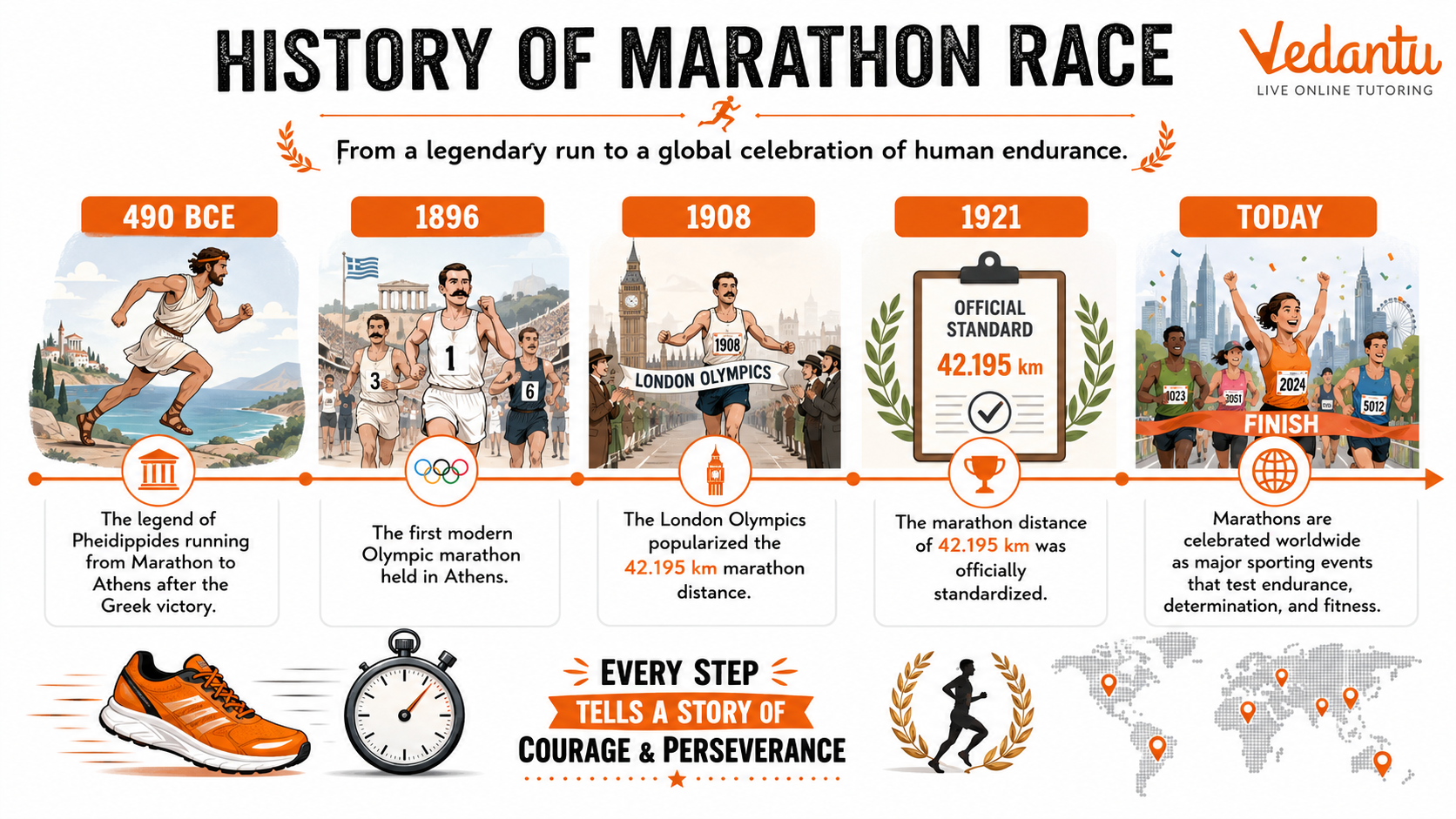
Origin of the Marathon
The marathon race traces its origin to ancient Greece. According to legend, a Greek soldier named Pheidippides ran from the battlefield of Marathon to Athens in 490 BCE to deliver news of victory over the Persians. After delivering the message, he collapsed and died. This legendary run became the inspiration for the modern marathon race.
- Battle of Marathon took place in 490 BCE.
- Pheidippides is believed to have run approximately 40 kilometers.
- The story symbolizes endurance, courage, and determination.
Introduction in the Modern Olympic Games
The modern marathon race was introduced in the first modern Olympic Games held in Athens in 1896. The idea was proposed by French historian Michel Breal to honor the ancient Greek legend. The first Olympic marathon was won by Spyridon Louis of Greece.
- First Olympic Marathon held in 1896.
- Winner - Spyridon Louis from Greece.
- Distance was approximately 40 kilometers.
Standardization of Marathon Distance
Initially, the marathon distance was not fixed and varied from one Olympic Games to another. The standard distance of 42.195 kilometers was established during the 1908 London Olympics. The race distance was extended so that it could start at Windsor Castle and finish in front of the royal family at the Olympic stadium. In 1921, the International Amateur Athletic Federation officially adopted this distance.
Key Milestones in the History of Marathon Race
| Year | Event | Significance |
|---|---|---|
| 490 BCE | Battle of Marathon | Legend of Pheidippides |
| 1896 | First Olympic Marathon | Modern marathon introduced |
| 1908 | London Olympics | Distance set to 42.195 km |
| 1921 | IAAF Decision | Official standard distance adopted |
These milestones highlight how the marathon evolved from a legendary run into a globally recognized competitive sport with standardized rules and distance.
Growth of Marathon Races Worldwide
During the 20th century, marathon races gained popularity across different countries. Major city marathons such as the Boston Marathon, New York City Marathon, London Marathon, Berlin Marathon, Chicago Marathon, and Tokyo Marathon are now internationally recognized events. These races attract elite athletes as well as amateur runners.
Boston Marathon
The Boston Marathon, first held in 1897, is the world's oldest annual marathon and remains one of the most prestigious road racing events.
Women in Marathon
Women were officially allowed to compete in Olympic marathons starting in 1984 at the Los Angeles Olympics. Since then, female participation in marathons has increased significantly worldwide.
Famous Marathon World Records
Over the years, athletes have continuously improved marathon timings through advanced training techniques and sports science.
- Men's marathon world record has gone below 2 hours and 1 minute.
- Women's marathon world record continues to improve with professional competition.
- Elite marathon runners maintain an average pace of about 3 minutes per kilometer.
Importance of Marathon in Modern Times
The marathon race is not just a competitive event but also a symbol of physical fitness and mental endurance. Many marathons today are organized for charity and social awareness. Participation in marathon events promotes healthy lifestyles and community involvement.
- Promotes physical fitness and discipline.
- Encourages social causes and fundraising.
- Builds international sports culture.
Conclusion
The History of Marathon Race reflects a journey from ancient legend to modern global sport. Starting from the heroic story of Pheidippides to becoming a prestigious Olympic and international event, the marathon has evolved significantly over centuries. Its standardized distance, global participation, and cultural importance make it one of the most celebrated endurance sports in the world. For students and competitive exam aspirants, understanding the historical development of the marathon race provides valuable general knowledge about sports history and international events.
FAQs on History of the Marathon Race from Ancient Greece to Today
1. What is the history of the Marathon race?
The Marathon race originated from an ancient Greek legend and later became a modern Olympic event.
- Inspired by the story of Pheidippides, a Greek messenger who ran from Marathon to Athens in 490 BCE.
- Introduced in the first Modern Olympic Games (1896, Athens).
- Standardized distance set in 1908 London Olympics.
The history of marathon reflects themes of endurance, ancient Greece, and Olympic tradition.
2. Who was Pheidippides in Marathon history?
Pheidippides was a Greek messenger linked to the origin of the marathon legend.
- Lived during the Battle of Marathon (490 BCE).
- Ran approximately 40 km from Marathon to Athens to announce victory over Persia.
- His story symbolizes endurance and sacrifice in Greek history.
He is often searched in relation to marathon origin, ancient Greece, and Olympic history.
3. What is the official distance of a Marathon race?
The official marathon distance is 42.195 kilometers (26.2 miles).
- Standardized during the 1908 London Olympics.
- Distance adjusted to start at Windsor Castle and finish at the Olympic Stadium.
- Adopted officially by the International Amateur Athletic Federation (IAAF) in 1921.
This distance is used in all major international marathon competitions.
4. When was the Marathon first included in the Olympic Games?
The marathon was first included in the 1896 Athens Olympic Games.
- Organized to honor the ancient Greek legend.
- Winner: Spyridon Louis of Greece.
- Marked the beginning of marathon as a global sporting event.
It remains one of the most prestigious Olympic track events.
5. Why is the Marathon race named 'Marathon'?
The race is named after the town of Marathon in Greece.
- Location of the Battle of Marathon (490 BCE).
- Associated with the legendary run of Pheidippides.
- Symbolizes victory, endurance, and ancient Greek heritage.
The name connects modern athletics with classical history.
6. What are the most famous Marathon races in the world?
Some of the most famous marathons are part of the World Marathon Majors.
- Boston Marathon
- London Marathon
- New York City Marathon
- Berlin Marathon
- Chicago Marathon
- Tokyo Marathon
These races are globally recognized for elite runners, world records, and mass participation.
7. When were women allowed to compete in the Olympic Marathon?
Women officially competed in the Olympic marathon for the first time in 1984 (Los Angeles Olympics).
- Winner: Joan Benoit Samuelson (USA).
- Marked a milestone in women’s athletics and gender equality in sports.
- Expanded global participation in long-distance running.
This event transformed marathon history and women’s sports.
8. What is the significance of the Marathon race in modern sports?
The marathon symbolizes endurance, determination, and physical fitness in modern sports.
- Featured in the Olympic Games and international championships.
- Encourages mass participation and charity events.
- Tests stamina, mental strength, and athletic discipline.
It is one of the most prestigious long-distance running events worldwide.
9. Who holds the current Marathon world records?
The marathon world records are held by elite long-distance runners recognized by World Athletics.
- Men’s Record: Kelvin Kiptum (2:00:35, 2023).
- Women’s Record: Tigst Assefa (2:11:53, 2023).
- Records are set in certified international marathons.
These achievements represent peak human endurance and speed.
10. How has the Marathon race evolved over time?
The marathon has evolved from an ancient legend to a global competitive sport.
- Began as a tribute event in 1896 Olympics.
- Standardized distance in 1908–1921.
- Inclusion of women in 1984.
- Introduction of technology, timing chips, and global city marathons.
Today, marathon racing combines history, athletics, fitness culture, and international competition.
