






Key Differences Between Hinayana and Mahayana Traditions in Beliefs and Practices
Hinayana and Mahayana are the two major traditions of Buddhism that developed after the death of Gautama Buddha. Over time, differences in interpretation of teachings, spiritual goals, and practices led to the emergence of these two paths. Understanding Hinayana and Mahayana is important for students of history, religion, and competitive exams, as it explains the evolution of Buddhist philosophy, art, culture, and its spread across Asia. Both traditions aim at liberation from suffering, but they differ in their approach, ideals, and scriptures.
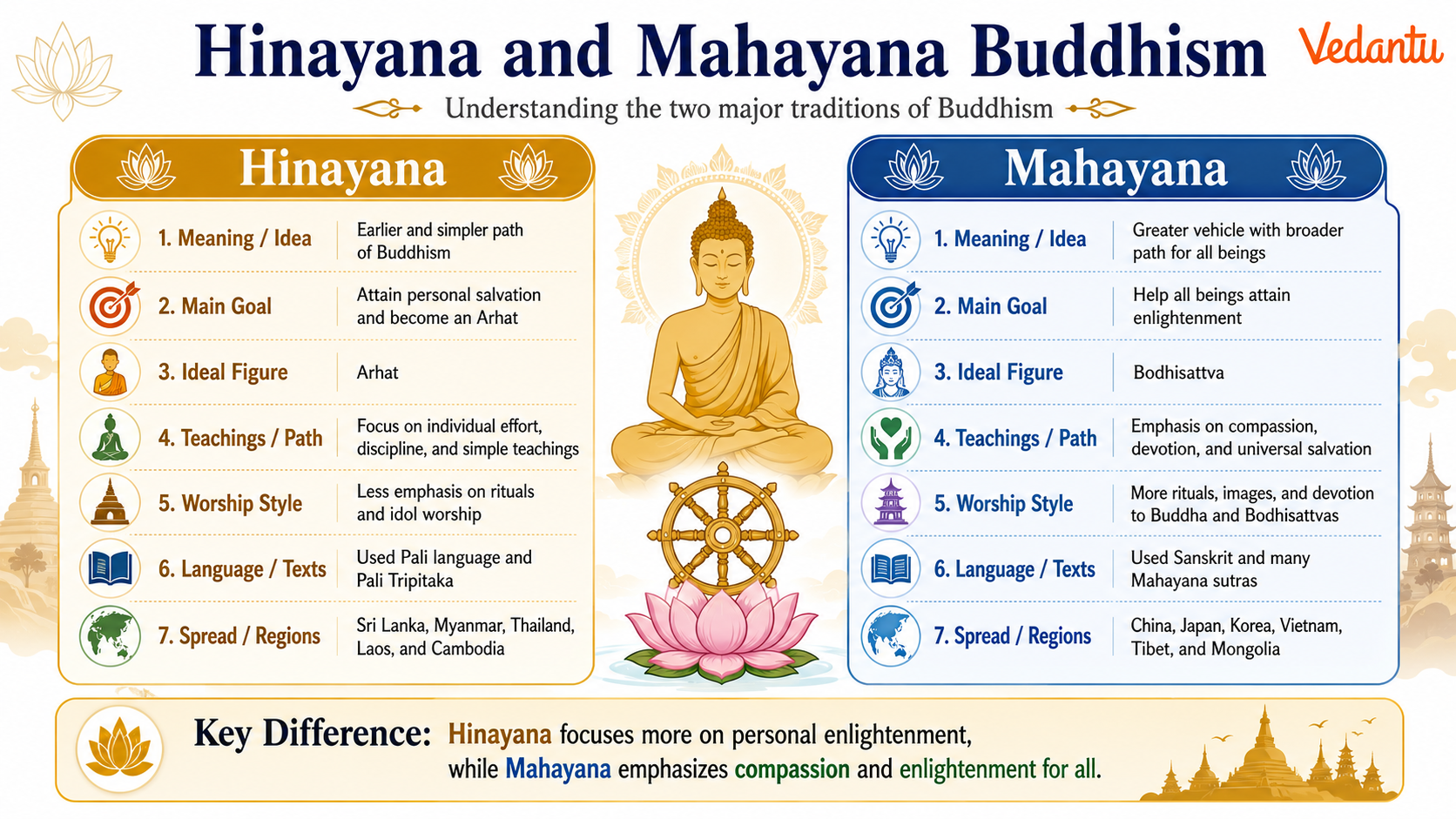
Meaning and Origin of Hinayana and Mahayana
Hinayana
The term Hinayana means Lesser Vehicle. It was used by Mahayana followers to describe the earlier Buddhist schools. Followers of this tradition focus mainly on the original teachings of Buddha and emphasize individual salvation. Today, the Theravada school is considered the surviving branch of Hinayana Buddhism.
Mahayana
Mahayana means Greater Vehicle. It emerged around the 1st century CE and introduced new ideas, texts, and devotional practices. Mahayana Buddhism promotes the ideal of becoming a Bodhisattva who seeks enlightenment not only for oneself but for all beings.
Key Differences Between Hinayana and Mahayana
| Basis of Difference | Hinayana | Mahayana |
|---|---|---|
| Meaning | Lesser Vehicle | Greater Vehicle |
| Ideal Person | Arhat | Bodhisattva |
| Goal | Individual liberation | Universal liberation |
| Language of Texts | Pali | Sanskrit |
| Worship of Buddha | Does not emphasize idol worship | Encourages idol worship |
| Geographical Spread | Sri Lanka, Myanmar, Thailand | China, Korea, Japan, Tibet |
The table above highlights the fundamental distinctions between the two traditions. While Hinayana focuses on strict adherence to early Buddhist teachings and monastic discipline, Mahayana introduced devotional elements and broader philosophical interpretations.
Philosophical Differences
Concept of Salvation
- Hinayana teaches that a person must strive individually to attain Nirvana.
- Mahayana teaches that compassion is central, and one should help others achieve enlightenment.
Nature of Buddha
- Hinayana views Buddha as a great teacher who attained enlightenment.
- Mahayana regards Buddha as a divine or superhuman being with multiple forms.
Scriptures
- Hinayana follows the Tripitaka written in Pali.
- Mahayana follows additional Sutras such as the Lotus Sutra and Heart Sutra written in Sanskrit.
Spread and Cultural Impact
Hinayana Buddhism spread mainly to Sri Lanka and Southeast Asia. It influenced the culture, architecture, and monastic traditions of these regions. Mahayana Buddhism spread to Central Asia, China, Korea, Japan, and Tibet. It played a significant role in shaping Buddhist art, including large statues of Buddha and Bodhisattvas, cave temples, and monasteries.
Similarities Between Hinayana and Mahayana
- Both accept the Four Noble Truths and the Eightfold Path.
- Both believe in Karma and rebirth.
- Both aim at attaining Nirvana.
- Both revere Gautama Buddha as the founder of Buddhism.
Importance for Competitive Exams
Questions related to Hinayana and Mahayana are frequently asked in history and general studies sections of various competitive exams. Students should focus on differences in philosophy, texts, language, and geographical spread. Understanding these distinctions helps in answering multiple choice and descriptive questions effectively.
Conclusion
Hinayana and Mahayana represent two important paths within Buddhism that evolved due to differences in interpretation and practice. While Hinayana emphasizes personal effort and monastic discipline, Mahayana promotes universal compassion and broader devotional practices. Both traditions have significantly influenced the religious and cultural landscape of Asia and continue to guide millions of followers worldwide.
FAQs on Hinayana and Mahayana Buddhism: Meaning and Differences Explained
1. What is the difference between Hinayana and Mahayana in Buddhism?
The main difference between Hinayana and Mahayana Buddhism lies in their beliefs about salvation and the role of Buddha.
• Hinayana (Theravada) focuses on individual salvation through self-discipline.
• Mahayana emphasizes universal salvation and helping others achieve enlightenment.
• Hinayana considers Gautama Buddha a teacher, while Mahayana regards him as a divine being.
• Mahayana promotes the ideal of the Bodhisattva, whereas Hinayana follows the Arhat ideal.
These two major schools of Buddhism developed different philosophies, practices, and scriptures.
2. What is Hinayana Buddhism?
Hinayana, also known as Theravada Buddhism, is the oldest form of Buddhism focused on personal enlightenment.
• Means “Lesser Vehicle” (a term mainly used by Mahayana followers).
• Emphasizes strict monastic discipline and meditation.
• Follows the original teachings of Buddha in the Pali Canon (Tripitaka).
• Ideal follower is the Arhat, who achieves Nirvana individually.
It is mainly practiced in Sri Lanka, Thailand, Myanmar, and Cambodia.
3. What is Mahayana Buddhism?
Mahayana Buddhism is a broad branch of Buddhism that promotes universal salvation for all beings.
• Means “Greater Vehicle”.
• Believes in multiple Buddhas and Bodhisattvas.
• Focuses on compassion (Karuna) and wisdom (Prajna).
• Uses scriptures written in Sanskrit.
• Ideal follower is the Bodhisattva, who postpones Nirvana to help others.
It spread widely in China, Japan, Korea, Tibet, and Mongolia.
4. What is the meaning of Bodhisattva in Mahayana Buddhism?
A Bodhisattva is a person who seeks enlightenment but delays Nirvana to help others attain it.
• Central concept in Mahayana Buddhism.
• Represents compassion and selflessness.
• Famous Bodhisattvas include Avalokiteshvara and Manjushri.
• Opposite of the Arhat ideal in Hinayana.
This concept highlights the Mahayana belief in universal liberation.
5. What is the Arhat ideal in Hinayana?
The Arhat is an enlightened individual who achieves Nirvana through personal effort.
• Central goal in Hinayana (Theravada) Buddhism.
• Focuses on self-discipline, meditation, and moral conduct.
• Does not delay enlightenment for others.
• Follows the teachings of Four Noble Truths and Eightfold Path.
The Arhat ideal emphasizes individual liberation from suffering.
6. When did Mahayana Buddhism emerge?
Mahayana Buddhism emerged around the 1st century CE as a reform movement within Buddhism.
• Developed after the Fourth Buddhist Council.
• Gained royal support under Kanishka of the Kushan dynasty.
• Introduced new scriptures and devotional practices.
• Expanded through trade routes like the Silk Road.
It became one of the two major branches of Buddhism.
7. What are the main scriptures of Hinayana and Mahayana?
Hinayana and Mahayana follow different sacred texts and languages.
• Hinayana: Follows the Pali Tripitaka (Vinaya, Sutta, Abhidhamma).
• Mahayana: Uses Sanskrit texts like the Lotus Sutra and Heart Sutra.
• Mahayana includes additional philosophical writings.
• Hinayana preserves early Buddhist teachings.
These scriptures shape their beliefs, rituals, and meditation practices.
8. Why is Mahayana called the Greater Vehicle?
Mahayana is called the “Greater Vehicle” because it aims to carry all beings toward enlightenment.
• Promotes universal salvation.
• Encourages helping others achieve Nirvana.
• Follows the compassionate path of the Bodhisattva.
• More flexible in rituals and worship practices.
The term reflects its inclusive and compassionate approach to Buddhist philosophy.
9. In which countries are Hinayana and Mahayana practiced today?
Hinayana and Mahayana Buddhism are practiced in different parts of Asia.
• Hinayana (Theravada): Sri Lanka, Thailand, Myanmar, Laos, Cambodia.
• Mahayana: China, Japan, Korea, Vietnam.
• Vajrayana (a Mahayana branch) is followed in Tibet and Mongolia.
These traditions shaped the cultural and religious history of many Asian civilizations.
10. How did Hinayana and Mahayana influence Buddhist art and culture?
Hinayana and Mahayana significantly influenced Buddhist art, architecture, and cultural traditions.
• Hinayana art: Early symbolic representation of Buddha (footprints, stupas).
• Mahayana art: Idol worship and grand statues of Buddha and Bodhisattvas.
• Development of Gandhara and Mathura schools of art.
• Spread of monasteries, stupas, and cave architecture like Ajanta and Ellora.
Both schools contributed richly to Indian and Asian heritage.
