






How the Global Hunger Index Measures Hunger and Why It Matters
The Global Hunger Index (GHI) is an annual report that measures and tracks hunger at global, regional, and national levels. It highlights the severity of hunger and undernutrition across countries and provides insights into the factors contributing to food insecurity. The index serves as an important tool for policymakers, researchers, students, and competitive exam aspirants to understand global nutrition challenges and progress toward eliminating hunger. By combining multiple indicators, the Global Hunger Index presents a comprehensive picture of hunger and malnutrition worldwide.
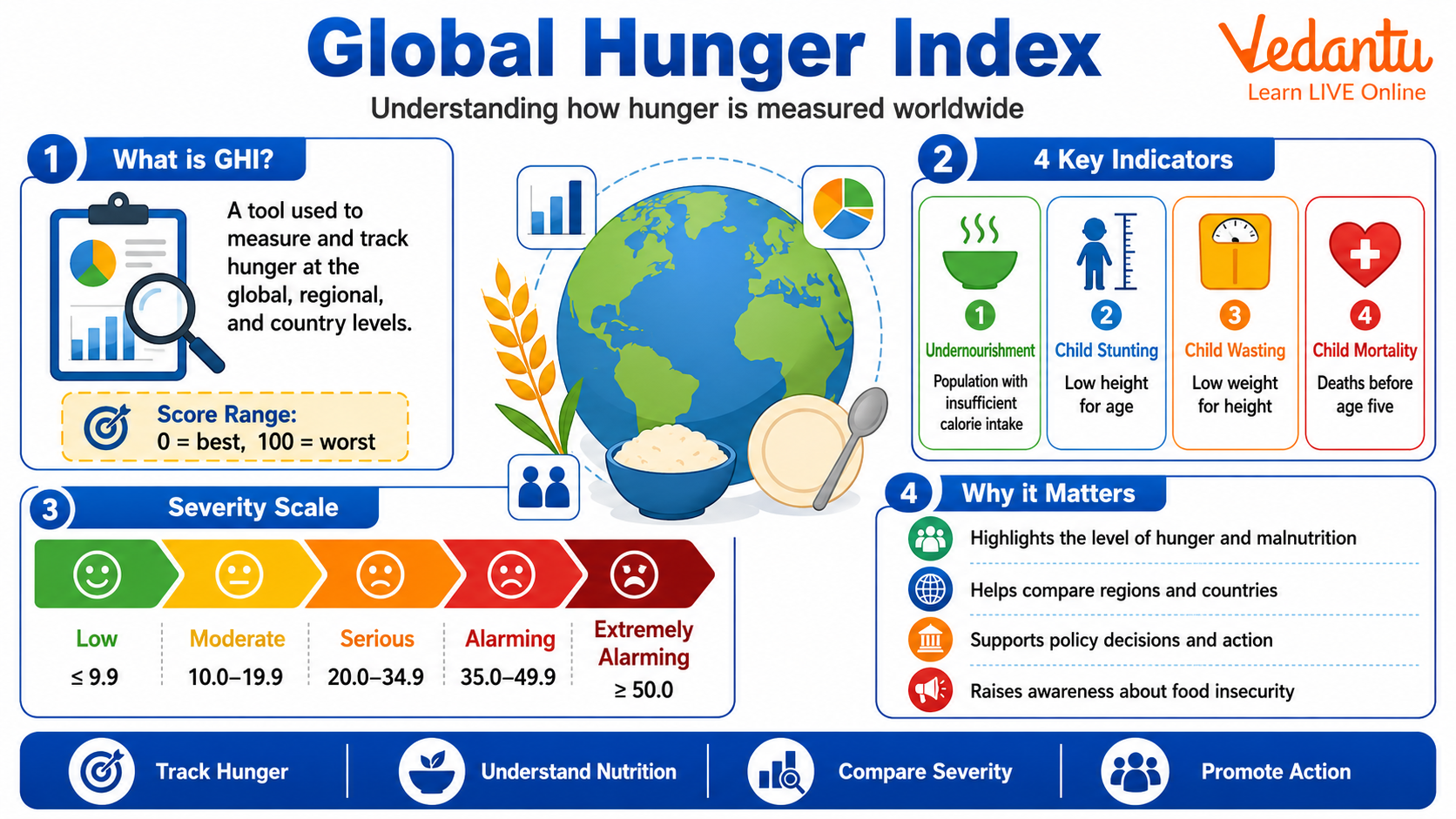
What is the Global Hunger Index?
The Global Hunger Index is a peer-reviewed annual publication designed to measure and monitor hunger globally. It was first published in 2006 and is jointly prepared by Concern Worldwide and Welthungerhilfe. The report ranks countries based on a composite score derived from key indicators of undernutrition and provides a clear picture of hunger levels across nations.
- Launched in 2006
- Published annually
- Prepared by Concern Worldwide and Welthungerhilfe
- Measures hunger using four scientific indicators
Objectives of the Global Hunger Index
The Global Hunger Index aims to raise awareness and understanding of the struggle against hunger. It also encourages action by governments, international organizations, and civil society.
- To measure and track hunger globally
- To highlight regions and countries facing severe hunger
- To promote accountability and policy action
- To support Sustainable Development Goal 2 - Zero Hunger
Indicators Used in Global Hunger Index
The GHI score is calculated using four key indicators that reflect different aspects of hunger and undernutrition. These indicators capture both insufficient food intake and the consequences of malnutrition.
Indicators of Global Hunger Index
| Indicator | What it Measures | Weight in GHI Score |
|---|---|---|
| Undernourishment | Insufficient calorie intake in population | 1 by 3 |
| Child Wasting | Low weight for height in children under 5 | 1 by 6 |
| Child Stunting and Child Mortality | Low height for age and mortality rate under 5 years | 1 by 6 each |
Undernourishment reflects inadequate food supply at the population level. Child wasting indicates acute undernutrition, while child stunting shows chronic undernutrition. Child mortality represents the fatal synergy of inadequate nutrition and unhealthy environments.
How is the GHI Score Interpreted?
Each country receives a score on a 100-point scale, where 0 represents no hunger and 100 represents the worst level of hunger. The lower the score, the better the country's performance in controlling hunger.
- 0 to 9.9 - Low hunger
- 10.0 to 19.9 - Moderate hunger
- 20.0 to 34.9 - Serious hunger
- 35.0 to 49.9 - Alarming hunger
- 50 or more - Extremely alarming hunger
Importance of the Global Hunger Index
The Global Hunger Index plays a crucial role in highlighting global nutrition challenges. It helps identify vulnerable populations and regions where urgent intervention is required. The index also provides evidence-based data to support policy decisions.
- Encourages policy reforms and targeted nutrition programs
- Supports international cooperation to fight hunger
- Tracks progress toward Sustainable Development Goals
- Provides reliable data for academic and competitive exam preparation
Factors Contributing to Global Hunger
Hunger is influenced by multiple interconnected factors that vary across regions and countries. Understanding these causes is essential for designing effective solutions.
- Poverty and income inequality
- Armed conflicts and political instability
- Climate change and natural disasters
- Poor healthcare and sanitation
- Lack of access to education and employment
Criticism and Limitations of GHI
Although widely respected, the Global Hunger Index has faced criticism from some countries and experts. These criticisms often relate to data sources, methodology, and representation.
- Reliance on secondary data from international agencies
- Time lag in data collection and reporting
- Limited coverage of micronutrient deficiencies
- Debate over methodology and weight distribution
Global Hunger Index and India
India's performance in the Global Hunger Index is often discussed in public and academic debates. The country faces challenges such as child stunting, child wasting, and undernutrition despite economic growth. Government initiatives like the National Food Security Act, Integrated Child Development Services, and Mid Day Meal Scheme aim to improve nutrition and reduce hunger.
Understanding India's position in the GHI is important for competitive exams and general awareness, as it reflects both developmental achievements and persistent challenges.
Conclusion
The Global Hunger Index is a significant tool for measuring and understanding hunger across the world. By combining indicators related to undernourishment, child health, and mortality, it provides a comprehensive assessment of food insecurity. The index not only highlights areas requiring urgent attention but also motivates global action toward achieving Zero Hunger. For students and exam aspirants, knowledge of the Global Hunger Index is essential for understanding global development issues and contemporary international reports.
FAQs on Global Hunger Index Explained: Meaning, Scores and Country Rankings
1. What is the Global Hunger Index (GHI)?
The Global Hunger Index (GHI) is an annual report that measures and tracks hunger levels at global, regional, and national levels. It is designed to assess food insecurity, malnutrition, and undernourishment worldwide. • Published jointly by Concern Worldwide and Welthungerhilfe • Provides a hunger score for each country • Helps compare progress in reducing global hunger • Used by policymakers, researchers, and competitive exam aspirants.
2. Who publishes the Global Hunger Index?
The Global Hunger Index report is published annually by Concern Worldwide (Ireland) and Welthungerhilfe (Germany). • These are international non-governmental organizations (NGOs) • The report focuses on food security and nutrition indicators • It provides global rankings and country-wise analysis • Widely referenced in UPSC, SSC, and other competitive exams.
3. What indicators are used to calculate the Global Hunger Index?
The GHI score is calculated using four key indicators that reflect different dimensions of hunger. • Undernourishment – insufficient calorie intake • Child wasting – low weight for height • Child stunting – low height for age • Child mortality – death rate of children under five • These indicators measure malnutrition, child health, and food deprivation.
4. How is the Global Hunger Index score calculated?
The Global Hunger Index score is calculated by combining the four hunger indicators into a 100-point scale. • Each indicator is given a specific weight • Scores range from 0 (best) to 100 (worst) • Lower scores indicate better performance in reducing hunger • Countries are categorized as low, moderate, serious, alarming, or extremely alarming.
5. What do the different GHI categories mean?
The GHI categories classify countries based on the severity of hunger. • Low (Score ≤ 9.9) • Moderate (10.0–19.9) • Serious (20.0–34.9) • Alarming (35.0–49.9) • Extremely Alarming (≥ 50) • These categories reflect the level of food crisis, malnutrition rate, and public health concerns.
6. Why is the Global Hunger Index important?
The Global Hunger Index is important because it highlights the seriousness of hunger and guides policy decisions. • Raises awareness about world hunger and food insecurity • Helps governments design nutrition programs • Tracks progress toward Sustainable Development Goal 2 (Zero Hunger) • Assists researchers and international organizations in policy planning.
7. What is India’s performance in the Global Hunger Index?
India’s performance in the Global Hunger Index has often been placed in the serious category, indicating significant challenges. • High levels of child stunting and wasting • Concerns over malnutrition and undernourishment • Government schemes like POSHAN Abhiyaan and Mid-Day Meal Scheme aim to improve nutrition • Frequently discussed in current affairs and competitive exams.
8. What are the main causes of global hunger?
The main causes of global hunger include poverty, conflict, and climate change. • Poverty limits access to nutritious food • Armed conflicts disrupt food production • Climate change affects agriculture and crop yields • Economic inequality and poor healthcare worsen malnutrition and food crises.
9. How does the Global Hunger Index relate to Sustainable Development Goals (SDGs)?
The Global Hunger Index directly relates to SDG 2: Zero Hunger, which aims to end hunger by 2030. • Measures progress toward eliminating food insecurity • Tracks reduction in child malnutrition • Supports global monitoring of sustainable development • Highlights areas needing urgent policy action.
10. What are the criticisms of the Global Hunger Index?
The Global Hunger Index has faced criticism regarding its methodology and data sources. • Some countries question the accuracy of data • Debate over the use of child-based indicators • Concerns about sample size and estimation methods • Despite criticism, it remains a widely cited measure of world hunger and food security rankings.
