






Important GK Questions on Non-Constitutional Bodies for UPSC and SSC Exams
Non Constitutional Bodies are important institutions in India that are not mentioned in the Constitution of India but are created by an Act of Parliament or by executive resolution of the government. These bodies play a significant role in governance, policy-making, regulation, and administration. Questions related to Non Constitutional Bodies are frequently asked in competitive exams such as UPSC, SSC, Banking, Railways, and State PSC exams. In this article, we provide comprehensive GK questions and answers on Non Constitutional Bodies to help students strengthen their preparation.
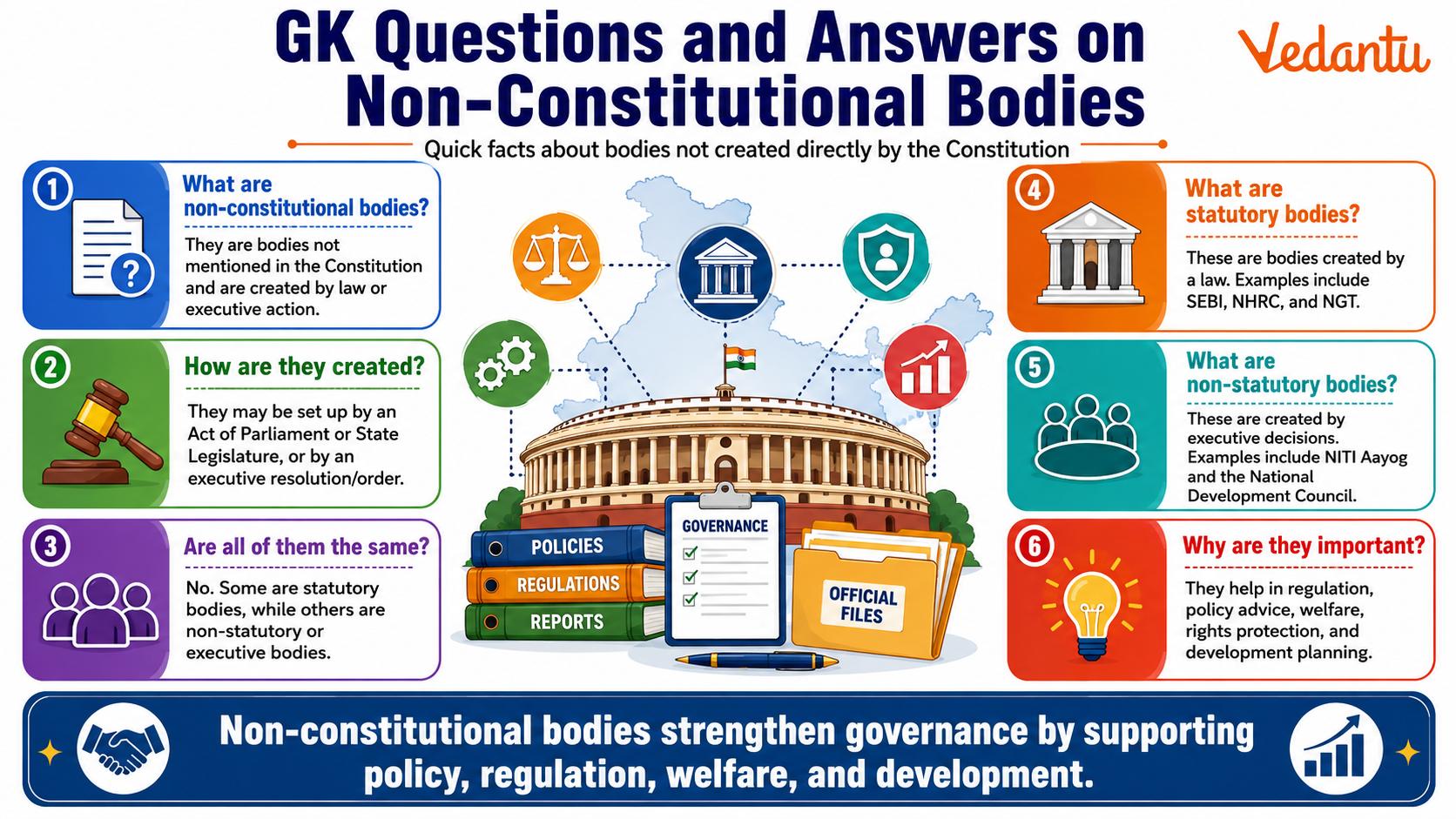
What are Non Constitutional Bodies?
Non Constitutional Bodies are institutions that are not directly mentioned in the Constitution of India. They are established either by an Act of Parliament (Statutory Bodies) or by a government resolution (Non Statutory Bodies). These bodies assist the government in performing specific functions such as regulation, advisory roles, monitoring, and administration.
- Not mentioned in the Constitution of India
- Created by Parliamentary law or executive order
- Perform advisory, regulatory, or executive functions
- Important for policy implementation and governance
Types of Non Constitutional Bodies
1. Statutory Bodies
Statutory Bodies are established by an Act of Parliament. They derive their powers and functions from the specific law under which they are created.
2. Non Statutory Bodies
Non Statutory Bodies are created through executive resolutions or government orders. They do not have a statutory backing.
Examples of Important Non Constitutional Bodies
| Name of Body | Type | Main Function |
|---|---|---|
| NITI Aayog | Non Statutory | Policy advisory body to the Government |
| National Human Rights Commission | Statutory | Protection of human rights |
| Central Information Commission | Statutory | Ensures implementation of RTI Act |
The above bodies are frequently asked in GK and competitive exams. Understanding their type and functions is essential for exam preparation.
GK Questions and Answers on Non Constitutional Bodies
Basic Level Questions
- Q. What is a Non Constitutional Body?
A. A body not mentioned in the Constitution and created by law or executive order. - Q. Is NITI Aayog a Constitutional Body?
A. No, it is a Non Statutory Body created by executive resolution. - Q. Which Act established the National Human Rights Commission?
A. Protection of Human Rights Act, 1993. - Q. What is the main function of the Central Information Commission?
A. To ensure the implementation of the Right to Information Act, 2005. - Q. Which body replaced the Planning Commission?
A. NITI Aayog.
Moderate Level Questions
- Q. Differentiate between Statutory and Non Statutory Bodies.
A. Statutory Bodies are created by an Act of Parliament, while Non Statutory Bodies are formed by executive resolution. - Q. Who appoints the Chairperson of NHRC?
A. The President of India. - Q. Under which Act was the Central Vigilance Commission given statutory status?
A. Central Vigilance Commission Act, 2003. - Q. What is the primary role of NITI Aayog?
A. To provide policy direction and foster cooperative federalism.
Advanced Level Questions
- Q. Explain the significance of Non Constitutional Bodies in Indian governance.
A. They support the government by advising on policy, regulating sectors, protecting rights, and ensuring transparency and accountability. - Q. Why are Non Constitutional Bodies important for competitive exams?
A. They are frequently asked in Prelims and Mains due to their administrative and governance roles.
Difference Between Constitutional and Non Constitutional Bodies
Comparison Table
| Basis | Constitutional Body | Non Constitutional Body |
|---|---|---|
| Source of Power | Indian Constitution | Act of Parliament or Executive Order |
| Example | Election Commission | NITI Aayog |
Constitutional Bodies derive their authority directly from the Constitution, whereas Non Constitutional Bodies depend on laws passed by Parliament or executive decisions for their existence and powers.
Preparation Tips for Exams
- Prepare a list of important Non Constitutional Bodies and revise their functions regularly.
- Understand the difference between Statutory and Non Statutory Bodies.
- Focus on recent developments related to these bodies.
- Practice previous year questions from UPSC and other exams.
Conclusion
Non Constitutional Bodies form an essential part of India’s administrative and governance framework. Although they are not mentioned in the Constitution, they perform crucial regulatory, advisory, and supervisory roles. Preparing GK questions and answers on Non Constitutional Bodies helps students gain clarity on important institutions such as NITI Aayog, NHRC, CVC, and CIC. A strong understanding of these bodies enhances performance in competitive exams and builds a solid foundation in Indian Polity.
FAQs on GK Questions and Answers on Non-Constitutional Bodies in India
1. What are Non-Constitutional Bodies in India?
Non-Constitutional Bodies are organizations that are not mentioned in the Indian Constitution but are created by Acts of Parliament, executive resolutions, or government orders to perform specific functions.
Key features include:
• Not directly mentioned in the Constitution of India
• Established through legislation or executive decision
• Perform advisory, regulatory, or investigative roles
• Important for governance, policy-making, and administration
These bodies differ from Constitutional Bodies like the Election Commission and UPSC.
2. What is the difference between Constitutional and Non-Constitutional Bodies?
The main difference lies in their origin and legal status.
• Constitutional Bodies are mentioned in the Constitution (e.g., Election Commission, CAG).
• Non-Constitutional Bodies are created by Parliament or the government (e.g., NITI Aayog, NHRC).
• Constitutional bodies have stronger legal backing.
• Non-Constitutional bodies can be modified or abolished more easily.
This distinction is important for competitive exams and General Knowledge preparation.
3. What are some important examples of Non-Constitutional Bodies in India?
Several important institutions in India are Non-Constitutional Bodies.
Major examples include:
• NITI Aayog
• National Human Rights Commission (NHRC)
• Central Information Commission (CIC)
• Central Vigilance Commission (CVC)
• Lokpal
These bodies play key roles in policy-making, transparency, anti-corruption, and human rights protection.
4. Is NITI Aayog a Constitutional Body?
No, NITI Aayog is a Non-Constitutional Body.
• Established in 2015
• Replaced the Planning Commission
• Formed through an executive resolution
• Acts as a policy think tank for the Government of India
NITI Aayog promotes cooperative federalism and strategic policy planning.
5. What is the National Human Rights Commission (NHRC)?
The National Human Rights Commission (NHRC) is a statutory Non-Constitutional Body that protects human rights in India.
• Established in 1993
• Formed under the Protection of Human Rights Act, 1993
• Investigates human rights violations
• Recommends corrective measures to the government
NHRC is important for safeguarding fundamental rights and civil liberties.
6. What is the role of the Central Vigilance Commission (CVC)?
The Central Vigilance Commission (CVC) is an apex anti-corruption body in India.
• Established in 1964
• Given statutory status in 2003
• Oversees vigilance administration
• Monitors corruption cases in central government departments
CVC promotes transparency, integrity, and accountability in public administration.
7. What is Lokpal and why is it important?
Lokpal is an anti-corruption ombudsman that investigates complaints against public officials.
• Established under the Lokpal and Lokayuktas Act, 2013
• Handles corruption cases against ministers and officials
• Strengthens anti-corruption framework
• Promotes good governance
Lokpal is a key Non-Constitutional Body for ensuring clean and accountable government.
8. What is the Central Information Commission (CIC)?
The Central Information Commission (CIC) ensures implementation of the Right to Information (RTI) Act.
• Established under the RTI Act, 2005
• Hears appeals regarding denial of information
• Promotes transparency in government functioning
• Strengthens citizens’ right to information
CIC plays a crucial role in open governance and accountability.
9. How are Non-Constitutional Bodies created in India?
Non-Constitutional Bodies are created through legal or executive processes.
They can be formed by:
• Acts of Parliament (Statutory Bodies like NHRC, Lokpal)
• Executive resolutions (e.g., NITI Aayog)
• Government notifications or orders
Unlike Constitutional Bodies, they do not require a constitutional amendment for establishment.
10. Why are Non-Constitutional Bodies important for competitive exams?
Non-Constitutional Bodies are frequently asked topics in competitive exams.
• Common in UPSC, SSC, Banking, State PSC exams
• Questions focus on formation, functions, and differences
• Important for General Studies and Polity sections
• Helps in understanding governance structure of India
Knowledge of bodies like NITI Aayog, NHRC, CVC, CIC, and Lokpal is essential for scoring well in GK and Polity.
