






Important 7th Pay Commission GK Questions with Answers and Key Facts
The 7th Pay Commission is one of the most important reforms in the salary structure of Central Government employees in India. It was introduced to revise the pay scales, allowances, and pension benefits of government employees and pensioners. Questions related to the 7th Pay Commission are frequently asked in competitive exams such as SSC, UPSC, Banking, Railways, and State PSC exams. Below is a comprehensive collection of General Knowledge questions and answers on the 7th Pay Commission to help students and aspirants prepare effectively.
Overview of the 7th Pay Commission
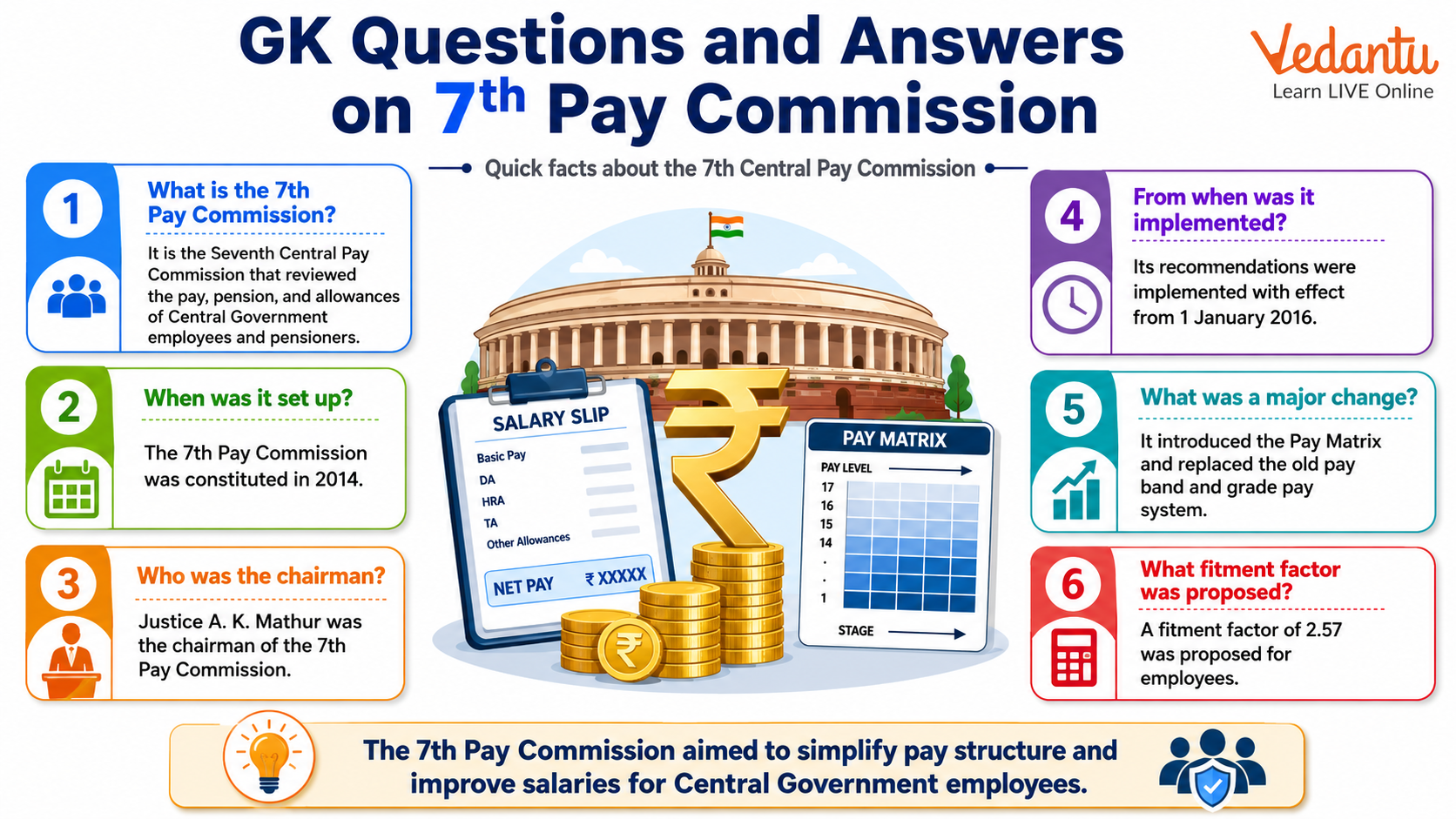
The 7th Central Pay Commission was constituted by the Government of India to review and recommend changes in the salary structure of central government employees. It aimed to ensure fair compensation in line with economic conditions and inflation trends.
- Constituted on - 28 February 2014
- Chairman - Justice A K Mathur
- Report submitted on - 19 November 2015
- Implemented from - 1 January 2016
- Affects - Central Government employees and pensioners
Key Recommendations of the 7th Pay Commission
The Commission made several major recommendations to improve the salary and pension structure of government employees. These recommendations significantly impacted lakhs of employees across India.
- Minimum basic pay increased to Rs 18,000 per month
- Maximum pay fixed at Rs 2,50,000 per month for Cabinet Secretary
- Introduction of Pay Matrix system
- Fitment factor fixed at 2.57
- Revision of pension with a minimum of Rs 9,000 per month
- Rationalization of allowances
Important Facts About 7th Pay Commission
| Particular | Details | Significance |
|---|---|---|
| Chairman | Justice A K Mathur | Headed the Commission |
| Fitment Factor | 2.57 | Basis for salary calculation |
| Implementation Date | 1 January 2016 | Effective salary revision date |
The Pay Matrix introduced by the 7th Pay Commission replaced the earlier grade pay system. It simplified salary progression and ensured transparency in increments and promotions.
GK Questions and Answers on 7th Pay Commission
Basic Level Questions
- When was the 7th Pay Commission constituted?
Answer - 28 February 2014. - Who was the Chairman of the 7th Pay Commission?
Answer - Justice A K Mathur. - When was the 7th Pay Commission implemented?
Answer - 1 January 2016. - What is the minimum basic pay recommended under the 7th Pay Commission?
Answer - Rs 18,000 per month. - What is the fitment factor under the 7th Pay Commission?
Answer - 2.57.
Advanced Level Questions
- What system replaced the Grade Pay structure under the 7th Pay Commission?
Answer - The Pay Matrix system. - What is the maximum salary recommended under the 7th Pay Commission?
Answer - Rs 2,50,000 per month for the Cabinet Secretary. - What is the minimum pension recommended under the 7th Pay Commission?
Answer - Rs 9,000 per month. - How many Pay Commissions have been constituted in India so far?
Answer - Seven. - Which employees are primarily affected by the 7th Pay Commission?
Answer - Central Government employees and pensioners.
Importance of 7th Pay Commission for Competitive Exams
Questions related to the 7th Pay Commission are important in General Awareness sections of various competitive examinations. Candidates preparing for SSC, UPSC, Banking, Railways, Defence, and State PCS exams should remember key facts such as the chairman, implementation date, fitment factor, and major recommendations.
- Focus on important dates and personalities
- Remember key salary figures and pension details
- Understand the concept of Pay Matrix
- Revise through MCQs for better retention
Conclusion
The 7th Pay Commission brought significant reforms in the salary and pension structure of Central Government employees in India. Understanding its formation, recommendations, and implementation is essential for students and competitive exam aspirants. By revising the important facts, key figures, and frequently asked questions provided above, candidates can strengthen their General Knowledge preparation and improve their performance in exams.
FAQs on Gk Questions & Answers on 7th Pay Commission for Students
1. What is the 7th Pay Commission?
The 7th Pay Commission is a government-appointed body that reviews and recommends changes in the salary structure, allowances, and pension benefits of central government employees and pensioners in India.
• Implemented on 1 January 2016
• Replaced the 6th Pay Commission
• Affects central government employees, defence personnel, and pensioners
• Focuses on pay matrix, minimum pay, and fitment factor
It is commonly searched under terms like latest pay commission in India, government salary revision, and central pay scale update.
2. When was the 7th Pay Commission implemented?
The 7th Pay Commission was implemented from 1 January 2016, though it was approved by the Union Cabinet in June 2016.
• Arrears were paid from January 2016 onwards
• Recommendations submitted in November 2015
• Approved by the Central Government of India
This date is important for GK and competitive exams under topics like Indian economy reforms and government salary structure.
3. What is the minimum salary under the 7th Pay Commission?
The minimum basic salary under the 7th Pay Commission is ₹18,000 per month for central government employees.
• Earlier minimum pay (6th CPC): ₹7,000
• Increased using a fitment factor of 2.57
• Applies to Level 1 employees in the Pay Matrix
This is often searched as minimum pay in 7th CPC or lowest government salary after 7th Pay Commission.
4. What is the fitment factor in the 7th Pay Commission?
The fitment factor in the 7th Pay Commission is 2.57, used to calculate revised basic pay.
• Formula: Old Basic Pay × 2.57
• Determines new salary under the Pay Matrix system
• Applies to all central government employees
It is a frequently asked question in exams related to salary calculation, pay revision formula, and government pay hike.
5. What is the Pay Matrix introduced in the 7th Pay Commission?
The Pay Matrix is a simplified salary structure introduced to replace the Grade Pay system of the 6th Pay Commission.
• Contains Levels (1–18)
• Shows vertical progression (annual increments)
• Shows horizontal progression (promotions)
• Makes salary calculation transparent and simple
It is also known as 7th CPC Pay Matrix Table or new pay scale chart.
6. Who headed the 7th Pay Commission?
The 7th Pay Commission was headed by Justice A.K. Mathur, a retired Supreme Court judge.
• Full name: Justice Ashok Kumar Mathur
• Commission constituted in 2014
• Submitted report in 2015
This question is important for GK under Indian polity, government committees, and constitutional bodies.
7. What changes were made to pensions under the 7th Pay Commission?
The 7th Pay Commission revised pension benefits for central government pensioners by increasing minimum pensions and introducing revised calculation methods.
• Minimum pension increased to ₹9,000 per month
• Pension calculated using fitment factor 2.57
• Benefits extended to family pensioners
Common searches include 7th CPC pension revision and latest pension rules in India.
8. How many employees benefited from the 7th Pay Commission?
Over 1 crore people benefited from the 7th Pay Commission, including employees and pensioners.
• Around 50 lakh central government employees
• Around 58 lakh pensioners
• Includes defence personnel and civilian staff
This data is useful in GK topics like Indian economy, public administration, and government expenditure.
9. What is Dearness Allowance (DA) under the 7th Pay Commission?
Dearness Allowance (DA) is a cost-of-living adjustment given to central government employees and pensioners under the 7th Pay Commission.
• Revised twice a year (January and July)
• Calculated as a percentage of basic pay
• Linked to Consumer Price Index (CPI)
It is commonly searched as current DA rate, DA hike news, and inflation allowance for government employees.
10. Why is the 7th Pay Commission important for competitive exams?
The 7th Pay Commission is important for competitive exams because it relates to Indian economy, government policies, and administrative reforms.
• Frequently asked in SSC, UPSC, Banking, Railways
• Covers topics like salary structure, pension reforms, and DA
• Linked to economic impact and fiscal policy
It is part of GK under Indian Government schemes, economic reforms, and public sector salary revision.
