






Causes and Effects of a Financial Emergency under Article 360 of the Indian Constitution
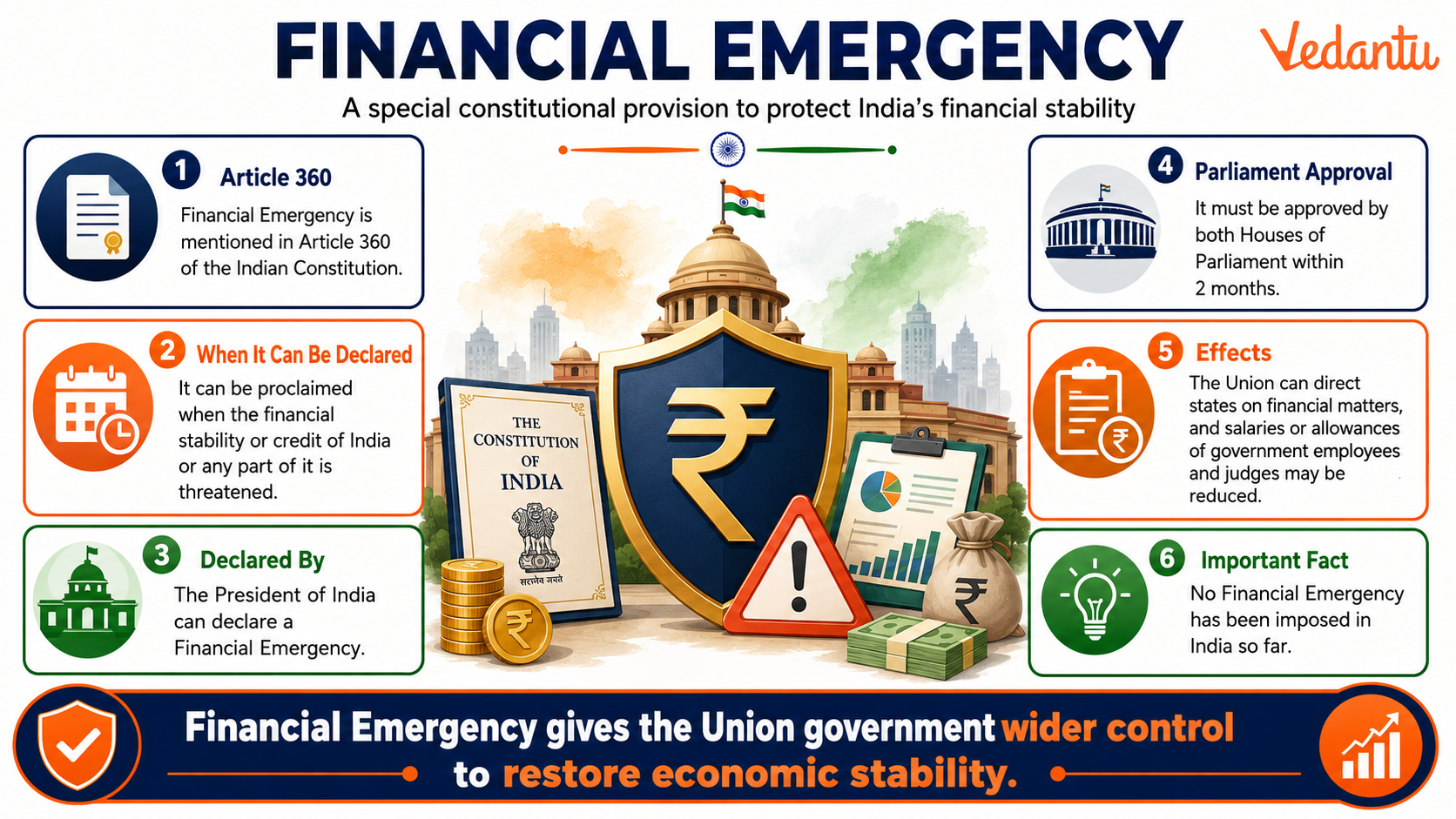
A Financial Emergency is a constitutional provision that allows the central authority of a country to take control of its financial matters during a severe economic crisis. In India, Financial Emergency is mentioned under Article 360 of the Constitution. It is declared when the financial stability or credit of India or any part of its territory is threatened. This topic is important for students, competitive exam aspirants, and general readers as it explains how constitutional mechanisms protect the country during economic instability.
What is Financial Emergency?
Financial Emergency refers to a situation in which the economic stability of a nation is under serious threat. In India, it is one of the three types of emergencies provided in the Constitution, the other two being National Emergency and President’s Rule. Financial Emergency ensures that the government can take strict financial measures to restore stability and maintain economic discipline.
Constitutional Provision of Financial Emergency
Article 360 of the Indian Constitution deals with Financial Emergency. If the President is satisfied that the financial stability or credit of India or any part of its territory is threatened, he or she can proclaim Financial Emergency.
- It is declared by the President of India.
- It must be approved by both Houses of Parliament within two months.
- If approved, it continues indefinitely until revoked by the President.
- It can be revoked anytime by a subsequent proclamation.
Grounds for Declaration
The Constitution does not clearly define specific conditions for declaring Financial Emergency. However, it can be declared in situations such as:
- Severe economic crisis
- Massive fiscal deficit
- Collapse of banking or financial institutions
- Failure of credit system
- Sharp decline in foreign exchange reserves
Effects of Financial Emergency
Once Financial Emergency is declared, the central government gets extensive financial powers to control the economy and ensure stability. The following are the major effects:
1. Control Over States
- The President can direct states to observe financial propriety.
- States may be required to reduce salaries and allowances of government employees.
- All Money Bills passed by state legislatures may be reserved for the President’s consideration.
2. Reduction of Salaries
- The President can order reduction in salaries and allowances of central and state government employees.
- This includes judges of the Supreme Court and High Courts.
3. Centralized Financial Control
- The Union government gains authority to give financial directions to states.
- Strict control over expenditure and borrowing is imposed.
Comparison of Three Types of Emergencies in India
| Type of Emergency | Article | Grounds |
|---|---|---|
| National Emergency | Article 352 | War, External Aggression, Armed Rebellion |
| President’s Rule | Article 356 | Failure of Constitutional Machinery in State |
| Financial Emergency | Article 360 | Threat to Financial Stability or Credit |
Among the three types of emergencies, Financial Emergency has never been declared in India so far. It remains a preventive constitutional safeguard to deal with extreme economic situations.
Duration of Financial Emergency
Unlike National Emergency, there is no maximum time limit prescribed for Financial Emergency. Once approved by Parliament, it continues indefinitely until revoked by the President. This shows the seriousness of financial instability and the need for long term corrective measures.
Has Financial Emergency Ever Been Declared in India?
No, Financial Emergency has never been declared in India since the adoption of the Constitution in 1950. Even during major economic crises such as the 1991 balance of payments crisis, the government managed the situation without invoking Article 360.
Importance of Financial Emergency
Financial Emergency is important because it:
- Protects the economic stability of the country.
- Ensures financial discipline across states.
- Prevents economic collapse during severe crises.
- Strengthens the authority of the Union government in financial matters.
Key Points for Competitive Exams
- Mentioned under Article 360 of the Indian Constitution.
- Declared by the President of India.
- Requires approval of Parliament within two months.
- No time limit for continuation.
- Never declared in India till date.
Conclusion
Financial Emergency is a crucial constitutional provision designed to safeguard the financial stability and credit of India. Though it has never been implemented, its presence ensures that the government has the authority to take strict financial measures in times of severe economic crisis. Understanding Financial Emergency helps students grasp how constitutional mechanisms maintain economic order and national stability.
FAQs on Financial Emergency in India: Meaning, Features and Constitutional Basis
1. What is Financial Emergency in India?
A Financial Emergency in India is a constitutional provision under Article 360 that allows the President to take control of the country’s financial stability if it is threatened.
• Declared when the financial stability or credit of India is at risk
• Proclaimed by the President of India
• Applies to the entire country or any part of it
• Part of the Emergency Provisions of the Indian Constitution (National Emergency, State Emergency, Financial Emergency)
2. Under which Article is Financial Emergency mentioned?
The provision for Financial Emergency is mentioned under Article 360 of the Indian Constitution.
• Included in Part XVIII of the Constitution
• Empowers the President to declare Financial Emergency
• Requires approval by both Houses of Parliament within two months
• Related to constitutional emergency powers and fiscal control
3. When can a Financial Emergency be declared in India?
A Financial Emergency can be declared when the financial stability or credit of India or any part of its territory is threatened.
• Severe economic crisis or fiscal instability
• Collapse of financial institutions or credit system
• Major budgetary imbalance or economic breakdown
• Decision based on the President’s satisfaction (executive advice)
4. What is the procedure to declare a Financial Emergency?
The procedure for declaring a Financial Emergency involves constitutional approval and parliamentary consent.
• Proclaimed by the President of India
• Must be approved by Lok Sabha and Rajya Sabha within two months
• Continues indefinitely until revoked
• Can be revoked by the President at any time
5. What are the effects of Financial Emergency?
The effects of a Financial Emergency mainly impact salaries, financial powers, and state autonomy.
• Reduction of salaries and allowances of government employees, including judges of the Supreme Court and High Courts
• States must follow financial directions from the Central Government
• Money bills and financial decisions of states may require presidential approval
• Centralized control over fiscal management and budget policies
6. Has Financial Emergency ever been declared in India?
No, a Financial Emergency has never been declared in India since the Constitution came into force in 1950.
• Despite economic crises (1991 balance of payments crisis, global recession), it was not invoked
• Considered an extreme constitutional measure
• Remains a theoretical but powerful emergency provision
7. How is Financial Emergency different from National Emergency?
A Financial Emergency deals with economic instability, while a National Emergency (Article 352) deals with war, external aggression, or armed rebellion.
• Financial Emergency: Related to economic crisis and fiscal stability
• National Emergency: Related to security threats
• Fundamental Rights may be suspended during National Emergency but not specifically during Financial Emergency
• Both require Parliamentary approval
8. What happens to government employees during Financial Emergency?
During a Financial Emergency, the salaries and allowances of government employees can be reduced.
• Includes employees of the Central and State Governments
• Judges of the Supreme Court and High Courts may also face salary cuts
• Aim is to restore financial discipline and economic stability
• Temporary measure under constitutional authority
9. How long does a Financial Emergency last?
A Financial Emergency continues until it is revoked by the President and has no maximum time limit.
• Must be approved within two months by Parliament
• Once approved, it remains in force indefinitely
• Can be withdrawn at any time by a new presidential proclamation
• Unlike National Emergency, no periodic re-approval is required
10. Why is Financial Emergency important for competitive exams?
Financial Emergency is an important topic for General Knowledge (GK) and competitive exams because it relates to constitutional provisions and emergency powers.
• Frequently asked in UPSC, SSC, Banking, and State PSC exams
• Covers key concepts like Article 360, emergency provisions, fiscal crisis
• Helps in understanding India’s constitutional safeguards during economic crisis
• Important for civics, polity, and current affairs preparation
