






Key Objectives and Features of the Fiscal Responsibility and Budget Management Act
The Fiscal Responsibility and Budget Management Act - commonly known as the FRBM Act - is an important legislation in India aimed at ensuring fiscal discipline and maintaining economic stability. It was introduced to control the government’s fiscal deficit, revenue deficit, and public debt levels. The Act plays a crucial role in promoting transparency in fiscal operations and strengthening macroeconomic management. Understanding the FRBM Act is essential for students, competitive exam aspirants, and anyone interested in Indian economic policy.
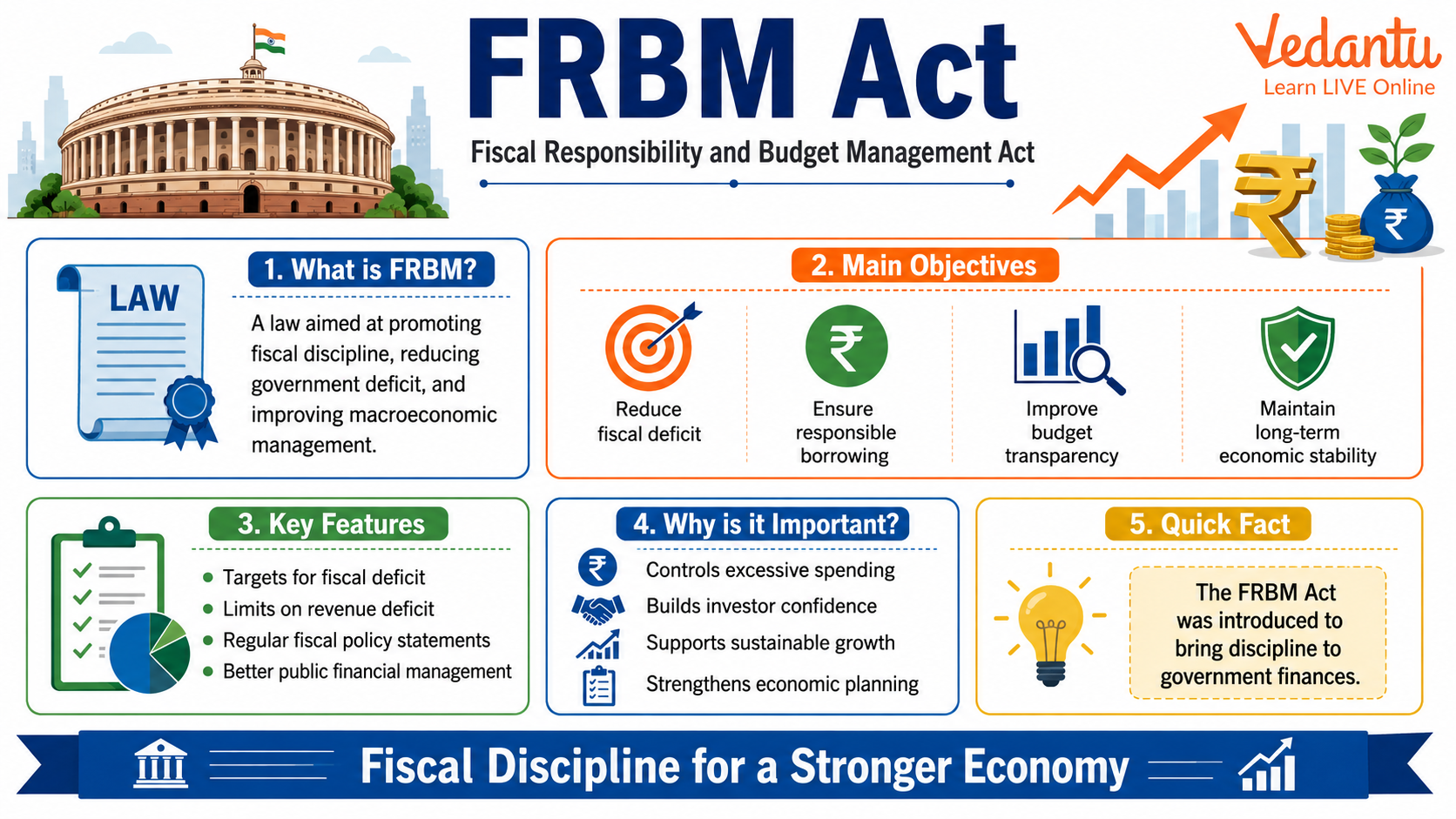
What is the FRBM Act?
The Fiscal Responsibility and Budget Management Act was enacted by the Parliament of India in 2003. Its main objective is to institutionalize financial discipline, reduce fiscal deficit, and improve macroeconomic management in the country. The Act sets targets for the government to reduce fiscal and revenue deficits and aims to ensure long-term fiscal stability.
Objectives of the FRBM Act
- To reduce fiscal deficit and revenue deficit of the Central Government.
- To promote fiscal discipline and transparency in fiscal operations.
- To ensure long-term macroeconomic stability.
- To limit public debt and maintain sustainable borrowing levels.
- To improve accountability in the management of public funds.
Key Features of the FRBM Act
The FRBM Act introduced specific fiscal targets and required the government to present certain documents before Parliament to enhance transparency and accountability.
- Targeted reduction of fiscal deficit to 3 percent of GDP.
- Elimination of revenue deficit over a specified period.
- Restriction on government borrowing from the Reserve Bank of India, except under exceptional circumstances.
- Mandatory presentation of fiscal policy statements in Parliament.
- Provision for escape clauses in case of national security, natural calamities, or economic crisis.
Important Fiscal Indicators under FRBM
Major Fiscal Indicators
| Indicator | Meaning | Target under FRBM |
|---|---|---|
| Fiscal Deficit | Excess of total expenditure over total receipts excluding borrowings | 3 percent of GDP |
| Revenue Deficit | Excess of revenue expenditure over revenue receipts | Elimination over time |
| Public Debt | Total liabilities of the government | Maintain sustainable levels |
These indicators help measure the financial health of the government. By setting limits on deficits and debt, the FRBM Act aims to prevent excessive borrowing and ensure fiscal sustainability.
FRBM Review Committee - N K Singh Committee
In 2016, the government set up the N K Singh Committee to review the FRBM Act. The committee recommended a more flexible fiscal framework and proposed a debt-to-GDP ratio as a key anchor for fiscal policy. It suggested reducing the combined debt of the Centre and States and maintaining fiscal deficit targets with flexibility under certain conditions.
Key Recommendations
- Central government debt should be reduced to 40 percent of GDP.
- Fiscal deficit should be maintained at 3 percent of GDP.
- Creation of an independent Fiscal Council.
- Use of escape clause up to 0.5 percent of GDP under specified conditions.
Significance of the FRBM Act
The FRBM Act is significant because it promotes responsible fiscal management. By limiting excessive borrowing, it helps control inflation and ensures that future generations are not burdened with unsustainable debt. It also improves investor confidence and strengthens India’s credit rating in global markets.
- Encourages fiscal transparency.
- Improves macroeconomic stability.
- Enhances credibility of government policies.
- Ensures better management of public funds.
Challenges and Criticism
Despite its importance, the FRBM Act has faced criticism. During economic slowdowns or crises such as the global financial crisis or pandemic, strict fiscal targets may limit the government’s ability to increase spending for economic recovery. As a result, targets have been relaxed at times.
- Rigid targets may restrict countercyclical fiscal policy.
- Frequent revisions reduce credibility.
- Dependence on economic growth assumptions.
Conclusion
The FRBM Act is a landmark reform in India’s fiscal policy framework. It aims to maintain fiscal discipline, reduce deficits, and ensure sustainable public debt levels. While flexibility is necessary during economic crises, the Act continues to serve as a guiding framework for responsible fiscal governance in India. For students and competitive exam aspirants, understanding the objectives, features, and significance of the FRBM Act is essential for mastering Indian economic policy and public finance.
FAQs on FRBM Act: Complete Guide to Fiscal Responsibility Law
1. What is the FRBM Act?
The FRBM Act is a law enacted to ensure fiscal discipline and reduce India’s fiscal deficit.
FRBM (Fiscal Responsibility and Budget Management) Act, 2003 aims to:
• Reduce fiscal deficit and revenue deficit
• Maintain macroeconomic stability
• Improve public financial management
• Ensure long-term economic growth
It is commonly asked in exams under topics like fiscal policy, budget management, and government deficit control.
2. When was the FRBM Act enacted and implemented?
The FRBM Act was enacted in 2003 and came into effect on July 5, 2004.
Key timeline:
• 2003 – FRBM Act passed by Parliament
• 2004 – Act implemented
• Subsequent amendments introduced fiscal targets and escape clauses
This Act is frequently asked in UPSC, SSC, Banking, and State PSC exams under Indian Economy.
3. What are the main objectives of the FRBM Act?
The main objective of the FRBM Act is to ensure fiscal stability and reduce government borrowing.
Major objectives include:
• Reduction of fiscal deficit
• Elimination of revenue deficit
• Maintaining debt sustainability
• Promoting transparent fiscal policy
It supports concepts like budgetary discipline, public debt control, and economic stability.
4. What is fiscal deficit under the FRBM Act?
Fiscal deficit is the excess of total government expenditure over its total receipts excluding borrowings.
Under the FRBM framework:
• The government sets targets to limit fiscal deficit (usually around 3% of GDP)
• It ensures controlled public borrowing
• It prevents excessive inflation and debt burden
This concept is also linked with budget deficit, primary deficit, and public finance.
5. What amendments were made to the FRBM Act?
The FRBM Act was amended to introduce flexibility and updated fiscal targets.
Major amendments:
• 2012 Amendment – Introduced effective revenue deficit concept
• 2018 Amendment – Based on N.K. Singh Committee recommendations
• Introduced escape clause during emergencies
These reforms strengthened India’s fiscal consolidation roadmap.
6. What is the N.K. Singh Committee in relation to FRBM Act?
The N.K. Singh Committee reviewed the FRBM Act and suggested fiscal reforms in 2017.
Key recommendations:
• Reduce fiscal deficit to 3% of GDP
• Maintain debt-to-GDP ratio at 60%
• Establish an independent Fiscal Council
Its recommendations shaped modern fiscal policy reforms in India.
7. What is the escape clause in the FRBM Act?
The escape clause allows the government to exceed fiscal deficit targets during exceptional situations.
It can be used during:
• National security threats
• Natural disasters
• Severe economic slowdown
• Extraordinary structural reforms
This clause provides flexibility while maintaining fiscal responsibility.
8. Why is the FRBM Act important for the Indian economy?
The FRBM Act is important because it promotes economic stability and responsible governance.
Importance includes:
• Controls government borrowing
• Reduces inflationary pressure
• Enhances investor confidence
• Ensures long-term economic sustainability
It plays a key role in budget planning and macroeconomic management.
9. What is revenue deficit under the FRBM Act?
Revenue deficit occurs when revenue expenditure exceeds revenue receipts.
Under the FRBM Act:
• The government aims to eliminate revenue deficit
• Focus is on reducing non-productive expenditure
• Encourages capital expenditure for growth
This concept is linked with budget deficit, fiscal deficit, and public expenditure.
10. How does the FRBM Act promote transparency in fiscal policy?
The FRBM Act mandates regular reporting and disclosure of fiscal indicators.
It requires the government to:
• Present Fiscal Policy Strategy Statement
• Publish Medium-Term Fiscal Policy Statement
• Disclose deficit and debt targets
This improves accountability, transparency, and good governance in India’s public finance system.
