






How the Portuguese Built Their Dominion in India and Key Historical Events
The Establishment of the Portugal Dominion in India marks the beginning of European colonial rule in the Indian subcontinent. The Portuguese were the first Europeans to arrive in India by sea and establish a strong political and commercial presence. Their arrival changed the course of Indian maritime trade and opened the way for other European powers like the Dutch, English, and French. Understanding the establishment of Portuguese dominion is important for students preparing for competitive exams as it forms a key chapter in medieval Indian history.
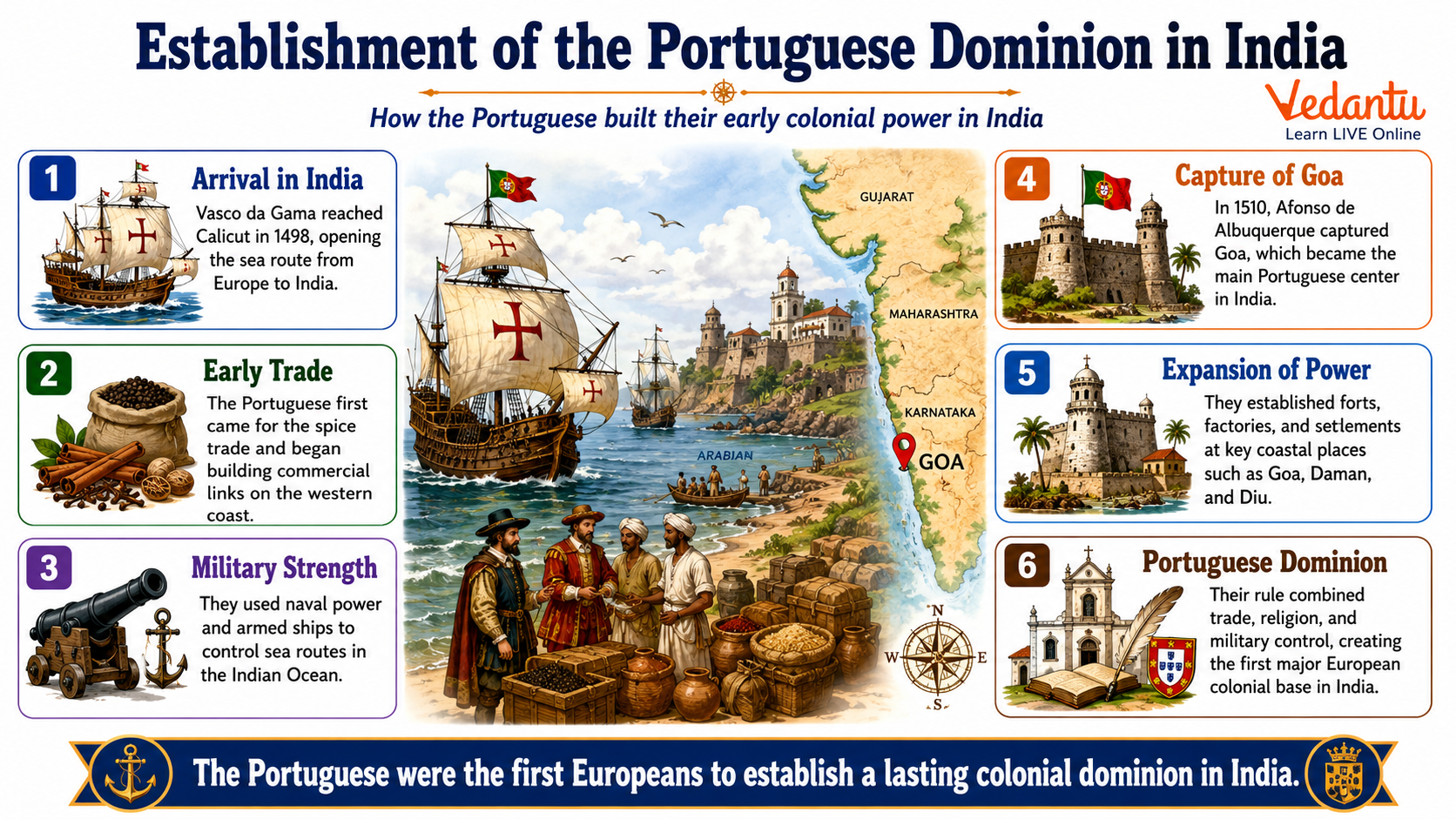
Background of Portuguese Arrival in India
During the 15th century, European countries were searching for a direct sea route to India to gain access to spices and other valuable goods. The traditional land routes were controlled by Arab merchants and the Ottoman Empire, making trade expensive for Europeans. Portugal took the lead in maritime exploration under the patronage of Prince Henry the Navigator.
- Portugal focused on improving shipbuilding and navigation techniques.
- Explorers moved along the western coast of Africa.
- In 1498, Vasco da Gama reached Calicut in India.
Vasco da Gama's arrival at Calicut marked the beginning of direct trade relations between Europe and India through the sea route around the Cape of Good Hope.
Early Portuguese Settlements in India
After Vasco da Gama's successful voyage, the Portuguese sent several expeditions to India to strengthen their trade relations. Gradually, they moved from trade to territorial control.
Capture of Goa
In 1510, Afonso de Albuquerque captured Goa from the Bijapur Sultanate. Goa became the headquarters of Portuguese power in India and remained under their control for about 450 years.
Other Important Settlements
- Daman
- Diu
- Bassein
- Cochin
These coastal territories helped the Portuguese control maritime trade routes in the Arabian Sea and the Indian Ocean.
Administration of Portuguese Dominion
The Portuguese established a centralized administration in their Indian territories. The Governor or Viceroy, appointed by the King of Portugal, governed the region from Goa.
- The Viceroy had military, administrative, and judicial powers.
- They introduced the cartaz system, a naval pass required for ships to trade.
- Fortresses were built to secure their trading posts.
Their main objective was to monopolize the spice trade and weaken Arab and local competitors.
Key Events in the Establishment of Portuguese Dominion
| Year | Event | Significance |
|---|---|---|
| 1498 | Vasco da Gama reaches Calicut | Opened sea route between Europe and India |
| 1505 | Francisco de Almeida appointed Viceroy | Beginning of formal Portuguese administration |
| 1510 | Capture of Goa by Albuquerque | Goa becomes capital of Portuguese India |
These events played a crucial role in transforming Portuguese trade missions into a powerful colonial dominion in India.
Impact of Portuguese Dominion in India
The establishment of Portuguese rule had political, economic, cultural, and religious impacts on Indian society.
Economic Impact
- Monopoly over spice trade.
- Decline of traditional Arab traders in the Indian Ocean.
- Introduction of new crops like tobacco and cashew.
Cultural and Religious Impact
- Spread of Christianity in coastal regions.
- Establishment of churches and missionary activities.
- Influence on Indian architecture and language.
The Portuguese also introduced printing technology in India in 1556, which contributed to the spread of education and religious texts.
Decline of Portuguese Power
The Portuguese dominance began to decline in the 17th century due to several reasons.
- Rise of other European powers like the Dutch and English.
- Corruption and weak administration.
- Military defeats and loss of territories.
Although their political power reduced, the Portuguese retained Goa, Daman, and Diu until 1961, when these territories were integrated into India.
Conclusion
The establishment of the Portugal Dominion in India marked the beginning of European colonial expansion in the subcontinent. Starting with Vasco da Gama's arrival in 1498 and strengthened by the capture of Goa in 1510, the Portuguese created a powerful maritime empire. Their administration, trade policies, and cultural influence left a lasting impact on Indian history. For students preparing for competitive exams, this topic is important as it explains the early phase of European intervention and its long term consequences on Indian society and economy.
FAQs on Establishment of the Portuguese Dominion in India: Causes and Impact
1. What was the establishment of the Portugal Dominion in India?
The Establishment of the Portugal Dominion in India refers to the creation of Portuguese political and commercial control over parts of India in the early 16th century.
• It began after Vasco da Gama’s arrival in 1498 at Calicut.
• The Portuguese aimed to control the spice trade in the Indian Ocean.
• They established strongholds like Goa, Daman, and Diu.
• This marked the beginning of European colonial rule in India.
2. Who was Vasco da Gama and why is he important?
Vasco da Gama was a Portuguese explorer who discovered the sea route to India in 1498, opening direct trade between Europe and Asia.
• Landed at Calicut (Kozhikode) in Kerala.
• Strengthened Portugal’s position in the Indian Ocean trade network.
• His voyage led to the rise of the Portuguese Empire in Asia.
• He is a key figure in the Age of Exploration.
3. When was Goa captured by the Portuguese?
The Portuguese captured Goa in 1510 under the leadership of Afonso de Albuquerque.
• Goa became the capital of Portuguese India.
• It served as a major administrative and naval base.
• The city became a center of Christian missionary activities.
• Portuguese rule in Goa lasted until 1961.
4. Who was Afonso de Albuquerque?
Afonso de Albuquerque was the second governor of Portuguese India and the real founder of the Portuguese colonial empire in India.
• Captured Goa (1510).
• Strengthened Portuguese naval dominance.
• Encouraged intermarriage to stabilize rule.
• Established forts and trading posts across the Indian Ocean region.
5. Why did the Portuguese come to India?
The Portuguese came to India mainly to control the lucrative spice trade and expand their empire.
• Wanted direct access to pepper, cloves, and cinnamon.
• Sought to bypass Arab and Venetian traders.
• Aimed to spread Christianity.
• Intended to establish a strong maritime empire in Asia.
6. What were the main Portuguese settlements in India?
The main Portuguese settlements in India were strategic coastal regions for trade and defense.
• Goa – Capital of Portuguese India.
• Daman and Diu – Important trading ports.
• Bassein (Vasai) – Military base near Mumbai.
• Cochin – Early trading center in Kerala.
7. What was the impact of Portuguese rule in India?
The Portuguese rule in India had cultural, economic, and religious impacts.
• Introduced Christianity and built churches.
• Influenced Indian architecture and cuisine.
• Strengthened European presence in Asia.
• Paved the way for other colonial powers like the Dutch and British.
8. What was the Portuguese trading system in India?
The Portuguese established a controlled trading system known as the Cartaz System.
• Ships needed a Portuguese license (cartaz).
• Helped control the Indian Ocean maritime trade.
• Protected Portuguese merchant ships.
• Increased revenue through customs duties.
9. How did the Portuguese decline in India?
The decline of the Portuguese in India was due to military, political, and economic challenges.
• Defeated by the Dutch and English.
• Weak administration and corruption.
• Limited resources from Portugal.
• Lost Goa, Daman, and Diu to India in 1961.
10. How long did Portuguese rule last in India?
Portuguese rule in India lasted for about 451 years (1510–1961).
• Began with the capture of Goa in 1510.
• Continued despite the fall of other colonies.
• Ended after Operation Vijay (1961) by the Indian government.
• Marked the end of European colonial rule in mainland India.
