






Major Reforms and Objectives in the Draft National Education Policy 2019
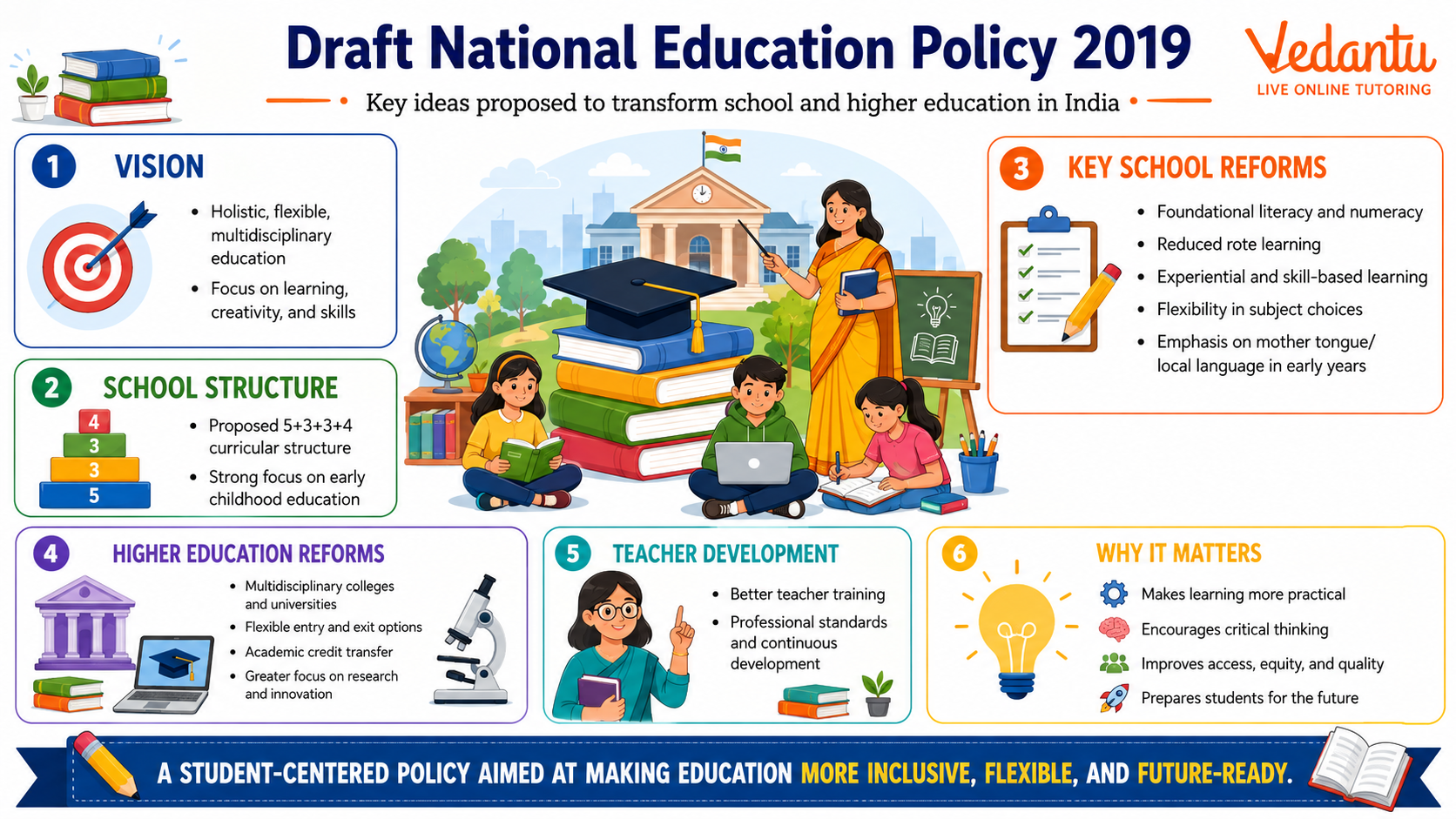
The Draft National Education Policy 2019 was a comprehensive reform proposal introduced by the Government of India to transform the country’s education system. Prepared by a committee chaired by Dr. K. Kasturirangan, the policy aimed to make education more holistic, flexible, multidisciplinary, and aligned with 21st-century needs. It focused on improving access, equity, quality, affordability, and accountability in school and higher education. The draft laid the foundation for major structural and curricular changes that later influenced the National Education Policy 2020.
Background of Draft National Education Policy 2019
India’s earlier education policy was the National Policy on Education 1986, which was modified in 1992. Over the decades, rapid technological, economic, and social changes created the need for a new framework. In 2017, the Ministry of Human Resource Development formed a committee under Dr. K. Kasturirangan to draft a new policy. The Draft National Education Policy 2019 was released for public consultation in May 2019.
- Chaired by Dr. K. Kasturirangan
- Focused on holistic and multidisciplinary education
- Emphasized foundational literacy and numeracy
- Proposed structural reforms in school and higher education
Objectives of Draft National Education Policy 2019
The draft policy aimed to address the major challenges in the Indian education system and prepare students for future global demands.
- Ensure universal access to education at all levels
- Achieve 100 percent Gross Enrolment Ratio in school education by 2030
- Improve quality of teaching and learning outcomes
- Promote research and innovation in higher education
- Strengthen teacher training and professional development
Key Features of Draft National Education Policy 2019
1. New School Education Structure
The draft proposed replacing the traditional 10+2 structure with a new 5+3+3+4 curricular structure to better match cognitive development stages.
Proposed 5+3+3+4 Structure
| Stage | Age Group | Classes |
|---|---|---|
| Foundational | 3 to 8 years | Pre-school to Grade 2 |
| Preparatory | 8 to 11 years | Grades 3 to 5 |
| Middle | 11 to 14 years | Grades 6 to 8 |
| Secondary | 14 to 18 years | Grades 9 to 12 |
This structure emphasized early childhood care and education and focused on conceptual understanding rather than rote learning.
2. Focus on Foundational Literacy and Numeracy
The draft recognized foundational literacy and numeracy as urgent priorities. It proposed a national mission to ensure that every child attains basic reading, writing, and arithmetic skills by Grade 3.
3. Multidisciplinary Higher Education
The policy encouraged multidisciplinary universities and flexible degree programs. It proposed phasing out single-stream institutions and introducing a four-year undergraduate degree with multiple exit options.
- Certificate after 1 year
- Diploma after 2 years
- Bachelor’s degree after 3 or 4 years
4. National Research Foundation
The draft proposed setting up a National Research Foundation to fund and promote quality research across disciplines, including sciences, social sciences, and humanities.
5. Teacher Education and Training
Teacher education was to be strengthened by introducing a four-year integrated B.Ed. degree as the minimum qualification by 2030. Continuous professional development was also emphasized.
6. Use of Technology in Education
The draft highlighted the integration of technology for improving access, quality, and governance. It proposed the creation of a National Educational Technology Forum to promote digital learning tools.
Language Policy
The Draft National Education Policy 2019 supported the three-language formula. It recommended that wherever possible, the medium of instruction until at least Grade 5, and preferably Grade 8, should be in the mother tongue or regional language.
Significance of Draft National Education Policy 2019
- Shift from rote learning to conceptual understanding
- Greater flexibility in subject choices
- Integration of vocational education from middle school
- Promotion of research culture in higher education
- Focus on equity and inclusion
Differences from Previous Education Policy
Comparison with National Policy on Education 1986
| Aspect | NPE 1986 | Draft NEP 2019 |
|---|---|---|
| Structure | 10+2 system | 5+3+3+4 system |
| Focus | Access and expansion | Quality, flexibility, multidisciplinary learning |
| Research | Limited emphasis | National Research Foundation proposed |
The Draft National Education Policy 2019 introduced structural reforms and a stronger focus on holistic and multidisciplinary education compared to the earlier policy.
Importance for Competitive Exams
The Draft National Education Policy 2019 is important for General Knowledge and current affairs sections of competitive examinations. Questions may be asked about its structure, objectives, key features, and committee chairperson. Students should remember the 5+3+3+4 structure, focus on foundational literacy, and the proposal for the National Research Foundation.
Conclusion
The Draft National Education Policy 2019 marked a major step towards transforming India’s education system. By proposing structural reforms, promoting multidisciplinary learning, strengthening research, and focusing on foundational skills, it aimed to prepare learners for the challenges of the modern world. The draft served as the basis for the final National Education Policy 2020 and remains an important topic for students and competitive exam aspirants.
FAQs on Draft National Education Policy 2019 Explained for Students
1. What is the Draft National Education Policy 2019?
The Draft National Education Policy (NEP) 2019 is a comprehensive reform proposal aimed at transforming India’s education system. It was prepared by a committee chaired by Dr. K. Kasturirangan to replace the National Policy on Education 1986.
- Focuses on quality education, equity, and access
- Proposes restructuring of school and higher education
- Emphasizes holistic, multidisciplinary learning
- Aims to make India a knowledge superpower
It addresses key areas often searched as "What is NEP 2019?", "education reforms in India", and "features of National Education Policy 2019."
2. What are the main objectives of the Draft National Education Policy 2019?
The main objective of NEP 2019 is to create an inclusive, flexible, and skill-oriented education system in India. The policy aims to improve learning outcomes and global competitiveness.
- Ensure universal access to education from early childhood to secondary level
- Promote critical thinking and creativity
- Increase Gross Enrolment Ratio (GER) in higher education
- Encourage vocational education and skill development
- Strengthen teacher training and accountability
These goals are frequently asked in competitive exams under "objectives of National Education Policy" and "aims of NEP 2019."
3. Who drafted the National Education Policy 2019?
The Draft NEP 2019 was prepared by a nine-member committee led by Dr. K. Kasturirangan, former Chairman of ISRO. The committee was formed by the Ministry of Human Resource Development (MHRD) in 2017.
- Submitted the draft in May 2019
- Conducted nationwide consultations
- Collected feedback from states, institutions, and citizens
This question is commonly searched as "Who prepared NEP 2019?" and "Kasturirangan Committee report."
4. What changes were proposed in the school education system under NEP 2019?
NEP 2019 proposed a major restructuring of the school system by introducing a new 5+3+3+4 curricular structure. This model replaces the old 10+2 system.
- 5 years: Foundational stage (Anganwadi + Classes 1–2)
- 3 years: Preparatory stage (Classes 3–5)
- 3 years: Middle stage (Classes 6–8)
- 4 years: Secondary stage (Classes 9–12)
- Emphasis on Early Childhood Care and Education (ECCE)
It focuses on experiential learning and competency-based assessment, often searched as "new education structure in India."
5. What reforms were suggested for higher education in NEP 2019?
The Draft NEP 2019 proposed multidisciplinary and flexible higher education reforms to improve global standards. It aimed to simplify regulation and enhance research.
- Creation of a single regulator: National Higher Education Regulatory Authority (NHERA)
- Introduction of four-year undergraduate programs
- Establishment of a National Research Foundation (NRF)
- Multiple entry and exit options in degree courses
These reforms are frequently asked in exams under "higher education reforms in NEP 2019."
6. What is the role of mother tongue in NEP 2019?
NEP 2019 strongly recommends teaching in the mother tongue or regional language at least until Grade 5. The policy emphasizes better conceptual understanding in early years.
- Promotes multilingualism
- Supports the three-language formula
- Encourages preservation of Indian languages
This aspect is commonly searched as "language policy in NEP 2019" and "medium of instruction in new education policy."
7. How does NEP 2019 promote vocational education?
The Draft National Education Policy 2019 integrates vocational education into mainstream schooling to enhance employability and skills. It aims to remove the stigma attached to skill-based courses.
- Vocational training from Class 6 onwards
- Internship opportunities with local industries
- Focus on skill development and entrepreneurship
- Target of 50% learners exposed to vocational education by 2025
It is widely searched as "skill development in NEP 2019" and "vocational reforms in education policy."
8. What is the significance of Early Childhood Care and Education (ECCE) in NEP 2019?
Early Childhood Care and Education (ECCE) is a foundational pillar of NEP 2019 aimed at strengthening learning at an early age. The policy recognizes that over 85% of brain development occurs before age 6.
- Universal access to pre-school education
- Strengthening Anganwadi centers
- Play-based and activity-based curriculum
- Focus on literacy and numeracy skills
Students often search this under "importance of ECCE in NEP" and "foundational literacy and numeracy."
9. How does NEP 2019 address teacher education and training?
NEP 2019 proposes major reforms in teacher education and professional development to improve teaching quality. Teachers are considered central to educational transformation.
- Introduction of a four-year integrated B.Ed. program
- Continuous professional development programs
- Merit-based recruitment and promotions
- National Professional Standards for Teachers (NPST)
This topic is often searched as "teacher training reforms in NEP 2019."
10. Why is the Draft National Education Policy 2019 important for competitive exams?
The Draft National Education Policy 2019 is important for competitive exams because it represents a major shift in India’s education framework. Questions frequently appear in UPSC, SSC, State PSC, and teaching exams.
- Covers topics like education reforms, governance, and policy changes
- Includes key terms such as 5+3+3+4 structure, GER, NHERA, NRF
- Relevant for General Studies and Current Affairs
Understanding NEP 2019 helps aspirants answer questions on "education policy in India" and "recent government reforms."
