






Key Differences Between Curfew and Section 144 Under CrPC Law
Curfew and Section 144 of the Code of Criminal Procedure (CrPC) are two legal measures used by the government in India to maintain public order and prevent unrest. Although both are imposed during situations of disturbance, violence, or threat to public peace, they are not the same. Many students and competitive exam aspirants often confuse these two terms. Understanding the difference between Curfew and Section 144 of CrPC is important for General Knowledge, civics studies, and various competitive examinations. This article explains their meaning, purpose, legal basis, and key differences in a clear and structured manner.
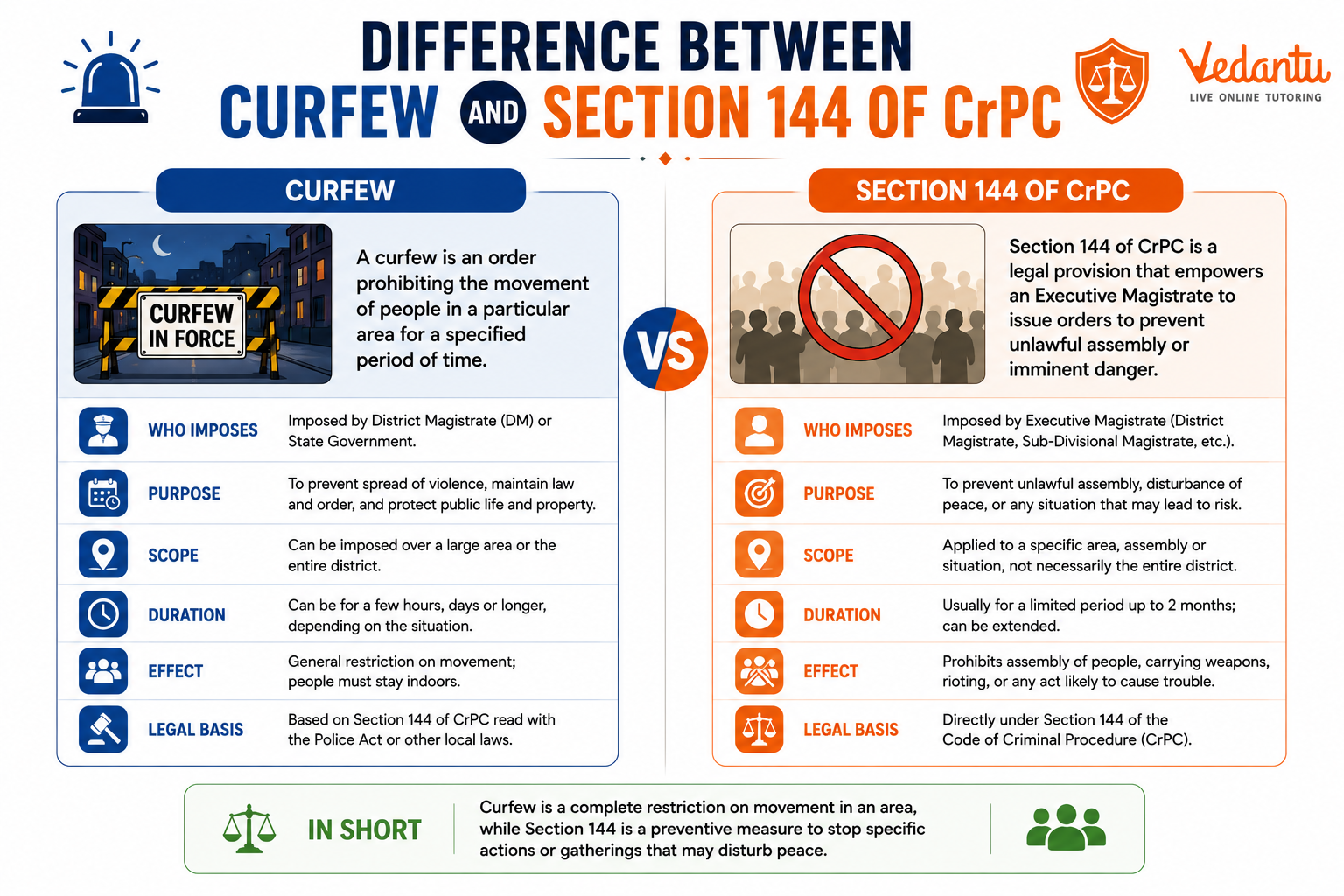
What is Section 144 of CrPC?
Section 144 of the Code of Criminal Procedure, 1973 empowers a District Magistrate, Sub-Divisional Magistrate, or any other Executive Magistrate specially authorized by the state government to issue orders in urgent cases of nuisance or apprehended danger. It is a preventive measure used to restrict the assembly of people and prevent potential disturbances.
Key Features of Section 144
- Prohibits the assembly of four or more people in an area.
- Restricts carrying of weapons or dangerous objects.
- Can be imposed in cases of riots, protests, communal tension, or emergencies.
- Usually imposed for a maximum period of two months, unless extended by the state government up to six months.
- It is preventive in nature and aims to maintain public peace.
Section 144 does not completely restrict movement of individuals. People can move for essential activities unless specifically restricted by the order.
What is Curfew?
Curfew is a stricter administrative measure imposed by authorities to maintain law and order in extreme situations. It is generally enforced under Section 144 of CrPC but involves stricter controls. During a curfew, people are required to stay indoors for a specified period, and movement is allowed only with special permission.
Key Features of Curfew
- Complete restriction on movement of people in the affected area.
- Shops, markets, schools, and offices remain closed.
- Only essential services such as hospitals and emergency services are allowed.
- Police and security forces strictly monitor the area.
- People may need curfew passes to step outside for essential work.
Curfew is generally imposed during severe riots, violent protests, or situations where public safety is at serious risk.
Difference Between Curfew and Section 144 of CrPC
| Basis of Difference | Section 144 of CrPC | Curfew |
|---|---|---|
| Nature | Preventive legal order | Stricter administrative restriction |
| Public Movement | Limited movement allowed | Complete restriction on movement |
| Assembly of People | Prohibits gathering of four or more people | No gathering allowed and people must stay indoors |
| Severity | Imposed in sensitive situations | Imposed in extreme emergency situations |
| Legal Basis | Specifically mentioned under CrPC | Usually enforced under Section 144 with stricter rules |
In simple terms, Section 144 restricts assembly and certain activities, while curfew completely restricts public movement. Curfew can be considered a more intense form of restriction compared to Section 144.
When Are These Measures Imposed?
Both Curfew and Section 144 are imposed to maintain law and order, but the intensity of the situation determines which one is applied.
Situations for Section 144
- Political rallies that may turn violent.
- Communal tension between groups.
- Preventive action during protests.
- Public health emergencies in certain cases.
Situations for Curfew
- Large scale riots or violent clashes.
- Severe breakdown of law and order.
- Threat to life and property on a large scale.
- Serious security threats.
Punishment for Violating Section 144 or Curfew
Violating orders issued under Section 144 or curfew can lead to legal consequences under the Indian Penal Code. Disobedience of a lawful order by a public servant may attract punishment, including fines and imprisonment. The police have the authority to take action against those who fail to comply with the imposed restrictions.
Importance for Competitive Exams
The difference between Curfew and Section 144 of CrPC is a frequently asked topic in General Knowledge, UPSC, SSC, state PSC, banking exams, and other competitive examinations. Questions may be asked in the form of direct differences, legal provisions, or current affairs related to their imposition.
- Remember that Section 144 restricts assembly, not complete movement.
- Curfew is stricter and restricts people from leaving their homes.
- Section 144 is a legal provision under CrPC, while curfew is an administrative action.
Conclusion
Curfew and Section 144 of CrPC are important legal tools used by authorities to maintain public order and safety. While both aim to prevent unrest and ensure peace, Section 144 mainly restricts unlawful assembly and certain activities, whereas curfew imposes a complete ban on public movement in extreme situations. Understanding their differences helps students build strong civic awareness and prepare effectively for competitive examinations. A clear grasp of these concepts also enhances awareness about citizens rights and government powers in maintaining law and order.
FAQs on Difference Between Curfew and Section 144 in India Explained for Students
1. What is the difference between Curfew and Section 144 of CrPC?
The main difference between Curfew and Section 144 of CrPC is the level of restriction imposed on public movement and assembly.
• Section 144 prohibits the gathering of four or more people in a specific area.
• Curfew is a stricter measure where people are required to stay indoors during specified hours.
• Curfew is usually imposed in extreme law-and-order situations.
• Section 144 allows limited movement but bans unlawful assembly.
In simple terms, curfew is more restrictive than Section 144 under the Criminal Procedure Code (CrPC), 1973.
2. What is Section 144 of CrPC?
Section 144 of the Criminal Procedure Code (CrPC) empowers a District Magistrate or Executive Magistrate to issue orders to prevent danger or nuisance.
• Prohibits assembly of four or more people.
• Restricts carrying weapons in public places.
• Imposed during protests, riots, or communal tension.
• Usually valid for up to 2 months (can be extended to 6 months).
It is commonly used to maintain public order, law and order, and public safety.
3. What is Curfew and when is it imposed?
A Curfew is a strict government order that restricts people from leaving their homes during specific hours to maintain law and order.
• Imposed during riots, violence, or emergencies.
• Movement is completely banned except for essential services.
• Police and administration strictly monitor compliance.
• Schools, markets, and offices remain closed.
Curfew is generally imposed under Section 144 but involves stricter enforcement.
4. Who has the authority to impose Section 144 and Curfew?
The authority to impose Section 144 lies with the District Magistrate (DM), Sub-Divisional Magistrate (SDM), or Executive Magistrate.
• Orders are issued under the CrPC, 1973.
• Curfew is implemented by district administration and police.
• State governments oversee large-scale restrictions.
These powers are exercised to ensure public peace, safety, and prevention of unrest.
5. How long can Section 144 remain in force?
Section 144 can remain in force for a maximum of 2 months initially.
• The State Government can extend it up to 6 months if required.
• It is temporary and situation-specific.
• The order can be withdrawn once normalcy is restored.
This time limit ensures that restrictions under CrPC Section 144 are not permanent.
6. Is Curfew more strict than Section 144?
Yes, Curfew is stricter than Section 144 of CrPC because it completely restricts public movement.
• Section 144 bans gatherings but allows essential movement.
• Curfew requires people to stay indoors.
• Only emergency services are allowed during curfew.
Therefore, curfew is imposed in more serious law-and-order situations compared to Section 144.
7. Can schools and offices remain open during Section 144?
Yes, schools and offices may remain open during Section 144 depending on the situation.
• Public gatherings are banned.
• Educational institutions may function with restrictions.
• Markets may operate under regulation.
However, during a Curfew, schools, colleges, and offices are generally closed to ensure public safety.
8. What happens if someone violates Section 144 or Curfew?
Violating Section 144 or Curfew orders is a punishable offense under Indian law.
• Action can be taken under Section 188 of IPC (disobedience of public servant’s order).
• Police can arrest violators.
• Fines or imprisonment may be imposed.
Strict penalties ensure compliance with law and order regulations.
9. Why is Section 144 imposed in India?
Section 144 is imposed to prevent disturbances that could threaten public peace and safety.
• To control riots or communal violence.
• To prevent unlawful assemblies or protests.
• To avoid potential danger to human life.
It acts as a preventive measure under the Criminal Procedure Code to maintain stability.
10. Is Curfew mentioned separately in the CrPC?
No, Curfew is not specifically defined in the CrPC, 1973, but it is imposed using powers under Section 144.
• Curfew is an administrative action.
• It is a stricter form of restriction under Section 144.
• Used during emergencies and severe unrest.
Thus, curfew is implemented through the legal framework of Section 144 of CrPC.
