






What Is the Meaning of AD and BC in the Historical Timeline?
The terms AD and BC are commonly used in History to divide the timeline of human civilization into two major eras. Understanding the difference between AD and BC is important for students preparing for school exams, competitive exams, and general knowledge tests. These terms help in identifying historical events based on a reference point in time. In this article, we will clearly explain the meaning, origin, usage, and key differences between AD and BC in a simple and structured manner.
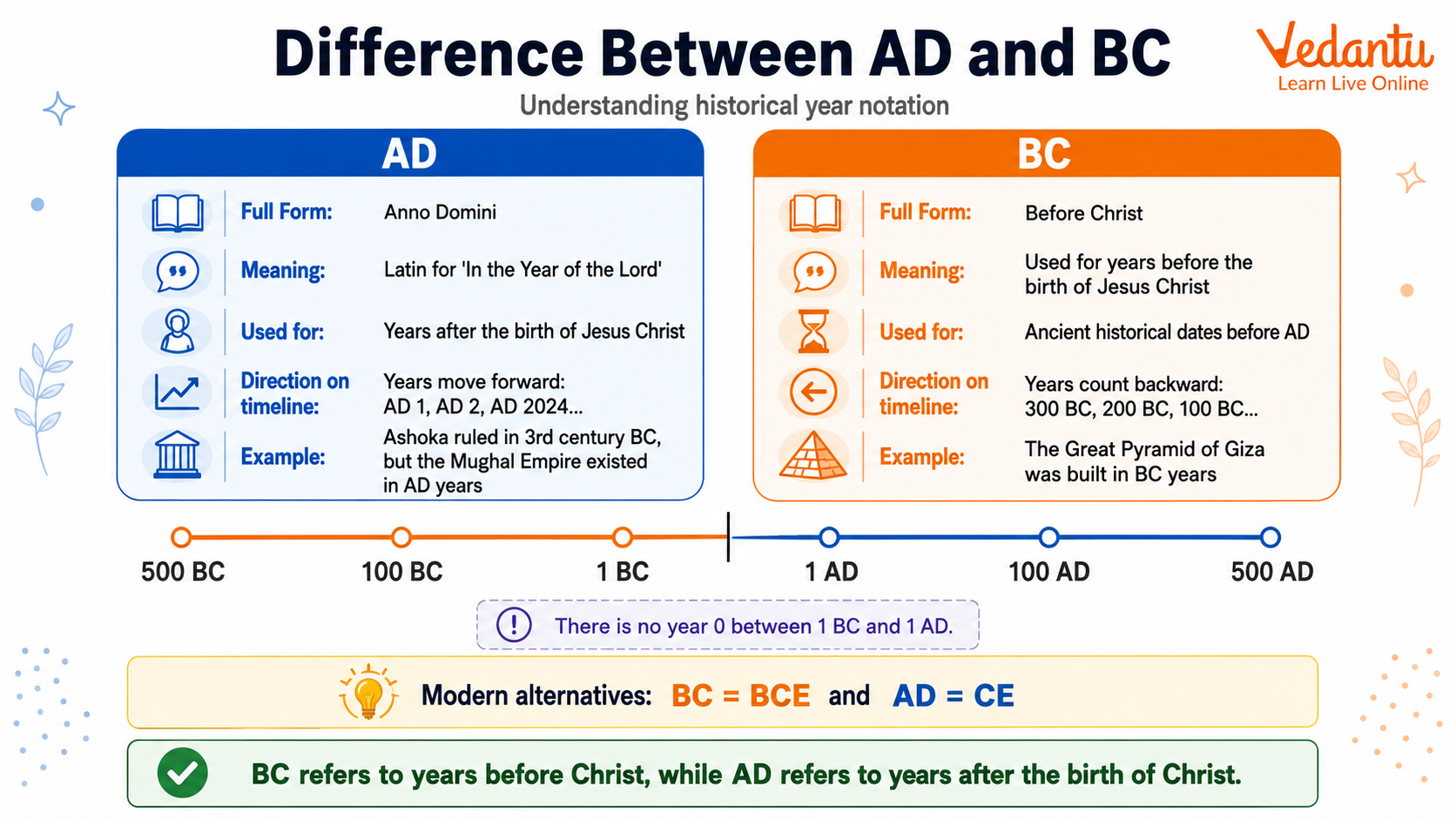
What is AD?
AD stands for "Anno Domini," a Latin term that means "In the year of our Lord." It is used to label years after the traditional birth year of Jesus Christ. The AD system was introduced by a monk named Dionysius Exiguus in the 6th century to standardize the Christian calendar.
- Represents years after the birth of Jesus Christ.
- Written before the year number, such as AD 2026.
- Used widely in Christian and Western calendars.
- Equivalent modern term is CE - Common Era.
What is BC?
BC stands for "Before Christ." It is used to denote the years before the birth of Jesus Christ. The BC system counts years backward from the assumed year of Christ’s birth.
- Represents years before the birth of Jesus Christ.
- Written after the year number, such as 300 BC.
- Years decrease as they approach AD 1.
- Equivalent modern term is BCE - Before Common Era.
Difference Between AD and BC
| Basis of Difference | AD | BC |
|---|---|---|
| Full Form | Anno Domini | Before Christ |
| Meaning | In the year of the Lord | Before the birth of Christ |
| Time Period | After birth of Jesus Christ | Before birth of Jesus Christ |
| Position in Writing | Written before year number | Written after year number |
| Example | AD 2026 | 300 BC |
The main difference between AD and BC lies in their reference point, which is the traditionally accepted year of Jesus Christ’s birth. BC counts years backward before this event, while AD counts years forward after it. There is no year zero in this system. The year 1 BC is immediately followed by AD 1.
Chronological Understanding
To better understand the AD and BC timeline, it is important to know how years are arranged:
- Years in BC decrease as time moves forward. For example, 500 BC comes before 300 BC.
- After 1 BC, the next year is AD 1.
- Years in AD increase normally, such as AD 100, AD 500, AD 2026.
Why AD and BC Are Important in History
The AD and BC system provides a standardized way to record and compare historical events across different civilizations. It allows historians and students to understand the sequence of events clearly.
- Helps in organizing world history chronologically.
- Used in textbooks, historical documents, and exams.
- Provides a common reference point for global events.
- Essential for understanding ancient and medieval history.
AD and BC vs CE and BCE
In modern times, many scholars and institutions use CE and BCE instead of AD and BC. CE stands for Common Era, and BCE stands for Before Common Era. The numbering of years remains the same. The difference is only in terminology, which makes it more culturally neutral.
- AD is equal to CE.
- BC is equal to BCE.
- The year numbering does not change.
Key Points to Remember
Students should remember the following important facts about AD and BC for exams and general knowledge:
- There is no year zero between BC and AD.
- BC years move in reverse order as they approach AD 1.
- AD is written before the year number.
- Modern equivalents are BCE and CE.
Conclusion
The difference between AD and BC lies mainly in their position relative to the birth of Jesus Christ. BC represents the years before his birth, while AD represents the years after. These terms play a crucial role in understanding historical timelines and organizing global history. By clearly understanding their meaning, usage, and chronological order, students can confidently answer questions related to historical dates in exams and competitive tests.
FAQs on Difference Between AD and BC in History Explained Simply
1. What is the difference between AD and BC?
AD and BC are terms used to label years in the Gregorian calendar, distinguishing periods before and after the birth of Jesus Christ.
• AD (Anno Domini) means “In the Year of Our Lord” and refers to years after the birth of Jesus Christ.
• BC (Before Christ) refers to years before the birth of Jesus Christ.
• In timelines, BC counts backward (e.g., 300 BC → 200 BC), while AD counts forward (AD 1 → AD 2026).
• These terms are widely used in history, chronology, and general knowledge studies.
2. What does AD stand for in history?
AD stands for “Anno Domini,” a Latin term meaning “In the Year of Our Lord.”
• It refers to the years after the birth of Jesus Christ.
• AD is placed before the year number (e.g., AD 2026).
• It is part of the Christian calendar system used globally.
• Commonly seen in world history timelines, competitive exams, and GK questions.
3. What does BC mean in the calendar system?
BC means “Before Christ” and refers to the years before the birth of Jesus Christ.
• It is used to describe ancient historical events.
• BC is written after the year number (e.g., 300 BC).
• The numbers decrease as they approach AD 1.
• Frequently used in ancient history, archaeology, and civilization studies.
4. Is there a year 0 between BC and AD?
No, there is no year 0 in the BC and AD system.
• The calendar moves directly from 1 BC to AD 1.
• This system was created by Dionysius Exiguus in the 6th century.
• The absence of year 0 sometimes causes confusion in historical calculations and timelines.
• Important for understanding chronology and date conversions.
5. How are BC years counted?
BC years are counted backward from the estimated birth year of Jesus Christ.
• Larger numbers indicate earlier years in ancient history.
• Example: 500 BC happened before 200 BC.
• Used to describe events like the rise of ancient Egypt, Mesopotamia, and the Indus Valley Civilization.
• Common in world history and GK exam questions.
6. Why are AD and BC important in history?
AD and BC are important because they provide a standardized system to organize historical events.
• Help in creating a clear historical timeline.
• Used worldwide in textbooks, academic research, and competitive exams.
• Allow comparison of events across different civilizations and centuries.
• Essential for understanding chronology, ancient history, and world events.
7. What are CE and BCE, and how are they related to AD and BC?
CE and BCE are modern alternatives to AD and BC used in the Gregorian calendar.
• CE (Common Era) is equivalent to AD.
• BCE (Before Common Era) is equivalent to BC.
• They use the same numbering system but are considered religiously neutral terms.
• Common in academic writing, global studies, and modern history books.
8. Where is AD written in a date?
AD is written before the year number in a date.
• Example: AD 476 (Fall of the Western Roman Empire).
• Unlike BC, which is written after the number (e.g., 300 BC).
• This placement rule is important in grammar, English writing, and history exams.
• Frequently asked in general knowledge quizzes.
9. Who introduced the AD and BC system?
The AD and BC dating system was introduced by Dionysius Exiguus in the 6th century.
• He was a Christian monk and scholar.
• Developed the system to calculate the date of Easter.
• Later became widely accepted in Europe and across the world.
• Forms the basis of the modern Gregorian calendar.
10. How do AD and BC help in understanding historical timelines?
AD and BC help organize events in chronological order for better historical understanding.
• Separate events into ancient and modern periods.
• Help students track centuries, civilizations, and major world events.
• Useful for preparing for school exams, UPSC, SSC, and other competitive exams.
• Essential for mastering world history, timelines, and chronological order.
