






How the Index of Industrial Production Is Calculated and Why It Matters
The Index of Industrial Production - IIP is an important economic indicator that measures the short-term changes in the volume of production of industrial products in an economy. It helps in assessing the performance and growth of the industrial sector, which includes manufacturing, mining, and electricity. Policymakers, economists, competitive exam aspirants, and students closely monitor IIP to understand economic trends and industrial health. Detailed information about the Index of Industrial Production helps in understanding economic planning, inflation trends, GDP growth, and overall development of a country.
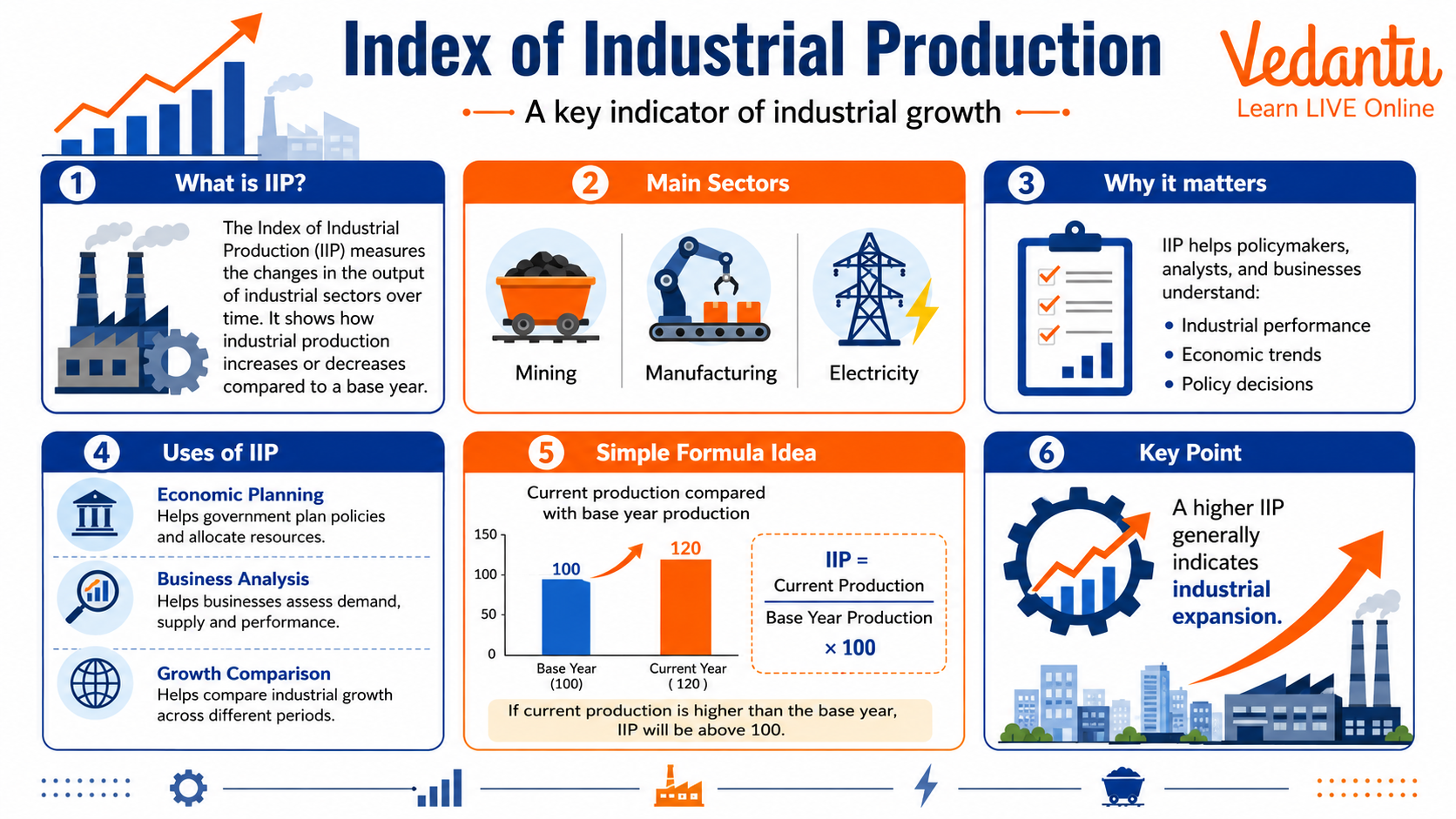
What is Index of Industrial Production?
The Index of Industrial Production - IIP is a composite indicator that shows the growth rate of various sectors in the economy over a specific period of time compared to a base year. It is expressed as an index number and reflects changes in industrial output.
- Measures short-term industrial growth
- Calculated monthly
- Uses a fixed base year for comparison
- Indicates economic strength and stability
Objectives of IIP
The main purpose of the Index of Industrial Production is to track industrial performance and provide reliable data for economic analysis and policy decisions.
- To measure growth in industrial sectors
- To help in economic planning and policy formulation
- To compare sector-wise industrial performance
- To assist in forecasting GDP trends
Sectors Covered Under IIP
The Index of Industrial Production is broadly classified into three major sectors. Each sector is assigned a weight based on its contribution to the overall industrial output.
Major Sectors in IIP
| Sector | Description | Importance |
|---|---|---|
| Mining | Extraction of minerals and natural resources | Supplies raw materials to industries |
| Manufacturing | Production of goods in factories | Largest contributor to IIP |
| Electricity | Generation of electrical power | Supports industrial and domestic activities |
Among these sectors, manufacturing holds the highest weight in the index because it contributes significantly to industrial output and employment.
Use-Based Classification of IIP
Apart from sector classification, IIP is also categorized based on the use of goods. This helps in understanding demand patterns and investment trends.
- Primary Goods
- Capital Goods
- Intermediate Goods
- Infrastructure and Construction Goods
- Consumer Durables
- Consumer Non-Durables
Base Year of IIP
The base year is the year against which current industrial production is compared. It is periodically revised to reflect structural changes in the economy and to include new industries and products. The base year ensures that the index remains relevant and accurate.
Calculation of Index of Industrial Production
The Index of Industrial Production is calculated using the Laspeyres formula, which uses base year weights. The formula compares the quantity of goods produced in the current period with the quantity produced in the base year.
- Select base year and assign weights to sectors
- Collect production data for current month
- Compare with base year production levels
- Calculate weighted average to derive index number
Importance of IIP in Economy
The Index of Industrial Production plays a vital role in economic analysis and decision making. It acts as an early indicator of economic performance and industrial activity.
- Helps in monitoring industrial growth
- Guides government monetary and fiscal policies
- Assists investors in understanding market trends
- Acts as a leading indicator of GDP growth
Limitations of IIP
Although IIP is a useful indicator, it has certain limitations that must be considered while interpreting the data.
- Does not cover the entire informal sector
- Subject to revisions and data delays
- Limited coverage of service sector activities
- May not reflect real-time economic shocks immediately
Key Points for Competitive Exams
For students preparing for competitive examinations, the Index of Industrial Production is an important topic under economics and general awareness sections.
- IIP measures industrial output growth
- Published monthly by the concerned statistical authority
- Manufacturing sector has the highest weight
- Uses base year comparison method
- Important for understanding GDP and inflation trends
Conclusion
The Index of Industrial Production - IIP is a crucial tool for measuring industrial growth and economic performance. It provides valuable insights into the strength of the industrial sector and helps policymakers, businesses, and researchers make informed decisions. Understanding the structure, calculation, importance, and limitations of IIP is essential for students, competitive exam aspirants, and anyone interested in economic developments. A clear grasp of this concept strengthens overall knowledge of macroeconomic indicators and their role in shaping national economic policies.
FAQs on Index of Industrial Production Explained for Students
1. What is the Index of Industrial Production (IIP)?
Index of Industrial Production (IIP) is an economic indicator that measures the short-term changes in the volume of production of industrial sectors in an economy.
- It tracks growth in manufacturing, mining, and electricity sectors.
- Published monthly in India by the National Statistical Office (NSO).
- Used to assess industrial growth rate and overall economic performance.
- Acts as a key indicator for GDP estimation and policy decisions.
2. What are the main sectors covered under the IIP?
IIP covers three major industrial sectors that reflect the country’s production activity.
- Manufacturing Sector – Largest weight in IIP.
- Mining Sector – Includes coal, crude oil, natural gas, etc.
- Electricity Sector – Measures power generation.
- These sectors help evaluate industrial output and economic trends.
3. Who releases the Index of Industrial Production in India?
The National Statistical Office (NSO), under the Ministry of Statistics and Programme Implementation (MoSPI), releases the IIP data every month.
- Data is usually released with a time lag of six weeks.
- It ensures accuracy through industrial surveys.
- Forms a critical part of economic data reporting in India.
4. What is the base year of the Index of Industrial Production?
The current base year of IIP in India is 2011–12, which is used for calculating industrial growth.
- The base year is periodically revised.
- Revision ensures updated industrial structure and product basket.
- Earlier base years included 2004–05 and 1993–94.
5. Why is the Index of Industrial Production important?
IIP is important because it reflects the health of the industrial sector and overall economy.
- Helps in measuring economic growth.
- Guides government policy and RBI decisions.
- Used by investors and analysts to track business cycles.
- Influences stock market trends and investment planning.
6. How is the Index of Industrial Production calculated?
IIP is calculated using the Laspeyres Index formula, which compares current production with the base year.
- Uses fixed base year weights.
- Measures percentage change in output.
- Combines data from manufacturing, mining, and electricity.
- Expressed as an index number showing industrial growth rate.
7. What is the difference between IIP and GDP?
IIP measures only industrial production, whereas GDP measures the total value of goods and services produced in an economy.
- IIP focuses on industrial sectors only.
- GDP (Gross Domestic Product) includes agriculture, services, and industry.
- IIP is released monthly; GDP is released quarterly.
- IIP acts as a short-term indicator of economic activity.
8. What does a rise or fall in IIP indicate?
A rise in IIP indicates industrial expansion, while a fall signals slowdown or contraction.
- Positive growth shows increased production and demand.
- Negative growth may indicate economic slowdown.
- Impacts investor confidence and market sentiment.
- Closely watched during recession or recovery phases.
9. What are the limitations of the Index of Industrial Production?
IIP has certain limitations despite being a key economic indicator.
- Does not cover the services sector.
- Subject to frequent revisions.
- Limited representation of informal industries.
- May not fully reflect real-time economic conditions.
10. How is IIP useful for competitive exams and general knowledge?
IIP is an important topic for competitive exams and general awareness due to its economic significance.
- Frequently asked in UPSC, SSC, Banking, and State PCS exams.
- Helps understand concepts like industrial growth, base year, GDP, and inflation.
- Essential for current affairs and economic surveys.
- Improves understanding of India’s economic indicators and policy framework.
