






Why the Cripps Offer of 1942 Failed in India
The Cripps Mission was a significant political initiative undertaken by the British Government in 1942 during World War II to secure Indian cooperation in the war effort. Sent under the leadership of Sir Stafford Cripps, the mission aimed to negotiate a constitutional settlement with Indian leaders. However, it ultimately failed due to differences between the British authorities and Indian political parties. The Cripps Mission holds great importance in modern Indian history as it paved the way for the Quit India Movement and exposed the widening gap between British rule and Indian aspirations for independence.
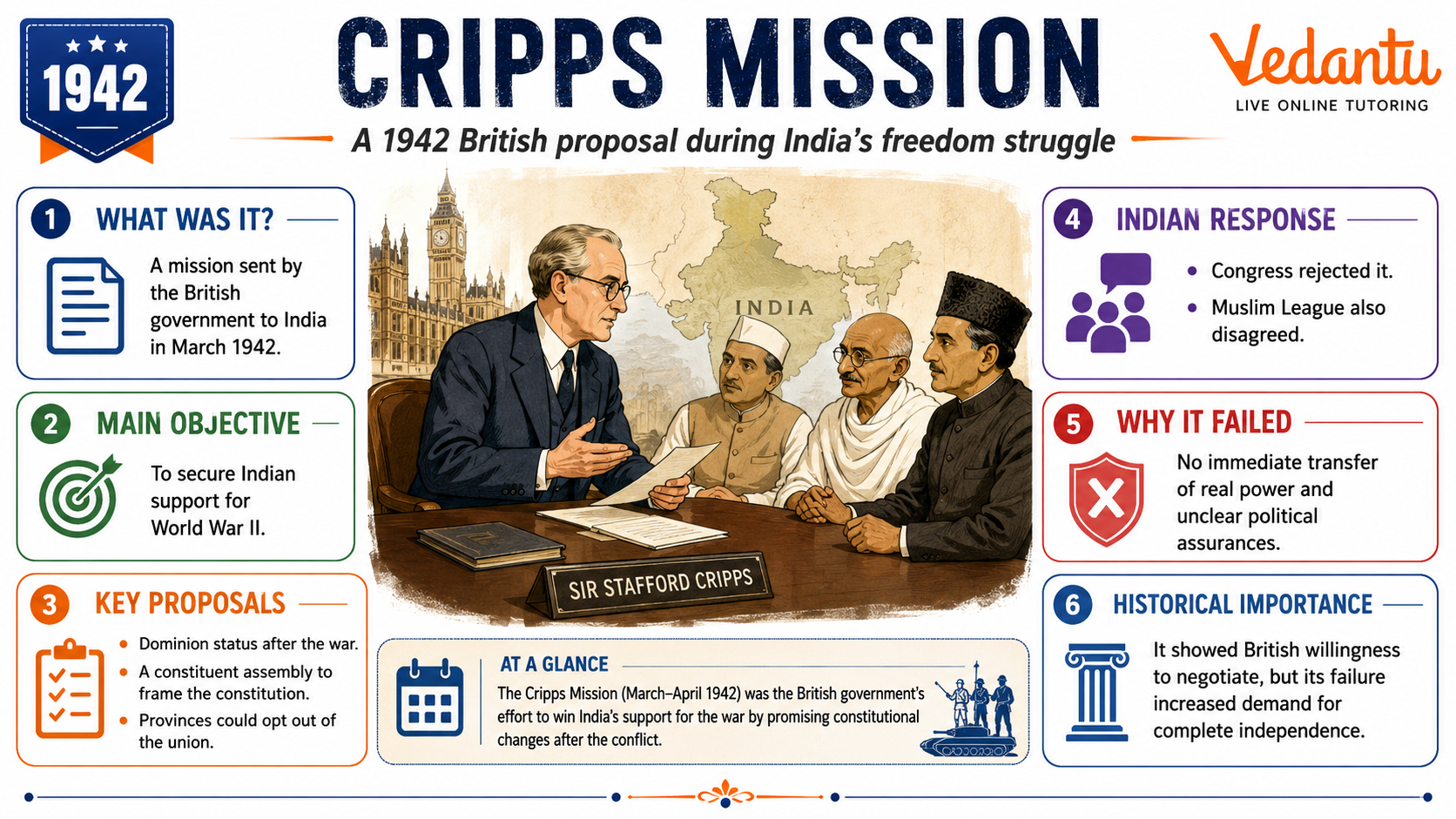
Background of the Cripps Mission
The Cripps Mission was launched at a critical time during World War II. Japan had rapidly advanced in Southeast Asia and posed a threat to British India. The British Government realized that it needed India's full support in the war. At the same time, Indian political leaders were demanding complete independence.
- World War II had begun in 1939 and India was declared a participant without consulting Indian leaders.
- The Indian National Congress had resigned from provincial ministries in protest.
- Japan’s success in Burma increased the urgency for British support from Indians.
- International pressure, especially from the United States, encouraged Britain to offer concessions to India.
Objectives of the Cripps Mission
The main objective of the Cripps Mission was to obtain Indian cooperation in World War II by offering political assurances about India’s future governance.
- To secure Indian support for the British war effort.
- To propose a constitutional framework for India after the war.
- To reduce political unrest in India.
- To maintain British control during the war period.
Main Proposals of the Cripps Mission
Key Provisions of the Cripps Offer
| Provision | Description | Impact |
|---|---|---|
| Dominion Status | India would be granted Dominion Status after the war. | Promise of self-governance in future. |
| Constituent Assembly | A new body would frame the Constitution of India. | Gave Indians role in constitution-making. |
| Right to Secede | Provinces could opt out of the Indian Union. | Encouraged demand for Pakistan. |
The proposals attempted to balance British interests with Indian demands. However, the provision allowing provinces to opt out created concerns about the unity of India and was strongly opposed by the Congress.
Response of Indian Leaders
Indian National Congress
The Congress rejected the Cripps proposals because they did not grant immediate self-government. Leaders like Mahatma Gandhi criticized the offer as a "post-dated cheque on a crashing bank."
- No immediate transfer of power.
- Defense remained under British control.
- Provision of provincial secession threatened national unity.
Muslim League
The Muslim League also rejected the proposals because they did not clearly guarantee the creation of Pakistan. However, the right of provinces to secede indirectly supported its demand.
Reasons for the Failure of the Cripps Mission
The Cripps Mission failed due to a lack of trust between Indian leaders and the British Government. The offers were seen as inadequate and vague.
- No immediate transfer of effective power.
- Differences between Congress and Muslim League.
- British unwillingness to compromise on defense matters.
- Suspicion about British intentions.
Impact and Significance
Although the Cripps Mission failed, it had long-term consequences for the Indian freedom struggle. The rejection of the proposals led to increased frustration among Indian leaders.
- Led to the launch of the Quit India Movement in August 1942.
- Exposed the rigid attitude of the British Government.
- Strengthened the demand for complete independence.
- Marked a turning point in the final phase of India’s freedom struggle.
Quick Facts About the Cripps Mission
Cripps Mission at a Glance
| Aspect | Details | Year |
|---|---|---|
| Leader | Sir Stafford Cripps | 1942 |
| Purpose | Secure Indian support in WWII | March 1942 |
| Outcome | Mission Failed | April 1942 |
The Cripps Mission remains an important chapter in Indian history. It highlights the political complexities of the time and the growing determination of Indian leaders to achieve complete independence rather than limited concessions. Understanding the Cripps Mission helps students grasp the sequence of events that eventually led to India’s independence in 1947.
FAQs on Cripps Mission 1942 – Clear Explanation for Students
1. What was the Cripps Mission of 1942?
The Cripps Mission (1942) was a British proposal offering India dominion status after World War II in exchange for Indian support in the war.
• Sent by the British Government under Prime Minister Winston Churchill
• Led by Sir Stafford Cripps
• Proposed Dominion Status after the war
• Allowed provinces the right to secede from the Indian Union
This mission aimed to secure Indian cooperation during World War II but ultimately failed.
2. Why was the Cripps Mission sent to India?
The main purpose of the Cripps Mission was to gain Indian political support for Britain during World War II.
• Japan’s rapid advance in Asia threatened British India
• Need for Indian military and political cooperation
• Pressure from the USA and Allied powers to resolve India’s constitutional issue
The mission was a wartime negotiation attempt to address India’s demand for self-government.
3. What were the main proposals of the Cripps Mission?
The Cripps Proposals offered constitutional reforms after the war.
• Grant of Dominion Status to India
• Formation of a Constituent Assembly to draft a new Constitution
• Provinces could opt out of the Union (right to secede)
• Protection of minority rights
These proposals were seen as inadequate by Indian leaders seeking immediate independence.
4. Why did the Cripps Mission fail?
The Cripps Mission failed because it did not satisfy major Indian political parties.
• Indian National Congress wanted immediate transfer of power
• Muslim League demanded a separate Pakistan
• Provision allowing provinces to secede weakened national unity
• British refusal to transfer defence powers immediately
As a result, the negotiations collapsed in April 1942.
5. How did Mahatma Gandhi react to the Cripps Mission?
Mahatma Gandhi strongly criticized the Cripps Offer, calling it a "post-dated cheque on a crashing bank."
• Rejected delayed dominion status
• Opposed British control over defence
• Considered proposals vague and uncertain
His rejection contributed to the launch of the Quit India Movement (1942).
6. What was the significance of the Cripps Mission in Indian history?
The Cripps Mission marked a crucial turning point in India’s freedom struggle.
• Showed Britain’s weakening imperial control
• Led directly to the Quit India Movement
• Highlighted divisions between Congress and Muslim League
• Set the stage for later constitutional developments like the Cabinet Mission (1946)
It intensified the demand for complete independence.
7. Who was Sir Stafford Cripps?
Sir Stafford Cripps was a senior British politician sent to negotiate with Indian leaders in 1942.
• Member of the British War Cabinet
• Leader of the Cripps Mission
• Known for his socialist and pro-India views
Despite his efforts, he could not bridge the gap between British authorities and Indian leaders.
8. How did the Muslim League respond to the Cripps Mission?
The Muslim League, led by Muhammad Ali Jinnah, did not fully accept the Cripps proposals.
• Welcomed the idea of provinces opting out
• Felt the proposals did not clearly guarantee Pakistan
• Continued to demand a separate Muslim state
This response deepened the divide between Congress and the League.
9. What was the impact of the Cripps Mission on the Quit India Movement?
The failure of the Cripps Mission directly led to the launch of the Quit India Movement (August 1942).
• Congress lost faith in British promises
• Demand shifted from dominion status to complete independence
• Nationwide protests and mass civil disobedience followed
The mission’s failure intensified anti-British sentiments across India.
10. What is the difference between the Cripps Mission and the Cabinet Mission?
The Cripps Mission (1942) and Cabinet Mission (1946) were British attempts to solve India’s constitutional crisis, but they differed in scope and outcome.
• Cripps Mission: Offered post-war dominion status; failed quickly
• Cabinet Mission: Proposed a federal structure; led to formation of the Constituent Assembly
• Cripps focused on wartime cooperation; Cabinet Mission addressed transfer of power
The Cabinet Mission had a more lasting constitutional impact.
