






How is a Chief Minister in India appointed and what are the key powers?
The Chief Minister in India is the head of the government in a state. He or she holds the highest executive authority at the state level and plays a key role in administration, law-making, and policy implementation. The Chief Minister leads the Council of Ministers and is responsible for governing the state effectively. This topic is important for students preparing for competitive exams such as UPSC, SSC, State PSC, Banking, and other General Knowledge based tests.
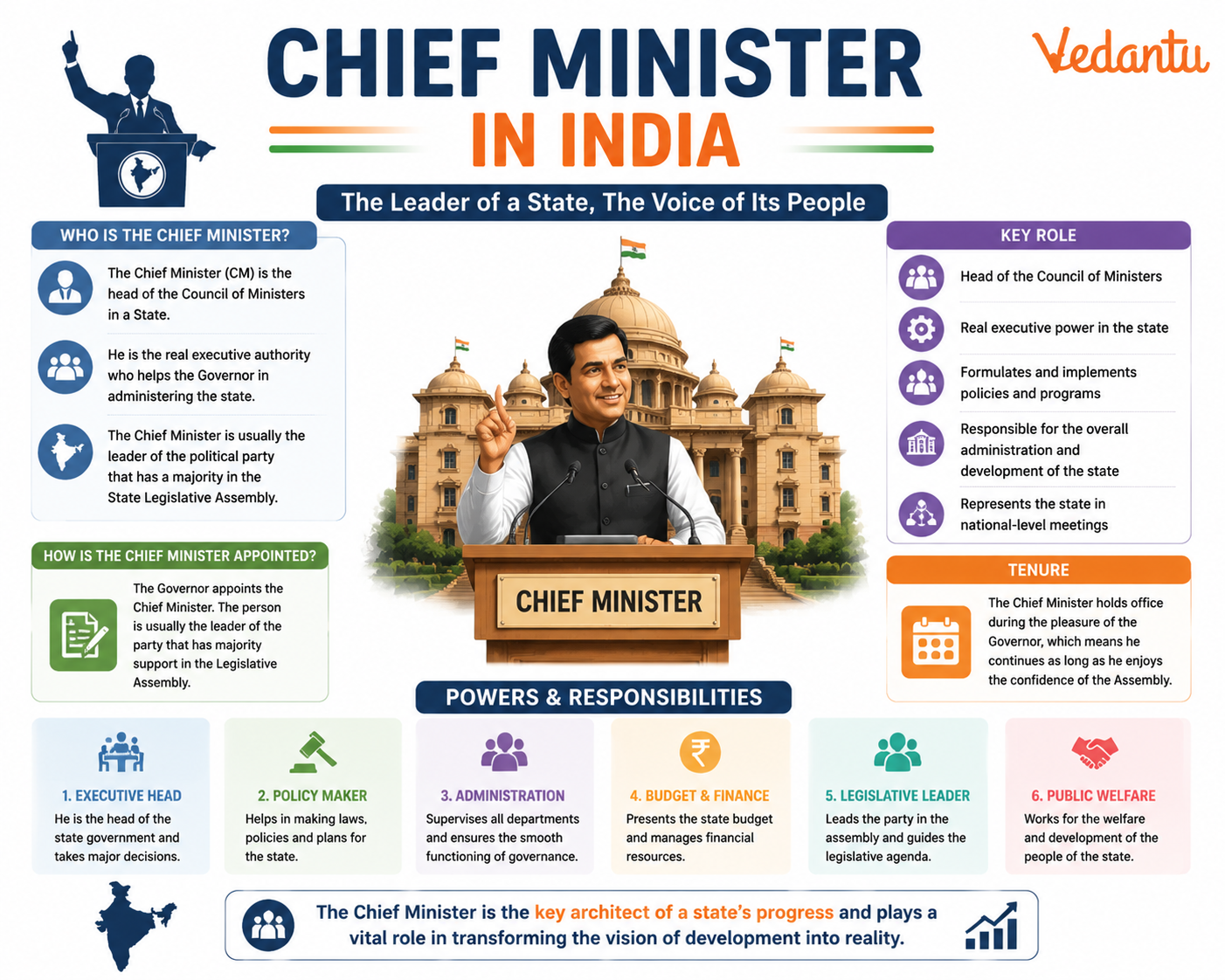
Who is the Chief Minister?
The Chief Minister is the elected leader of the majority party or coalition in the State Legislative Assembly. The Governor appoints the Chief Minister, but the appointee must have the support of the majority of the members of the Legislative Assembly. The Chief Minister acts as the real executive authority in the state, while the Governor is the constitutional head.
Appointment of Chief Minister
The process of appointing a Chief Minister is defined by the Constitution of India under Article 164. The Governor appoints the Chief Minister, but certain conditions must be fulfilled.
Eligibility Criteria
- Must be a citizen of India.
- Must be at least 25 years old.
- Must be a member of the State Legislature. If not, he or she must become a member within 6 months of appointment.
- Must not hold any office of profit under the government.
Oath of Office
The Chief Minister takes the oath of office and secrecy before the Governor of the state. The oath includes maintaining the sovereignty and integrity of India and performing duties faithfully.
Powers and Functions of Chief Minister
The Chief Minister performs several important functions related to administration, legislation, and coordination between the Governor and the Council of Ministers.
Executive Powers
- Forms the Council of Ministers.
- Allocates and reshuffles portfolios among ministers.
- Presides over meetings of the Council of Ministers.
- Advises the Governor on various matters.
Legislative Powers
- Leads the majority party in the Legislative Assembly.
- Participates in debates and introduces policies and bills.
- Advises the Governor to summon or prorogue the Assembly.
Financial Powers
- Supervises preparation of the state budget.
- Ensures proper allocation and utilization of state funds.
- Plays a key role in financial planning and development schemes.
Term of Office
The Chief Minister holds office during the pleasure of the Governor. However, in practice, the term lasts for five years, which is the normal term of the Legislative Assembly. The Chief Minister can resign or may be removed if he or she loses the majority support in the Assembly.
Chief Minister vs Governor
| Basis | Chief Minister | Governor |
|---|---|---|
| Position | Real executive head | Constitutional head |
| Appointment | Appointed by Governor | Appointed by President |
| Role | Runs state administration | Acts on advice of Council of Ministers |
The Chief Minister exercises real executive powers, while the Governor mainly performs ceremonial duties and acts according to the advice of the Council of Ministers headed by the Chief Minister.
Removal of Chief Minister
The Chief Minister may be removed in the following situations:
- If he or she loses majority support in the Legislative Assembly.
- If a no confidence motion is passed against the government.
- If he or she resigns voluntarily.
Important Constitutional Articles Related to Chief Minister
| Article | Provision | Description |
|---|---|---|
| Article 163 | Council of Ministers | Governor acts on aid and advice of Council of Ministers |
| Article 164 | Appointment | Chief Minister appointed by Governor |
| Article 167 | Duties | Chief Minister communicates decisions to Governor |
These constitutional provisions define the powers, duties, and relationship between the Chief Minister and the Governor in a state.
Importance of Chief Minister in State Governance
The Chief Minister is central to the functioning of state government. He or she ensures implementation of laws, maintains law and order, promotes development, and represents the state at national forums. The role becomes especially important during emergencies, policy reforms, and economic planning.
Preparation Tips for Competitive Exams
- Focus on Articles 163, 164, and 167 of the Constitution.
- Understand the difference between Chief Minister and Governor.
- Learn about appointment, powers, term, and removal.
- Practice multiple choice questions related to state executive.
A clear understanding of the Chief Minister in India helps students grasp the structure of state government and strengthens their preparation for various competitive examinations. This topic is fundamental in Indian Polity and frequently appears in General Knowledge sections.
FAQs on Chief Minister in India: Role, Powers and Responsibilities
1. Who is the Chief Minister of India?
The Chief Minister (CM) is the head of the state government in India. The Chief Minister leads the executive branch at the state level and is similar to the Prime Minister at the national level.
• Appointed by the Governor of the state
• Leader of the majority party in the State Legislative Assembly
• Real executive authority of the state
• Head of the Council of Ministers
This post is important in understanding Indian polity, state government structure, and constitutional offices.
2. How is the Chief Minister appointed in India?
The Chief Minister is appointed by the Governor of the state after elections. The Governor invites the leader of the majority party or coalition to form the government.
• Appointed under Article 164 of the Indian Constitution
• Must prove majority support in the Legislative Assembly
• Other ministers are appointed on the CM’s advice
This process is a key part of state elections, government formation, and constitutional procedures in India.
3. What are the powers and functions of the Chief Minister?
The Chief Minister exercises executive powers and manages state administration. The CM plays a central role in governance and policy-making.
• Heads the Council of Ministers
• Advises the Governor
• Frames and implements state policies and laws
• Allocates portfolios to ministers
• Represents the state in national forums
These powers make the CM the most important figure in state governance, administration, and political leadership.
4. What is the term of office of a Chief Minister?
The Chief Minister holds office for five years, subject to majority support. The term depends on the confidence of the Legislative Assembly.
• Normal tenure is 5 years
• Can resign before completion
• Must resign if they lose majority in the Assembly
• No fixed term limit on re-election
This is important for understanding state legislature tenure and democratic accountability.
5. What qualifications are required to become a Chief Minister?
A person must meet constitutional qualifications to become a Chief Minister. These qualifications are similar to those of a state legislator.
• Must be a citizen of India
• Must be at least 25 years old
• Must be a member of the State Legislative Assembly or Council (or become one within 6 months)
• Should not hold an office of profit
These rules are essential in Indian Constitution, eligibility criteria, and political leadership studies.
6. What is the difference between the Chief Minister and the Governor?
The Chief Minister is the real executive head, while the Governor is the constitutional head of the state. Their roles differ in authority and function.
• Chief Minister: Elected leader, exercises real executive powers
• Governor: Appointed by the President, acts as nominal head
• CM runs the government; Governor works on CM’s advice (except in special cases)
This distinction is important in understanding state executive, constitutional roles, and Indian federal system.
7. Can a Chief Minister be removed from office?
Yes, a Chief Minister can be removed if they lose majority support in the Assembly. The position depends on legislative confidence.
• Removal after No-Confidence Motion
• Resignation due to political crisis
• Dismissal in rare constitutional situations
This concept is related to legislative control, democratic system, and state politics in India.
8. Who was the first Chief Minister in India?
Pandit Govind Ballabh Pant was one of the first Chief Ministers in independent India. He served as the Chief Minister of Uttar Pradesh after independence in 1947.
• Freedom fighter and senior Congress leader
• Played a major role in state administration reforms
• Later became the Union Home Minister
This is an important fact in Indian political history and post-independence governance.
9. What is the salary of a Chief Minister in India?
The salary of a Chief Minister varies from state to state. Each state legislature decides the salary and allowances.
• Monthly salary differs across states
• Includes allowances, residence, and security
• Determined by state laws
This topic is commonly searched under CM salary in India, government pay scale, and public office benefits.
10. What role does the Chief Minister play in state administration?
The Chief Minister supervises and controls the entire state administration. The CM ensures smooth functioning of government departments.
• Coordinates between different ministries
• Implements laws passed by the State Legislature
• Maintains law and order with the help of officials
• Acts as a link between State and Central Government
This role is central to understanding public administration, governance system, and executive authority in Indian states.
