






Why the Cabinet Mission Plan of 1946 Failed and Its Impact on Indian Independence
The Cabinet Mission Plan of 1946 was one of the most significant constitutional proposals in the final phase of British rule in India. Sent by the British Government, the Cabinet Mission aimed to transfer power to Indian leaders and propose a framework for India’s independence while maintaining unity. The plan attempted to resolve the political deadlock between the Indian National Congress and the Muslim League regarding the demand for Pakistan. Although it initially received acceptance from major political parties, it ultimately failed, paving the way for the partition of India in 1947. Understanding the Cabinet Mission Plan is crucial for students and competitive exam aspirants as it marked a turning point in India’s constitutional and political history.
Background of the Cabinet Mission Plan
After the end of World War II, Britain was economically weak and politically pressured to grant independence to India. The Labour Government in Britain decided to send a high-level delegation to India to negotiate with Indian leaders and frame a constitutional solution. Communal tensions between Hindus and Muslims were increasing, and the Muslim League under Muhammad Ali Jinnah was demanding a separate nation, Pakistan. The British government aimed to prevent partition while ensuring a peaceful transfer of power.
Members of the Cabinet Mission
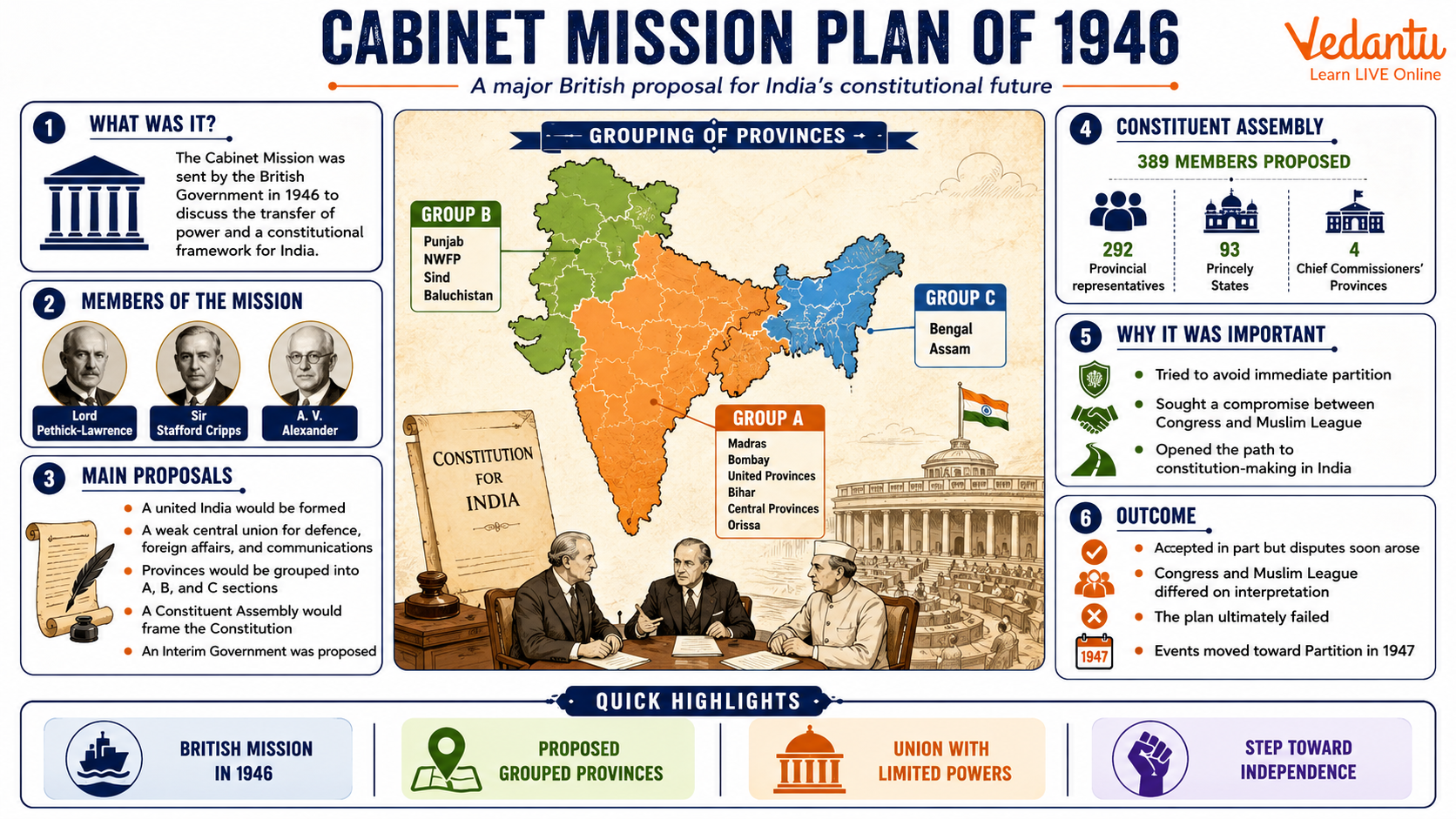
- Lord Pethick-Lawrence - Secretary of State for India
- Sir Stafford Cripps - President of the Board of Trade
- A.V. Alexander - First Lord of the Admiralty
Objectives of the Cabinet Mission
- To discuss the transfer of power from British rule to Indian leadership
- To frame a constitution for a united India
- To prevent the partition of India
- To create a constitutional framework acceptable to both Congress and the Muslim League
Main Proposals of the Cabinet Mission Plan
The Cabinet Mission proposed a three-tier constitutional structure to balance unity and provincial autonomy. It attempted to satisfy both Congress, which wanted a strong central government, and the Muslim League, which demanded safeguards for Muslims.
1. Union Government
- A Union of India including British India and princely states
- The Union would control foreign affairs, defense, and communications
- The Union would have powers to raise finances for these subjects
2. Provincial Grouping
Provinces were divided into three groups to provide autonomy and address communal concerns:
- Group A - Hindu majority provinces such as Madras, Bombay, United Provinces, Bihar, Central Provinces, and Orissa
- Group B - Muslim majority provinces like Punjab, Sindh, North West Frontier Province, and Baluchistan
- Group C - Bengal and Assam
3. Constituent Assembly
- A Constituent Assembly of 389 members was proposed
- 292 from British Indian provinces
- 93 from princely states
- 4 from chief commissioner provinces
Key Features of the Cabinet Mission Plan
| Feature | Description | Purpose |
|---|---|---|
| Union Government | Limited subjects like defense, foreign affairs, communication | Maintain unity of India |
| Provincial Autonomy | Provinces had maximum powers | Address regional and communal concerns |
| Grouping System | Provinces grouped into A, B, C sections | Balance Congress and Muslim League demands |
The plan tried to create a federal structure with a weak center and strong provinces. It rejected the immediate demand for Pakistan but provided significant autonomy to Muslim majority provinces.
Reaction of Political Parties
Indian National Congress
The Congress accepted the idea of a Constituent Assembly but opposed compulsory grouping of provinces. It favored a strong central government and interpreted the grouping as optional.
Muslim League
The Muslim League initially accepted the plan as it provided safeguards through provincial grouping. However, after disagreements with Congress over interpretation, the League withdrew support and called for Direct Action Day in August 1946.
Failure of the Cabinet Mission Plan
- Differences between Congress and Muslim League over grouping
- Lack of mutual trust between political parties
- Communal violence after Direct Action Day
- British inability to enforce agreement
Significance of the Cabinet Mission Plan
- It was the last major attempt to keep India united
- It led to the formation of the Constituent Assembly
- It highlighted the deep communal divide in Indian politics
- Its failure accelerated the process of partition
Conclusion
The Cabinet Mission Plan of 1946 was a crucial constitutional effort to transfer power peacefully and preserve the unity of India. Despite its well structured proposals, political disagreements and communal tensions led to its failure. However, it played a significant role in shaping the Constituent Assembly and influenced the framing of the Indian Constitution. For students and competitive exam aspirants, the Cabinet Mission Plan remains an important topic in modern Indian history as it directly contributed to the events leading to independence and partition in 1947.
FAQs on Cabinet Mission Plan of 1946: Background, Proposals and Failure Explained
1. What was the Cabinet Mission Plan of 1946?
The Cabinet Mission Plan (1946) was a British proposal to transfer power from British India to Indian leaders while keeping India united.
- Proposed by a three-member British Cabinet Mission in March 1946
- Aimed to frame a Constitution for independent India
- Suggested a federal structure with provinces grouped into sections
- Tried to avoid the demand for Pakistan
- Considered a major step in the Indian Independence Movement
2. Who were the members of the Cabinet Mission?
The Cabinet Mission consisted of three British leaders sent to negotiate India’s constitutional future.
- Lord Pethick-Lawrence (Secretary of State for India)
- Sir Stafford Cripps
- A.V. Alexander
- Arrived in India in March 1946
- Represented the British Labour Government
3. What were the main objectives of the Cabinet Mission Plan?
The main objective of the Cabinet Mission Plan was to ensure a peaceful transfer of power while maintaining Indian unity.
- Prevent the partition of India
- Form a Constituent Assembly to draft the Constitution
- Create an interim government
- Protect minority rights, especially Muslims
- Establish a federal union with limited central powers
4. What were the key features of the Cabinet Mission Plan?
The Cabinet Mission Plan proposed a three-tier constitutional structure for India.
- A Union Government controlling defense, foreign affairs, and communications
- Provincial autonomy for internal matters
- Grouping of provinces into Sections A, B, and C
- Formation of a Constituent Assembly
- No immediate creation of Pakistan
5. What was the grouping system under the Cabinet Mission Plan?
The grouping system divided provinces into three sections based on religious majority.
- Section A: Hindu-majority provinces (e.g., Madras, Bombay)
- Section B: Muslim-majority provinces in the northwest (e.g., Punjab, Sindh)
- Section C: Bengal and Assam
- Each group could frame its own constitution
- Aimed to balance Congress and Muslim League demands
6. Why did the Cabinet Mission Plan fail?
The Cabinet Mission Plan failed due to disagreements between the Indian National Congress and the Muslim League.
- Congress opposed compulsory grouping of provinces
- Muslim League insisted on Pakistan
- Differences over interpretation of federal powers
- Direct Action Day (16 August 1946) increased communal tensions
- Ultimately led to the Partition of India in 1947
7. What was the role of the Constituent Assembly in the Cabinet Mission Plan?
The Constituent Assembly was formed to draft the Constitution of independent India.
- Members elected indirectly by provincial legislatures
- Total strength proposed: 389 members
- Included representatives from provinces and princely states
- First meeting held on 9 December 1946
- Later framed the Constitution of India (1950)
8. How did the Congress and Muslim League react to the Cabinet Mission Plan?
The Congress and Muslim League initially accepted parts of the plan but later disagreed on its interpretation.
- Indian National Congress accepted the idea of a Constituent Assembly but rejected compulsory grouping
- Muslim League first accepted, then rejected the plan demanding Pakistan
- Led to political deadlock and communal violence
- Marked a turning point in the freedom struggle
9. How was the Cabinet Mission Plan different from the Cripps Mission?
The Cabinet Mission Plan was more detailed and practical compared to the earlier Cripps Mission of 1942.
- Cripps Mission (1942) offered dominion status after World War II
- Cabinet Mission proposed immediate steps for constitution-making
- Introduced a federal structure with grouping
- Had wider consultation with Indian leaders
- Played a direct role in shaping India’s constitutional framework
10. What is the significance of the Cabinet Mission Plan in Indian history?
The Cabinet Mission Plan is significant as it laid the foundation for India’s Constitution and independence process.
- Led to the formation of the Constituent Assembly
- Attempted to preserve Indian unity
- Highlighted growing divide between Congress and Muslim League
- Preceded the Mountbatten Plan (1947)
- Remains an important topic in modern Indian history and competitive exams
