






Types of Bills in the Indian Parliament and Stages of Law-Making
Bills and Acts in the Indian Parliament form the foundation of the country’s legislative framework. A Bill is a proposed law that is introduced in either House of Parliament, and once it is passed by both Houses and receives the President’s assent, it becomes an Act. Understanding the types of Bills, their procedure, and the constitutional provisions governing them is essential for students, competitive exam aspirants, and general readers. This topic holds high importance in Indian Polity and is frequently asked in exams like UPSC, SSC, State PSC, and other government examinations.
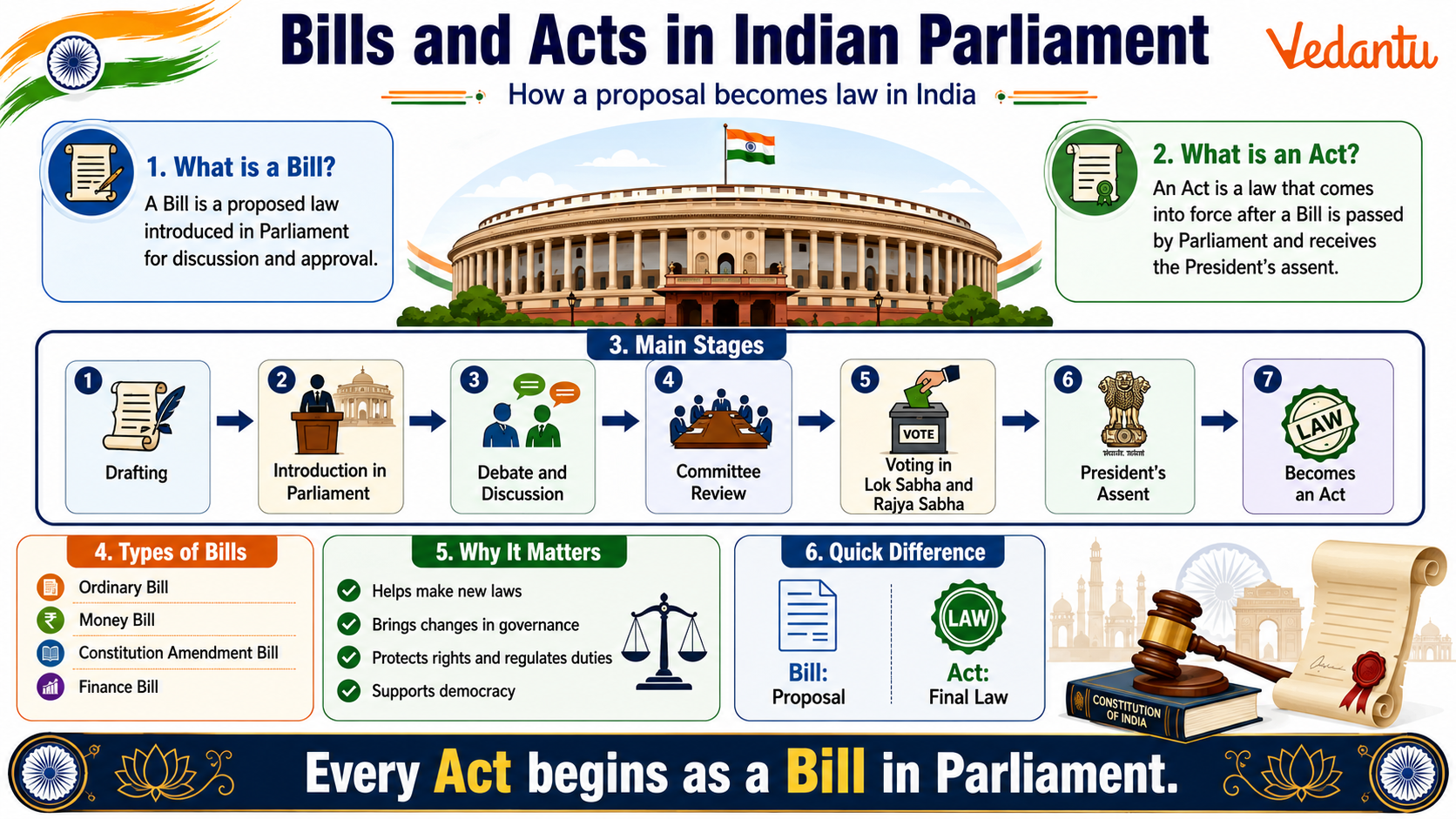
What is a Bill?
A Bill is a draft legislative proposal that is introduced in Parliament for discussion and approval. It may relate to new laws, amendment of existing laws, taxation, expenditure, or other public matters. Once a Bill is approved by both Houses of Parliament and receives the President’s assent, it becomes an Act and is enforceable as law.
Key Features of a Bill
- It is a proposal for legislation.
- It must pass through specific stages in Parliament.
- It requires approval from both Lok Sabha and Rajya Sabha, except in special cases.
- It becomes an Act only after receiving the President’s assent.
What is an Act?
An Act is a law that has been passed by Parliament and approved by the President. It has legal authority and is enforceable across India or in specified regions. Acts are published in the Gazette of India and come into force on the date specified within them.
Types of Bills in Indian Parliament
Bills introduced in the Indian Parliament are classified based on their subject matter and procedure. Understanding these categories is crucial for exams and conceptual clarity.
Major Types of Bills in Indian Parliament
| Type of Bill | Introduced In | Special Features |
|---|---|---|
| Ordinary Bill | Either House | Deals with general matters |
| Money Bill | Lok Sabha Only | Related to taxation and expenditure |
| Financial Bill | Lok Sabha | Includes financial provisions |
| Constitution Amendment Bill | Either House | Amends provisions of the Constitution |
Each type of Bill follows a specific procedure laid down in the Constitution of India. For example, a Money Bill can only be introduced in the Lok Sabha with prior recommendation of the President, and the Rajya Sabha has limited powers regarding it.
Ordinary Bill
- Can be introduced in either House of Parliament.
- Requires simple majority for passage.
- In case of disagreement, a Joint Sitting may be called under Article 108.
Money Bill
- Defined under Article 110 of the Constitution.
- Can only be introduced in Lok Sabha.
- Speaker of Lok Sabha certifies it as a Money Bill.
- Rajya Sabha can only make recommendations within 14 days.
Financial Bill
Financial Bills are of two types. Financial Bill Category A contains provisions of a Money Bill along with other matters. Financial Bill Category B deals with expenditure from the Consolidated Fund of India. Both require the President’s recommendation before introduction.
Constitution Amendment Bill
- Governed by Article 368.
- Requires special majority in both Houses.
- Some amendments require ratification by at least half of the State Legislatures.
- No provision for Joint Sitting.
Procedure for Passing a Bill
The legislative process in Parliament involves several stages to ensure detailed discussion and scrutiny.
- First Reading - Introduction of the Bill.
- Second Reading - Detailed discussion, committee stage, and clause by clause consideration.
- Third Reading - Final discussion and voting.
- Passage in the other House.
- President’s Assent - Bill becomes an Act.
Role of the President in Legislative Process
- May give assent to the Bill.
- May withhold assent.
- May return a non Money Bill for reconsideration.
- Must give assent if the Bill is passed again by Parliament.
Difference Between Bill and Act
Bill vs Act
| Basis | Bill | Act |
|---|---|---|
| Meaning | Proposed law | Approved law |
| Status | Under consideration | Legally enforceable |
| Approval | Needs parliamentary approval | Approved by Parliament and President |
The main distinction lies in their legal status. A Bill is only a proposal, while an Act is a law in force. This difference is commonly asked in objective and descriptive examinations.
Importance of Bills and Acts
- Ensure democratic law making.
- Reflect the will of the people through their representatives.
- Provide legal framework for governance and administration.
- Help in implementing social, economic, and political reforms.
Preparation Tips for Competitive Exams
- Memorize Articles 107 to 111 and Article 368 of the Constitution.
- Understand differences between Money Bill, Financial Bill, and Ordinary Bill.
- Practice previous year questions related to legislative procedure.
- Focus on recent important Acts passed by Parliament.
Bills and Acts in the Indian Parliament are central to the functioning of Indian democracy. A clear understanding of their types, procedures, and constitutional provisions helps students build a strong foundation in Indian Polity. Mastery of this topic ensures better performance in competitive examinations and enhances awareness of how laws are made in India.
FAQs on Bills & Acts in the Indian Parliament: How Laws Are Made
1. What is a Bill in the Indian Parliament?
A Bill is a draft proposal for a new law or amendment introduced in the Indian Parliament. • It is the first stage of the law-making process in India. • A Bill can be introduced in either the Lok Sabha or Rajya Sabha (except Money Bills). • After approval by both Houses and the President of India, it becomes an Act of Parliament. • Keywords: legislation process, draft law, parliamentary procedure, how a law is made in India.
2. What is the difference between a Bill and an Act?
The key difference is that a Bill is a proposed law, while an Act is an approved and enforceable law. • A Bill is debated and voted on in Parliament. • Once passed by both Houses and signed by the President, it becomes an Act. • Example: Right to Information Bill became the Right to Information Act, 2005. • Keywords: Bill vs Act, difference between law and bill, parliamentary approval.
3. What are the different types of Bills in the Indian Parliament?
There are several types of Bills in Indian Parliament based on their purpose and introduction. • Ordinary Bill – deals with general matters. • Money Bill – related to taxation, government spending (Article 110). • Financial Bill – includes financial matters but broader than Money Bill. • Constitutional Amendment Bill – amends the Constitution (Article 368). • Private Member’s Bill – introduced by MPs who are not ministers. • Keywords: types of bills, Article 110, Article 368, legislative categories.
4. How does a Bill become an Act in India?
A Bill becomes an Act after completing all stages of the legislative process in Parliament. • First Reading – Introduction of the Bill. • Second Reading – Detailed discussion and committee review. • Third Reading – Final voting. • Passage in both Houses (Lok Sabha and Rajya Sabha). • Assent by the President of India. • Keywords: stages of law making, parliamentary readings, presidential assent.
5. What is a Money Bill and how is it different from an Ordinary Bill?
A Money Bill deals exclusively with taxation and government expenditure under Article 110 of the Constitution. • It can be introduced only in the Lok Sabha. • It requires prior recommendation of the President. • The Rajya Sabha can only suggest amendments within 14 days. • The Speaker of Lok Sabha decides whether a Bill is a Money Bill. • Keywords: Money Bill features, taxation law, budget bill, financial legislation.
6. What is a Private Member’s Bill?
A Private Member’s Bill is introduced by any Member of Parliament who is not a minister. • It reflects individual MPs’ proposals on public issues. • It is usually introduced on Fridays. • Very few Private Member’s Bills have been passed in Indian history. • Keywords: non-government bill, MP proposal, parliamentary initiatives, legislative reforms.
7. What role does the President play in passing a Bill?
The President of India plays a crucial constitutional role by granting assent to a Bill. • The President can give assent, withhold assent, or return a non-Money Bill for reconsideration. • Without presidential assent, a Bill cannot become an Act. • This power ensures constitutional checks and balances. • Keywords: presidential assent, veto power, constitutional authority, approval of laws.
8. What is a Constitutional Amendment Bill?
A Constitutional Amendment Bill is introduced to amend provisions of the Indian Constitution under Article 368. • It requires a special majority in both Houses. • Some amendments also need ratification by at least half of the State Legislatures. • Example: 101st Constitutional Amendment Act (GST). • Keywords: amendment procedure, special majority, constitutional change, Article 368 process.
9. Can a Bill be rejected in the Indian Parliament?
Yes, a Bill can be rejected at various stages of the parliamentary process. • It may fail to secure majority support in either House. • The President may withhold assent. • A Bill may lapse if the Lok Sabha is dissolved (except certain cases). • Keywords: bill rejection, lapse of bill, parliamentary voting, legislative failure.
10. What happens if there is a disagreement between Lok Sabha and Rajya Sabha over a Bill?
If both Houses disagree on an Ordinary Bill, a Joint Sitting of Parliament may be called under Article 108. • The joint sitting is presided over by the Speaker of Lok Sabha. • Decisions are made by majority vote of members present. • Joint sittings are rare in Indian parliamentary history. • Keywords: deadlock in Parliament, Article 108, joint session, legislative dispute resolution.
