






Causes and Consequences of the Three Panipat Wars
The Battles of Panipat are three major battles fought in 1526, 1556, and 1761 at Panipat in present-day Haryana, India. These battles played a crucial role in shaping the political future of India. Each battle marked a turning point in Indian history by deciding the fate of ruling powers such as the Delhi Sultanate, the Mughal Empire, and the Maratha Confederacy. Due to its strategic location near Delhi, Panipat became a preferred battleground for armies seeking control over North India. The Battles of Panipat are important topics in General Knowledge and competitive exams because they significantly influenced the course of medieval and early modern Indian history.
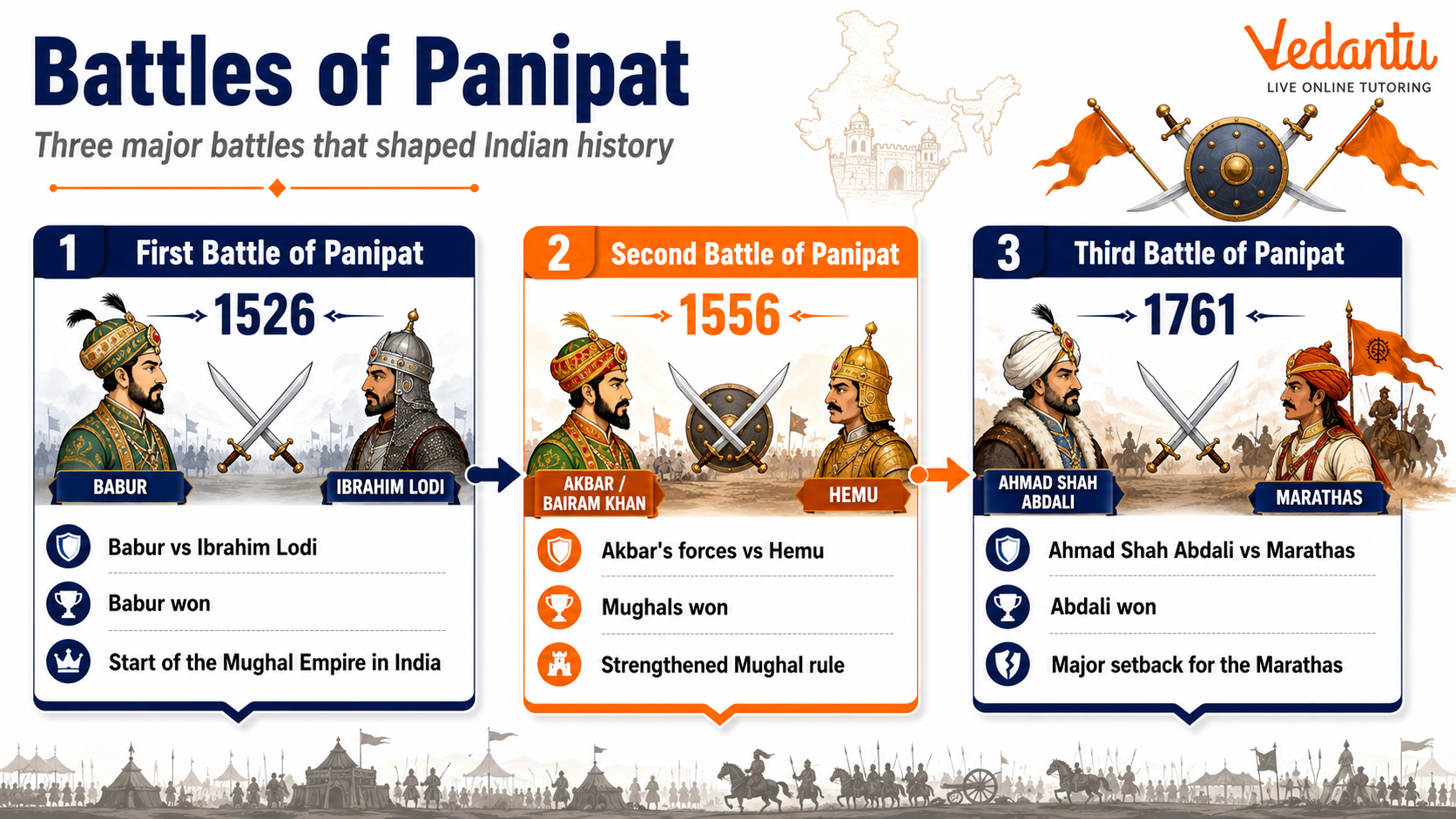
Overview of the Three Battles of Panipat
Summary of the Battles of Panipat
| Battle | Year | Main Contenders and Result |
|---|---|---|
| First Battle of Panipat | 1526 | Babur defeated Ibrahim Lodi and established the Mughal Empire |
| Second Battle of Panipat | 1556 | Akbar defeated Hemu and restored Mughal rule |
| Third Battle of Panipat | 1761 | Ahmad Shah Abdali defeated the Marathas |
These three battles collectively determined who would control North India at different points in history. Each battle had long-lasting political and social consequences.
First Battle of Panipat - 1526
Background
The First Battle of Panipat was fought on 21 April 1526 between Babur, the ruler of Kabul, and Ibrahim Lodi, the Sultan of Delhi. Ibrahim Lodi faced internal opposition from Afghan nobles, which weakened his position. Babur saw this as an opportunity to invade India and expand his empire.
Key Features
- Introduction of gunpowder and field artillery by Babur
- Use of Tulughma strategy and defensive formations
- Death of Ibrahim Lodi on the battlefield
Significance
The victory of Babur led to the establishment of the Mughal Empire in India. It marked the end of the Delhi Sultanate and introduced new military technologies in Indian warfare.
Second Battle of Panipat - 1556
Background
The Second Battle of Panipat was fought on 5 November 1556 between the Mughal forces led by Akbar and Bairam Khan, and Hemu, the Hindu general of Adil Shah Suri. After Humayun's death, Hemu captured Delhi and declared himself king.
Key Features
- Akbar was only 13 years old at the time
- Bairam Khan acted as regent and commander
- Hemu was injured and captured during the battle
Significance
This battle restored Mughal authority in North India and laid the foundation for Akbar's long and successful reign. It ensured the continuation of the Mughal dynasty in India.
Third Battle of Panipat - 1761
Background
The Third Battle of Panipat was fought on 14 January 1761 between the Maratha Confederacy and Ahmad Shah Abdali, also known as Ahmad Shah Durrani, the ruler of Afghanistan. The Marathas had expanded rapidly in North India and aimed to control Delhi.
Key Features
- One of the largest battles of the 18th century
- Massive casualties on both sides
- Defeat of the Maratha forces
Significance
The defeat weakened the Maratha power in North India and created a political vacuum. This situation later helped the British East India Company to expand its control over India.
Why Panipat Was a Repeated Battleground
Panipat was strategically located near Delhi, the political center of North India. Armies coming from the northwest had to pass through this region before reaching Delhi. The open plains of Panipat were suitable for large-scale warfare, making it an ideal location for decisive battles.
- Proximity to Delhi
- Open flat terrain suitable for cavalry and artillery
- Strategic position on invasion routes from Central Asia
Long Term Impact of the Battles of Panipat
- Establishment and consolidation of the Mughal Empire
- Shift in power dynamics in North India
- Weakening of regional powers such as the Marathas
- Indirect rise of British influence after 1761
Important Facts for Competitive Exams
- First Battle - 1526 - Babur vs Ibrahim Lodi
- Second Battle - 1556 - Akbar vs Hemu
- Third Battle - 1761 - Ahmad Shah Abdali vs Marathas
- Panipat is located in present-day Haryana
- The First Battle marked the beginning of Mughal rule in India
Conclusion
The Battles of Panipat were decisive events that reshaped Indian history across three centuries. Each battle changed the ruling power of North India and influenced the political structure of the subcontinent. Understanding these battles helps students grasp the transition from the Delhi Sultanate to the Mughal Empire and later the decline of regional powers before British dominance. Due to their historical importance, the Battles of Panipat remain a vital topic in General Knowledge and competitive examinations.
FAQs on Battles of Panipat in Indian History Explained
1. What were the Battles of Panipat?
The Battles of Panipat were three major wars fought in 1526, 1556, and 1761 at Panipat (Haryana) that shaped the course of Indian history. • First Battle (1526) – Babur defeated Ibrahim Lodi and founded the Mughal Empire. • Second Battle (1556) – Akbar defeated Hemu, restoring Mughal rule. • Third Battle (1761) – Ahmad Shah Abdali defeated the Marathas, altering power dynamics in India. These battles are key topics in GK, UPSC, SSC, and history exams.
2. Why was Panipat chosen as the battlefield?
Panipat was strategically important because it served as the gateway to Delhi and northern India. • Located on the route from Afghanistan to Delhi. • Open plains suitable for large armies and cavalry warfare. • Close to political centers like Delhi and Agra. Due to its geography and military advantage, Panipat became a repeated site of decisive medieval battles.
3. What happened in the First Battle of Panipat (1526)?
The First Battle of Panipat (1526) marked the beginning of the Mughal Empire in India. • Fought between Babur and Ibrahim Lodi. • Babur used artillery and gunpowder, a new military tactic in India. • Ibrahim Lodi was killed in battle. This victory established Mughal rule and ended the Delhi Sultanate under the Lodis.
4. What was the significance of the Second Battle of Panipat (1556)?
The Second Battle of Panipat (1556) secured the Mughal throne for Akbar. • Fought between Akbar’s forces (led by Bairam Khan) and Hemu. • Hemu was defeated and captured. • Strengthened Mughal authority in North India. This battle ensured the consolidation of the Mughal Empire during Akbar’s reign.
5. What caused the Third Battle of Panipat (1761)?
The Third Battle of Panipat (1761) was fought due to the power struggle between the Marathas and Ahmad Shah Abdali (Durrani). • Marathas aimed to expand influence in North India. • Abdali sought to curb Maratha power and protect Afghan interests. • Political instability after Mughal decline fueled conflict. This battle is often cited as a turning point in 18th-century Indian politics.
6. What were the consequences of the Third Battle of Panipat?
The Third Battle of Panipat weakened the Maratha Empire and reshaped Indian power politics. • Massive loss of Maratha soldiers and leaders. • Temporary Afghan dominance in North India. • Created a power vacuum later filled by the British East India Company. It significantly impacted the decline of Indian regional powers before British expansion.
7. Who were the key leaders in the Battles of Panipat?
Several prominent rulers and generals participated in the Battles of Panipat. • Babur – Founder of the Mughal Empire. • Ibrahim Lodi – Last Lodi Sultan. • Akbar and Bairam Khan – Mughal leaders in 1556. • Hemu – Hindu king who challenged Mughal rule. • Ahmad Shah Abdali – Afghan ruler. • Sadashivrao Bhau – Maratha commander. These names are frequently asked in GK and competitive exams.
8. How did gunpowder impact the First Battle of Panipat?
Gunpowder and artillery gave Babur a decisive advantage in the First Battle of Panipat. • Use of cannons and matchlock guns. • Introduced Tulughma and Araba tactics. • Created fear and confusion in Lodi’s army. This battle marked the beginning of organized gunpowder warfare in medieval India.
9. Why are the Battles of Panipat important in Indian history?
The Battles of Panipat were turning points that changed rulers and empires in India. • Led to the rise of the Mughal Empire. • Confirmed Akbar’s rule and stability. • Weakened the Marathas and enabled British expansion. These wars significantly influenced political transitions, making them crucial for history and GK studies.
10. How many Battles of Panipat were fought and when?
Three Battles of Panipat were fought in the 16th and 18th centuries. • First Battle – 21 April 1526. • Second Battle – 5 November 1556. • Third Battle – 14 January 1761. These dates are frequently asked in competitive exams like UPSC, SSC, NDA, and state PSC.
