






Which Planet Is the Hottest and Which Is the Coldest in the Solar System?
The Solar System is home to eight planets, each with unique physical and atmospheric conditions. One of the most interesting aspects of these planets is their temperature variation. Some planets experience extreme heat, while others remain intensely cold due to their distance from the Sun and atmospheric composition. Understanding the hottest and coldest planets in the Solar System is important for general knowledge, competitive exams, and astronomy studies. This topic helps students understand planetary science, greenhouse effect, and how distance from the Sun influences temperature.
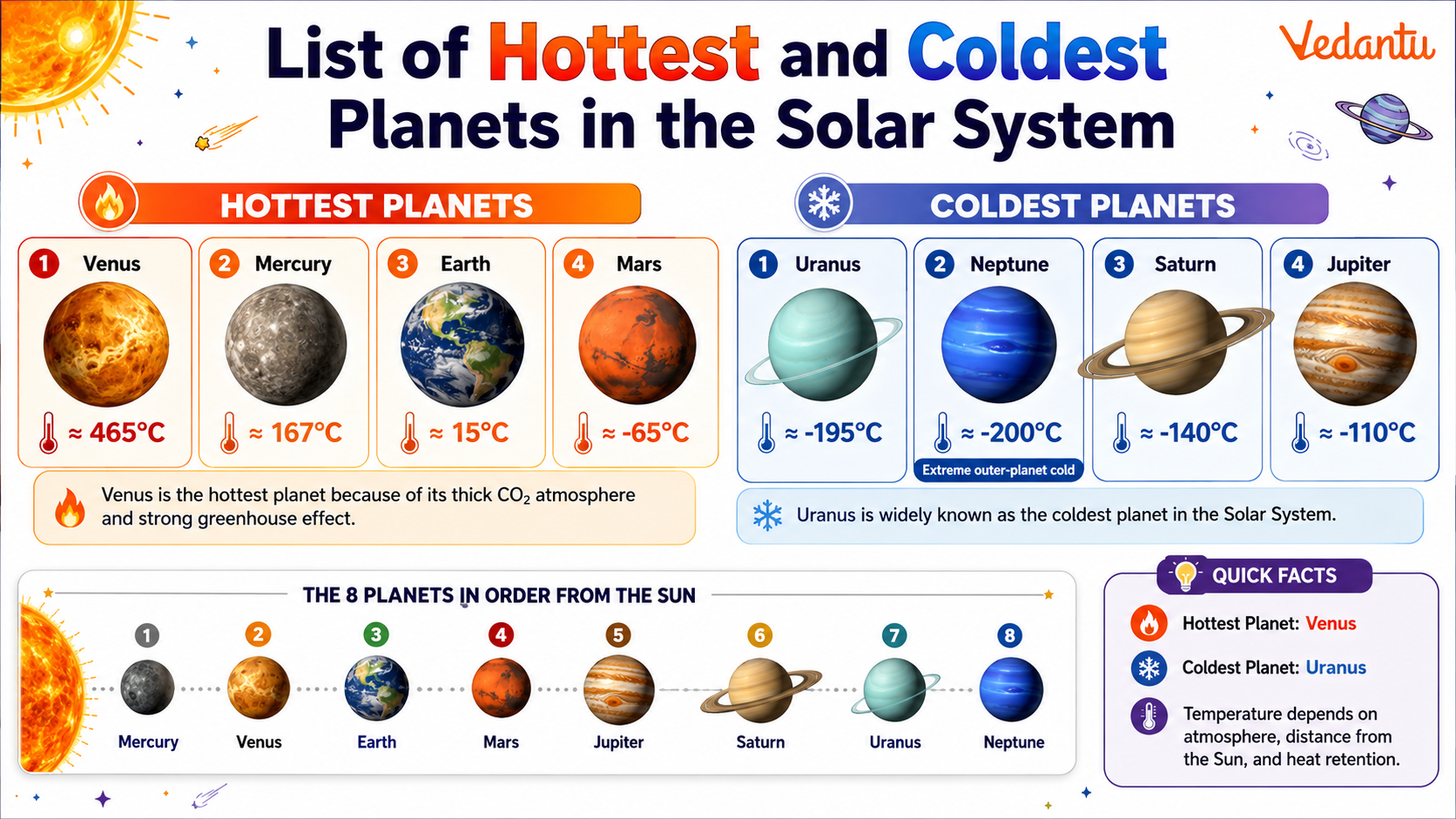
Factors Affecting Planetary Temperature
The temperature of a planet does not depend only on its distance from the Sun. Several factors influence how hot or cold a planet becomes. These factors explain why Venus is hotter than Mercury even though Mercury is closer to the Sun.
- Distance from the Sun - Planets closer to the Sun generally receive more solar radiation.
- Atmosphere composition - Thick atmospheres trap heat through the greenhouse effect.
- Surface properties - Rocky, gaseous, or icy surfaces absorb and reflect heat differently.
- Rotation and axial tilt - These affect how heat is distributed across the planet.
List Of Hottest And Coldest Planets In The Solar System
| Planet | Average Temperature | Category |
|---|---|---|
| Venus | About 465°C | Hottest Planet |
| Mercury | Day: 430°C Night: -180°C | Extreme Temperature Variation |
| Earth | About 15°C | Moderate |
| Mars | About -60°C | Cold |
| Jupiter | About -110°C | Very Cold |
| Saturn | About -140°C | Very Cold |
| Uranus | About -195°C | Coldest Planet |
| Neptune | About -200°C | Extremely Cold |
Although Neptune is farther from the Sun, Uranus records the lowest atmospheric temperature in the Solar System, making it the coldest planet. Venus, due to its dense carbon dioxide atmosphere, is the hottest planet despite not being the closest to the Sun.
Why Is Venus The Hottest Planet?
Venus is the second planet from the Sun, yet it is the hottest planet in the Solar System. Its extreme heat is due to a runaway greenhouse effect.
- Thick atmosphere made mostly of carbon dioxide.
- Dense cloud cover traps heat efficiently.
- Surface pressure about 90 times that of Earth.
- Very slow rotation, causing prolonged heating.
Due to these factors, Venus maintains an average temperature of around 465°C, hot enough to melt lead.
Why Is Uranus The Coldest Planet?
Uranus holds the record for the coldest atmospheric temperature among all planets in the Solar System. Even though Neptune is farther away from the Sun, Uranus lacks sufficient internal heat.
- Average temperature drops to about -195°C.
- Minimal internal heat emission compared to other gas giants.
- Large distance from the Sun reduces solar radiation.
- Atmosphere composed mainly of hydrogen, helium, and methane.
These factors combine to make Uranus the coldest planet in terms of recorded atmospheric temperature.
Temperature Comparison - Inner Vs Outer Planets
The inner planets - Mercury, Venus, Earth, and Mars - are generally warmer because they are closer to the Sun. The outer planets - Jupiter, Saturn, Uranus, and Neptune - are much colder due to their greater distance from the Sun and gaseous composition.
- Inner planets are rocky and have solid surfaces.
- Outer planets are gas or ice giants with thick atmospheres.
- Temperature decreases as distance from the Sun increases.
- Greenhouse effect can override distance factor, as seen on Venus.
Key Points For Competitive Exams
- Venus is the hottest planet in the Solar System.
- Uranus is the coldest planet based on minimum atmospheric temperature.
- Mercury has the highest temperature variation between day and night.
- Neptune is the farthest planet from the Sun.
- Greenhouse effect plays a major role in planetary temperature.
Conclusion
The study of the hottest and coldest planets in the Solar System highlights the importance of atmospheric composition, greenhouse effect, and solar distance in determining planetary temperature. Venus stands as the hottest planet due to its dense carbon dioxide atmosphere, while Uranus records the coldest temperatures among all planets. Understanding these differences strengthens foundational knowledge in astronomy and helps students prepare effectively for school exams and competitive examinations.
FAQs on List of the Hottest and Coldest Planets in Our Solar System Explained for Students
1. Which is the hottest planet in the Solar System?
Venus is the hottest planet in the Solar System due to its extreme greenhouse effect and thick atmosphere.
- Average surface temperature: about 465°C (869°F)
- Thick atmosphere rich in carbon dioxide traps heat
- Hotter than Mercury despite being farther from the Sun
- Often asked in GK, competitive exams, and astronomy quizzes about hottest planet
2. Why is Venus hotter than Mercury?
Venus is hotter than Mercury because of its powerful greenhouse effect that traps solar heat.
- Dense CO₂ atmosphere prevents heat from escaping
- Thick clouds of sulfuric acid increase heat retention
- Mercury lacks a strong atmosphere, so heat escapes quickly
- Common People Also Ask (PAA): Why is Mercury not the hottest planet?
3. Which is the coldest planet in the Solar System?
Uranus is the coldest planet in the Solar System with the lowest recorded atmospheric temperature.
- Minimum temperature: -224°C (-371°F)
- Classified as an ice giant
- Has very little internal heat compared to other giant planets
- Frequently searched as coldest planet in the Solar System
4. Why is Uranus colder than Neptune?
Uranus is colder than Neptune because it emits very little internal heat from its core.
- Weak internal heat source
- Extremely cold upper atmosphere
- Neptune generates more internal energy, keeping it slightly warmer
- Common PAS query: difference between Uranus and Neptune temperature
5. What are the top 3 hottest planets in the Solar System?
The top three hottest planets are Venus, Mercury, and Earth based on average surface temperature.
1. Venus – ~465°C
2. Mercury – up to 430°C (daytime)
3. Earth – average ~15°C
- Important for GK topics on planet temperature ranking
6. What are the coldest planets after Uranus?
After Uranus, Neptune and Saturn are among the coldest planets in the Solar System.
- Neptune – average ~-214°C
- Saturn – average ~-178°C
- Both are classified as gas/ice giants
- Often searched as temperature of outer planets
7. How does distance from the Sun affect a planet’s temperature?
A planet’s temperature generally decreases with increasing distance from the Sun, but atmosphere also plays a major role.
- Inner planets are usually hotter
- Outer planets receive less solar radiation
- Atmospheric composition can increase or reduce heat
- Example: Venus vs Mercury temperature difference
8. Is Mercury hot or cold overall?
Mercury experiences both extreme heat and extreme cold due to its thin atmosphere.
- Daytime temperature: up to 430°C
- Nighttime temperature: down to -180°C
- No significant atmosphere to retain heat
- Frequently asked in GK: temperature range of Mercury
9. Which planets are called ice giants and are they cold?
Uranus and Neptune are called ice giants and are extremely cold planets.
- Composed mainly of water, ammonia, and methane ices
- Located in the outer Solar System
- Very low atmospheric temperatures
- Common exam question: difference between gas giants and ice giants
10. Why are gas giants colder than inner rocky planets?
Gas giants are colder because they are farther from the Sun and receive less solar energy.
- Located beyond the asteroid belt
- Lower exposure to sunlight and heat
- Thick atmospheres but minimal surface heating
- Related searches: inner vs outer planets temperature comparison
