






Complete list of 24 Jain Tirthankaras in chronological order with symbols
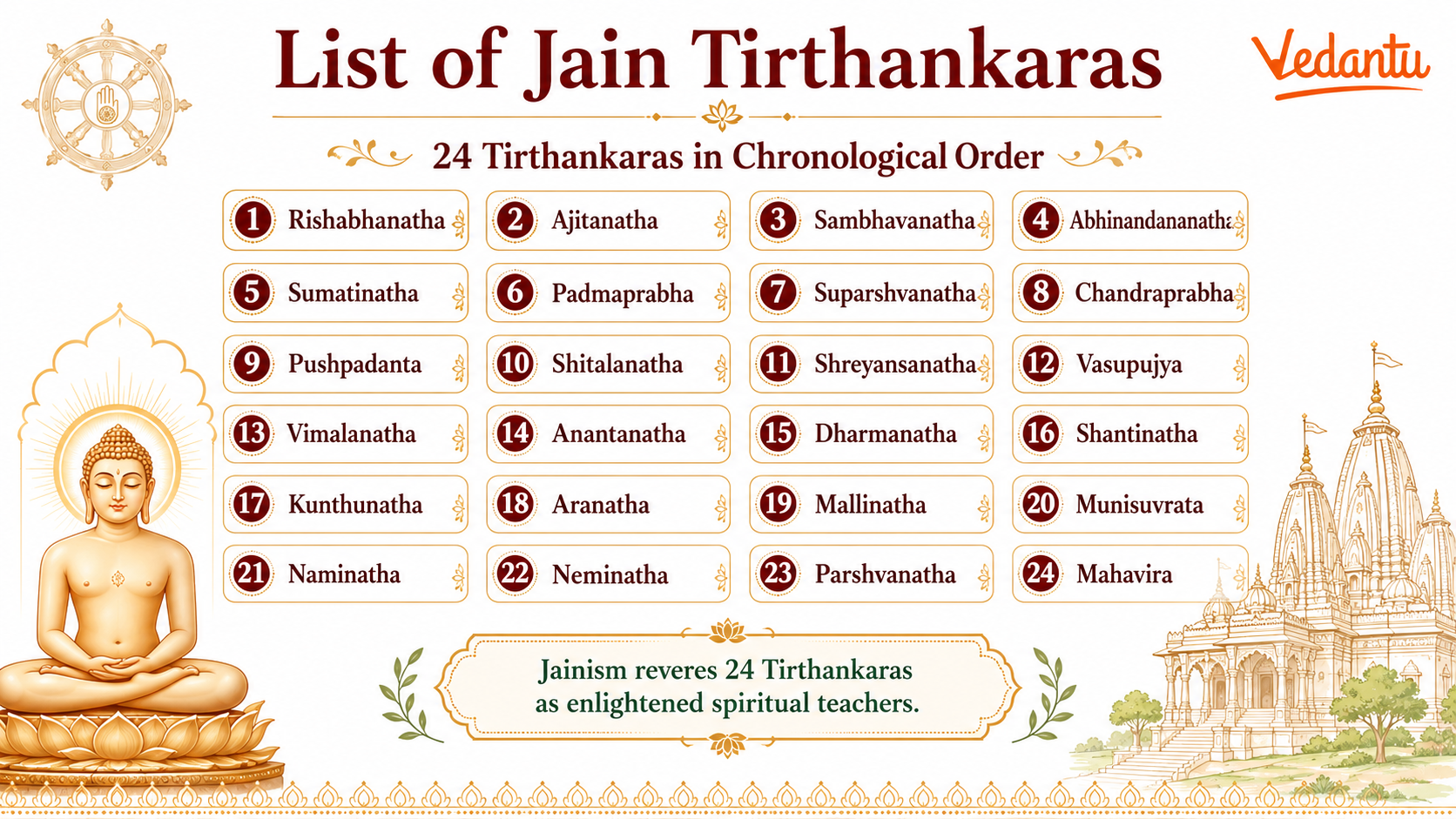
The List of Jain Tirthankaras refers to the 24 enlightened spiritual teachers of Jainism who revived and re-established the path of righteousness in different eras. The word Tirthankara means "ford-maker" or one who shows the path to liberation from the cycle of birth and death. Jain tradition believes that these 24 Tirthankaras attained Kevala Jnana - absolute knowledge - and taught the principles of non-violence, truth, non-attachment, and self-discipline. Understanding the Tirthankaras is important for students of Indian history, religion, and general knowledge, especially for competitive exams.
Who is a Tirthankara?
A Tirthankara is a spiritual teacher who conquers inner passions and attains supreme knowledge. After attaining enlightenment, they guide others toward Moksha - liberation from the cycle of rebirth. Jainism believes that 24 such Tirthankaras appeared in the current time cycle.
- They achieve Kevala Jnana or infinite knowledge.
- They establish the fourfold Jain Sangha - monks, nuns, laymen, and laywomen.
- They preach the path of Ahimsa - non-violence.
- They are free from attachment, anger, greed, and ego.
List of 24 Jain Tirthankaras
| No. | Name of Tirthankara | Symbol |
|---|---|---|
| 1 | Rishabhanatha | Bull |
| 2 | Ajitanatha | Elephant |
| 3 | Sambhavanatha | Horse |
| 4 | Abhinandananatha | Monkey |
| 5 | Sumatinatha | Curlew |
| 6 | Padmaprabha | Lotus |
| 7 | Suparshvanatha | Swastika |
| 8 | Chandraprabha | Crescent Moon |
| 9 | Pushpadanta | Crocodile |
| 10 | Shitalanatha | Shrivatsa |
| 11 | Shreyansanatha | Rhinoceros |
| 12 | Vasupujya | Buffalo |
| 13 | Vimalanatha | Boar |
| 14 | Anantanatha | Falcon |
| 15 | Dharmanatha | Vajra |
| 16 | Shantinatha | Deer |
| 17 | Kunthunatha | Goat |
| 18 | Aranatha | Fish |
| 19 | Mallinatha | Kalasha |
| 20 | Munisuvrata | Tortoise |
| 21 | Naminatha | Blue Lotus |
| 22 | Neminatha | Conch |
| 23 | Parshvanatha | Serpent |
| 24 | Mahavira | Lion |
The above table lists all 24 Jain Tirthankaras along with their traditional symbols. These symbols are important in Jain iconography and help devotees identify the Tirthankaras in temples and scriptures.
Important Tirthankaras in History
Rishabhanatha - The First Tirthankara
Rishabhanatha, also known as Adinatha, is regarded as the founder of Jainism in the present time cycle. He is believed to have introduced agriculture, crafts, and social institutions to humanity. His symbol is the bull.
Parshvanatha - The 23rd Tirthankara
Parshvanatha lived around the 8th century BCE and is considered a historical figure. He preached four main vows - non-violence, truth, non-stealing, and non-possession. His symbol is the serpent.
Mahavira - The 24th Tirthankara
Mahavira, born in 599 BCE according to Jain tradition, was the last Tirthankara. He expanded the teachings of Parshvanatha and emphasized five great vows - Ahimsa, Satya, Asteya, Brahmacharya, and Aparigraha. He attained Nirvana at Pavapuri.
Common Features of the 24 Tirthankaras
- All attained enlightenment through meditation and self-discipline.
- They taught the path of non-violence and ethical living.
- Each Tirthankara has a unique symbol for identification.
- They are depicted in meditative posture in Jain temples.
- They established moral and spiritual codes for followers.
Significance of the Tirthankaras in Jainism
The 24 Tirthankaras form the spiritual foundation of Jainism. Their teachings guide millions of followers in leading a life based on compassion, discipline, and truth. For students, understanding the sequence, symbols, and contributions of the Tirthankaras is essential for exams related to Indian history, culture, and religion.
The List of Jain Tirthankaras is not only important from a religious perspective but also from a cultural and historical viewpoint. Their principles of non-violence and ethical conduct continue to influence Indian philosophy and global peace movements today.
FAQs on List of Jain Tirthankaras with Names and Symbols Explained
1. Who are the 24 Tirthankaras in Jainism?
The 24 Tirthankaras are spiritual teachers of Jainism who attained enlightenment and guided humanity toward liberation (moksha).
• The first Tirthankara: Rishabhanatha (Adinath)
• The 23rd Tirthankara: Parshvanatha
• The 24th and last Tirthankara: Mahavira
• They are also called Jinas (conquerors) who showed the path of ahimsa (non-violence), truth, and renunciation.
• Their lives are central to Jain scriptures, Jain philosophy, and Jain religious practices.
2. Who was the first Tirthankara of Jainism?
The first Tirthankara of Jainism was Rishabhanatha, also known as Adinath.
• He is regarded as the founder of the Jain tradition.
• Believed to have lived in prehistoric times.
• Introduced basic social systems like agriculture, arts, and crafts.
• His symbol is the Bull, often seen in Jain iconography.
3. Who was the last Tirthankara of Jainism?
The last and 24th Tirthankara of Jainism was Lord Mahavira.
• Born in 599 BCE (traditional belief) in Kundagrama, Bihar.
• Attained Kevala Jnana (omniscience) at the age of 42.
• Emphasized the principles of Ahimsa, Aparigraha, Satya, Asteya, and Brahmacharya.
• His teachings form the foundation of modern Jainism.
4. How many Tirthankaras are there in Jainism?
There are 24 Tirthankaras in Jainism in the current time cycle.
• They appear in every half-cycle of time according to Jain cosmology.
• Each Tirthankara attains enlightenment and teaches the path to moksha (liberation).
• Important ones include Rishabhanatha, Parshvanatha, and Mahavira.
• Their lives are described in Jain texts like the Kalpa Sutra.
5. What is the role of Tirthankaras in Jainism?
The Tirthankaras are enlightened spiritual teachers who show the path to liberation in Jainism.
• They establish the fourfold Jain Sangha (monks, nuns, laymen, laywomen).
• Preach the doctrine of non-violence (Ahimsa) and self-discipline.
• Attain Kevala Jnana and become free from the cycle of birth and death.
• Serve as role models for ethical and spiritual living.
6. Who was the 23rd Tirthankara of Jainism?
The 23rd Tirthankara of Jainism was Parshvanatha.
• Lived around the 8th century BCE (historically recognized figure).
• Preached four main vows: Ahimsa, Satya, Asteya, and Aparigraha.
• His symbol is the Serpent.
• He greatly influenced the teachings later systematized by Mahavira.
7. What are the symbols of the 24 Tirthankaras?
Each of the 24 Tirthankaras has a unique identifying symbol known as a Lanchhana.
• Rishabhanatha – Bull
• Ajitanatha – Elephant
• Parshvanatha – Serpent
• Mahavira – Lion
• These symbols help devotees identify Tirthankara idols in Jain temples and scriptures.
8. What is the difference between Tirthankara and Jina?
A Tirthankara is a type of Jina who establishes the Jain religious order.
• Jina means “conqueror” of inner passions like anger and greed.
• Tirthankara means “ford-maker” who shows the path across the cycle of rebirth.
• All Tirthankaras are Jinas, but not all Jinas are Tirthankaras.
• The term is central to Jain philosophy and spiritual liberation.
9. In which texts are the lives of Tirthankaras mentioned?
The lives of the Tirthankaras are described in important Jain scriptures.
• Kalpa Sutra – Details lives of Mahavira and other Tirthankaras.
• Agamas – Sacred canonical texts of Jainism.
• Jain Puranas – Narratives about Jain cosmology and spiritual leaders.
• These texts are significant for Jain rituals, festivals, and religious teachings.
10. Why are the 24 Tirthankaras important for competitive exams and GK?
The list of 24 Tirthankaras is important for General Knowledge (GK) and competitive exams due to its relevance in Indian history and religion.
• Frequently asked in UPSC, SSC, State PSC, and school exams.
• Important for topics like Ancient Indian History and Jainism.
• Key figures include Rishabhanatha, Parshvanatha, and Mahavira.
• Understanding their teachings helps in comparative studies of Buddhism and Jainism.
