






Why Banking Mergers in India Happen and How They Affect Customers and the Economy
Banking Merger in India refers to the consolidation of two or more banks into a single entity to improve efficiency, strengthen financial stability, and enhance competitiveness in the banking sector. In recent years, India has witnessed several major mergers, especially among Public Sector Banks (PSBs), as part of the government's banking reforms. These mergers aim to create stronger banks with better capital base, improved risk management, and wider global presence. Banking mergers are an important topic for students, competitive exam aspirants, and general awareness learners.
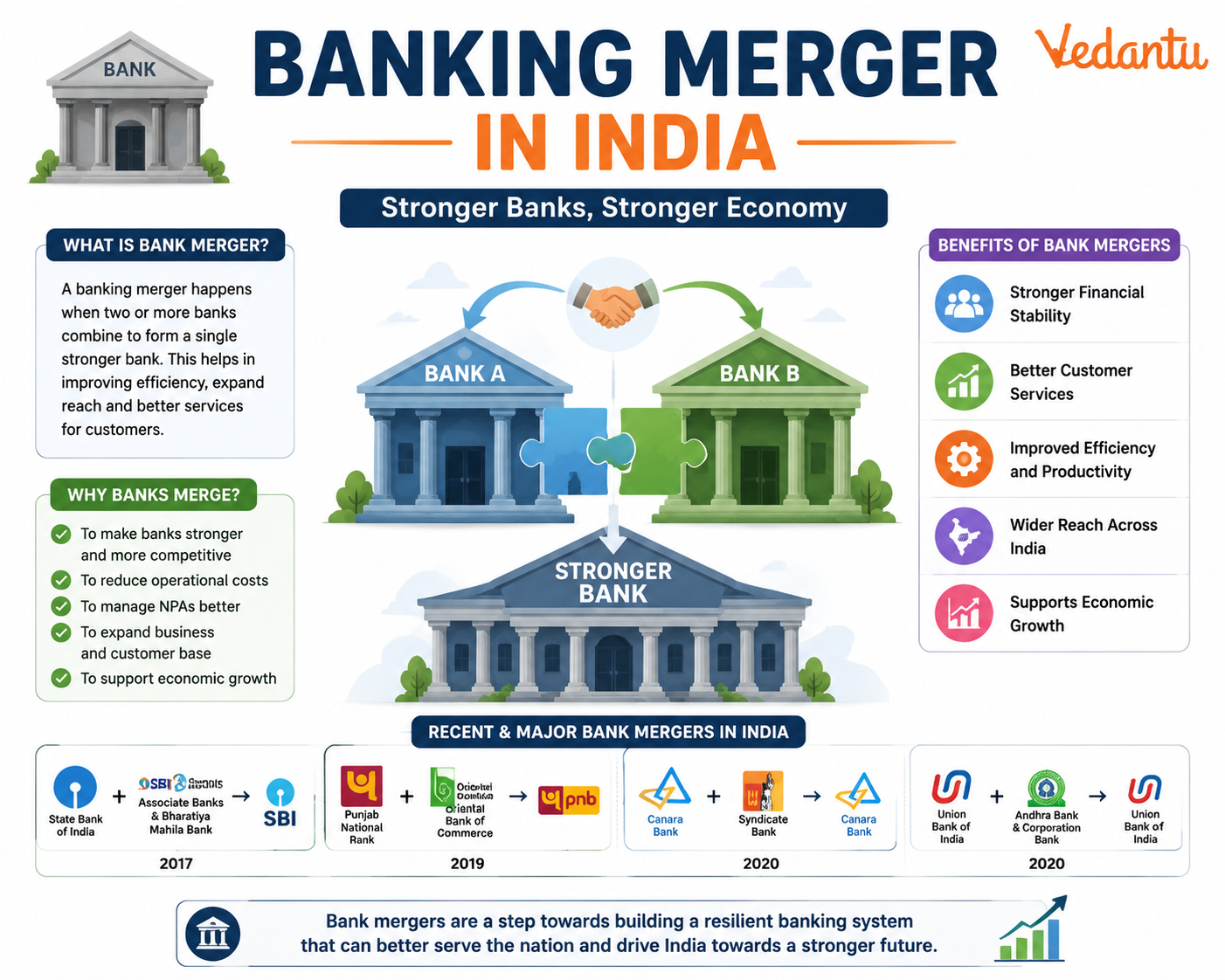
Meaning of Banking Merger
A banking merger occurs when two or more banks combine to form a single banking institution. After the merger, the merged entity operates under one management structure and brand name. The objective is to improve operational efficiency, reduce duplication of services, and create a financially stronger bank.
- Enhances capital strength and lending capacity
- Reduces operational costs
- Improves risk management
- Strengthens global competitiveness
Types of Banking Mergers in India
1. Voluntary Merger
In a voluntary merger, banks mutually agree to merge for strategic benefits such as expansion and profitability.
2. Compulsory Merger
In a compulsory merger, the Reserve Bank of India (RBI) or the Government of India forces the merger to protect depositors and maintain financial stability when a bank faces financial crisis.
Major Banking Mergers in India
Important Bank Mergers in India
| Year | Merger Details | Resulting Bank |
|---|---|---|
| 2017 | State Bank of India merged with its 5 associate banks and Bharatiya Mahila Bank | State Bank of India |
| 2019 | Bank of Baroda merged with Vijaya Bank and Dena Bank | Bank of Baroda |
| 2020 | Punjab National Bank merged with Oriental Bank of Commerce and United Bank of India | Punjab National Bank |
| 2020 | Canara Bank merged with Syndicate Bank | Canara Bank |
| 2020 | Union Bank of India merged with Andhra Bank and Corporation Bank | Union Bank of India |
| 2020 | Indian Bank merged with Allahabad Bank | Indian Bank |
These mergers reduced the number of Public Sector Banks in India significantly and created large banking entities with stronger financial positions.
Objectives of Banking Mergers
The Government of India and the RBI have promoted banking mergers to achieve several important goals in the financial sector.
- To create globally competitive banks
- To reduce Non Performing Assets (NPAs)
- To strengthen credit growth in the economy
- To improve operational efficiency and governance
- To ensure better customer service through integrated technology
Advantages of Banking Mergers
- Stronger capital base and increased lending power
- Better geographical reach and branch network
- Economies of scale
- Improved risk management system
- Enhanced ability to fund large infrastructure projects
Challenges and Disadvantages
- Short term operational disruptions
- Cultural and management integration issues
- Risk of job redundancies
- Temporary customer service challenges during transition
Role of RBI and Government
The Reserve Bank of India regulates and supervises banking mergers under the Banking Regulation Act, 1949. The Government of India plays a major role in merging Public Sector Banks by announcing consolidation policies and providing capital support. The objective is to maintain financial stability and protect depositors' interests.
Impact of Banking Mergers on Indian Economy
Banking mergers have strengthened the Indian banking system by creating fewer but stronger banks. Large banks are better equipped to support economic growth, infrastructure development, and international trade. Consolidation has also improved credit flow and enhanced the stability of the financial system.
Key Facts for Competitive Exams
- Major wave of PSB mergers took place in 2019 and 2020
- RBI regulates mergers under the Banking Regulation Act, 1949
- SBI merger in 2017 was one of the largest banking consolidations in India
- Objective was to create strong and globally competitive banks
Conclusion
Banking Merger in India is a significant reform aimed at strengthening the banking sector and supporting economic growth. By consolidating banks, the government has attempted to improve financial stability, increase efficiency, and enhance the global competitiveness of Indian banks. Understanding banking mergers is essential for students and competitive exam aspirants as it is frequently asked in General Knowledge, Banking, and Economy sections.
FAQs on Banking Mergers in India: Meaning, Reasons and Effects
1. What is a banking merger in India?
A banking merger in India refers to the consolidation of two or more banks into a single entity to strengthen the banking system.
• It combines assets, liabilities, and operations of merging banks.
• It aims to improve financial stability, efficiency, and profitability.
• It is regulated by the Reserve Bank of India (RBI) and the Government of India.
• It is often discussed in contexts like bank consolidation, public sector bank reforms, and banking sector restructuring.
2. Why are banks merged in India?
Banks are merged in India to create stronger and more competitive financial institutions.
• To reduce Non-Performing Assets (NPAs) and financial stress.
• To increase operational efficiency and reduce costs.
• To create globally competitive large public sector banks (PSBs).
• To improve credit growth and support the Indian economy.
• Frequently asked in exams under banking reforms and economic reforms in India.
3. Which was the largest banking merger in India?
The largest banking merger in India was the merger of State Bank of India (SBI) with its associate banks in 2017.
• SBI merged with 5 associate banks and Bharatiya Mahila Bank.
• It made SBI one of the top 50 global banks.
• It significantly expanded SBI’s customer base and branch network.
• This merger is a key topic in Indian banking history and SBI reforms.
4. What major public sector bank mergers took place in 2019–2020?
In 2019–2020, the Government of India announced mega mergers of public sector banks to reduce their number.
• Punjab National Bank merged with Oriental Bank of Commerce and United Bank of India.
• Canara Bank merged with Syndicate Bank.
• Union Bank of India merged with Andhra Bank and Corporation Bank.
• Indian Bank merged with Allahabad Bank.
• These are commonly asked in GK, UPSC, SSC, and banking exams.
5. What are the advantages of banking mergers in India?
Banking mergers offer several advantages for the financial system and customers.
• Stronger capital base and improved lending capacity.
• Better risk management and reduced NPAs.
• Wider branch network and digital banking services.
• Economies of scale and cost efficiency.
• Enhances India’s position in the global banking sector.
6. What are the disadvantages of banking mergers?
Despite benefits, banking mergers also have certain challenges.
• Risk of job losses and employee dissatisfaction.
• Integration issues in technology and operations.
• Temporary disruption in customer services.
• Cultural differences between merging banks.
• These concerns are often discussed under banking sector challenges and merger drawbacks.
7. How does RBI regulate bank mergers in India?
The Reserve Bank of India (RBI) plays a key regulatory role in bank mergers.
• Approves merger schemes under the Banking Regulation Act, 1949.
• Ensures protection of depositors’ interests.
• Monitors financial health before and after merger.
• Works with the Government in case of public sector bank consolidation.
• RBI guidelines are crucial in competitive exam preparation.
8. What is the impact of banking mergers on customers?
Banking mergers generally have a mixed but mostly positive impact on customers.
• Access to a larger ATM and branch network.
• Improved digital banking and financial services.
• Possible changes in account numbers or IFSC codes.
• Better loan and deposit products due to stronger capital base.
• Common query under effects of bank mergers on depositors.
9. How many public sector banks are there in India after recent mergers?
After the 2019–2020 mergers, the number of Public Sector Banks (PSBs) in India was reduced to 12.
• Earlier, there were 27 PSBs in 2017.
• Consolidation aimed at creating stronger and fewer banks.
• This reform is part of Indian banking sector reforms and financial consolidation.
• Frequently asked in GK and current affairs sections.
10. What is the difference between bank merger and bank acquisition?
A bank merger combines two banks into one entity, while a bank acquisition involves one bank taking over another.
• In a merger, both banks mutually agree to unite.
• In an acquisition, one bank absorbs the other.
• Mergers aim at mutual growth; acquisitions may occur due to financial weakness.
• Important concept under corporate restructuring, banking consolidation, and financial management.
