






Geography, History, and Importance of the Balochistan Region
Balochistan Province is the largest province of Pakistan by area and holds great geographical, economic, and strategic importance. Located in the southwestern part of the country, it shares borders with Iran and Afghanistan, as well as with the Arabian Sea. Despite being the largest province in terms of land area, it has the smallest population among Pakistan’s provinces. Balochistan is rich in natural resources, diverse cultures, and historical heritage, making it an important topic for General Knowledge, competitive exams, and academic studies.
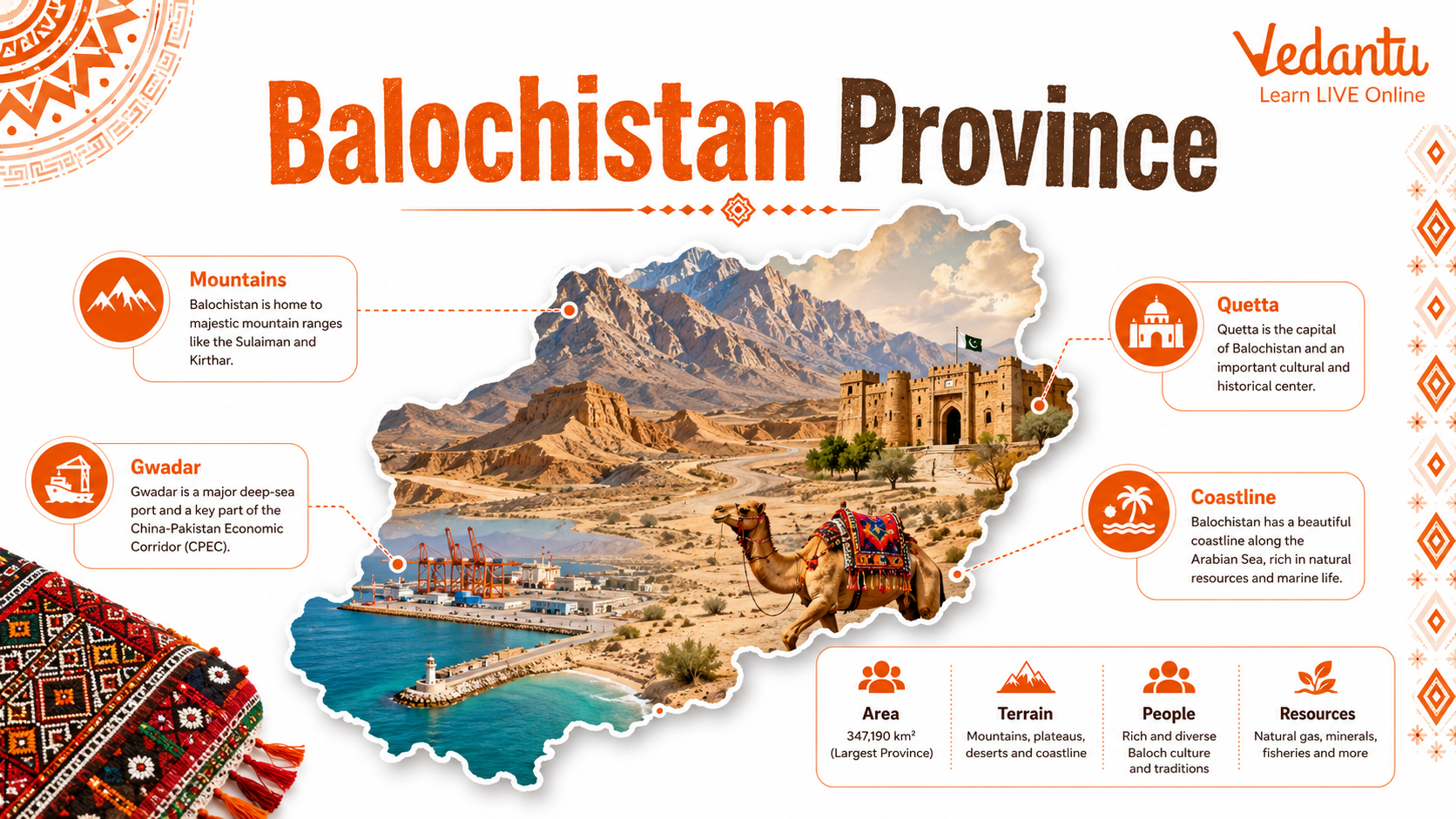
Overview of Balochistan Province
Balochistan covers nearly 44 percent of Pakistan’s total land area. The province is known for its rugged terrain, mountain ranges, deserts, and coastal belt. Quetta is the capital city and serves as the administrative and economic center of the province. Balochistan plays a key role in regional trade due to its strategic location near the Middle East and Central Asia.
Basic Facts about Balochistan
| Feature | Details | Remarks |
|---|---|---|
| Capital | Quetta | Provincial administrative center |
| Area | Approx. 347,190 sq km | Largest province of Pakistan |
| Population | Approx. 14 million | Least populated province |
Balochistan’s vast area and sparse population create unique administrative and developmental challenges. Its strategic position and abundant natural resources make it highly significant for national development.
Geography and Climate
The geography of Balochistan consists mainly of mountainous terrain, plateaus, and deserts. The province includes the Sulaiman and Kirthar mountain ranges and the Makran coastal belt along the Arabian Sea.
Major Geographical Features
- Sulaiman Mountains in the northeast
- Kirthar Range along the eastern border
- Makran Coastal Range and Gwadar Port area
- Chagai Hills known for mineral resources
The climate of Balochistan is mostly arid and semi-arid. Summers are generally hot and dry, while winters can be very cold in highland areas like Quetta and Ziarat.
Administrative Divisions
Balochistan is divided into several divisions and districts for administrative purposes. The provincial government is headed by the Chief Minister, while the Governor represents the federal government.
- Divisions such as Quetta, Kalat, Makran, Zhob, and Nasirabad
- Multiple districts including Quetta, Gwadar, Khuzdar, and Chagai
- Local government system at district and tehsil levels
Economy of Balochistan
The economy of Balochistan is primarily based on natural resources, agriculture, livestock, and trade. The province is rich in minerals and energy resources, which contribute significantly to Pakistan’s economy.
Major Economic Resources
- Natural gas fields in Sui
- Copper and gold mines in Saindak and Reko Diq
- Coal, chromite, and marble deposits
- Gwadar Port as a trade hub under CPEC
Agriculture includes the production of wheat, fruits, and dates. Livestock farming is also an important source of income for rural populations.
Culture and Languages
Balochistan has a rich cultural heritage influenced by tribal traditions and historical interactions with neighboring regions. The main ethnic groups include Baloch, Pashtun, and Brahui communities.
Major Languages
- Balochi
- Pashto
- Brahui
- Urdu as the national language
Traditional music, handicrafts, embroidery, and tribal customs are significant aspects of Balochistan’s cultural identity.
Tourist Attractions
Balochistan offers unique natural landscapes and historical sites that attract visitors.
- Hingol National Park
- Gwadar Beach and Princess of Hope rock formation
- Ziarat Residency
- Bolan Pass
Strategic Importance
Balochistan holds strategic importance due to its long coastline along the Arabian Sea and its borders with Iran and Afghanistan. The development of Gwadar Port under the China Pakistan Economic Corridor has increased its geopolitical significance. The province serves as a gateway for trade routes connecting South Asia, Central Asia, and the Middle East.
Key Points for Competitive Exams
- Largest province of Pakistan by area
- Capital city is Quetta
- Rich in natural gas and mineral resources
- Gwadar Port is a major deep sea port
- Shares international borders with Iran and Afghanistan
Understanding Balochistan Province is essential for students preparing for General Knowledge tests, civil services exams, and other competitive examinations. Its geographical size, natural wealth, and strategic position make it one of the most important regions of Pakistan.
FAQs on Balochistan Province of Pakistan: Complete Student Guide
1. What is Balochistan Province?
Balochistan is the largest province of Pakistan by area, located in the southwestern region of the country.
Key facts about Balochistan:
• Capital city: Quetta
• Area: About 44% of Pakistan’s total land area
• Borders: Iran, Afghanistan, and the Arabian Sea
• Major ethnic groups: Baloch and Pashtun
It is known for its vast deserts, mountains, mineral resources, and strategic importance in the region.
2. What is the capital of Balochistan?
The capital of Balochistan is Quetta, which is also its largest city.
Important details about Quetta:
• Located near the Pakistan-Afghanistan border
• Known as the "Fruit Garden of Pakistan"
• Administrative and economic center of the province
• Situated at an altitude of about 1,680 meters
Quetta plays a key role in governance, trade, and education in Balochistan.
3. Why is Balochistan important for Pakistan?
Balochistan is strategically and economically important due to its natural resources and geographic location.
Main reasons for its importance:
• Home to Gwadar Port, a key part of CPEC (China-Pakistan Economic Corridor)
• Rich in natural gas, coal, copper, and gold
• Long coastline along the Arabian Sea
• Border connections with Iran and Afghanistan
Its strategic position makes it vital for regional trade, defense, and energy security.
4. What are the major natural resources of Balochistan?
Balochistan is rich in natural resources, especially minerals and energy reserves.
Major resources include:
• Natural gas (Sui Gas Field)
• Copper and gold (Reko Diq project)
• Coal
• Marble and chromite
These resources contribute significantly to Pakistan’s economy and industrial development.
5. What is the climate of Balochistan?
The climate of Balochistan is mostly dry and arid, with extreme temperatures in many areas.
Climate features:
• Hot summers in desert regions
• Cold winters, especially in Quetta and northern highlands
• Low rainfall throughout the year
• Coastal areas have a relatively moderate climate
The province’s geography includes deserts, plateaus, and mountain ranges like the Sulaiman Mountains.
6. What languages are spoken in Balochistan?
Several languages are spoken in Balochistan, reflecting its ethnic diversity.
Main languages:
• Balochi
• Pashto
• Brahui
• Urdu (national language)
This linguistic diversity represents the cultural richness and tribal heritage of the province.
7. What is Gwadar Port and why is it significant?
Gwadar Port is a deep-sea port in Balochistan that plays a key role in regional trade and CPEC.
Significance of Gwadar Port:
• Located on the Arabian Sea
• Part of the China-Pakistan Economic Corridor (CPEC)
• Connects Central Asia to global markets
• Boosts economic growth and investment
Gwadar enhances Pakistan’s strategic and economic position in South Asia.
8. When did Balochistan become a province of Pakistan?
Balochistan became a province of Pakistan after independence in 1947, with full provincial status granted in 1970.
Historical timeline:
• 1947: Accession of princely states to Pakistan
• 1955: Merged under the One Unit Scheme
• 1970: Recognized as a full-fledged province
This historical background is important for understanding Pakistan’s political structure.
9. What are the major cities of Balochistan?
Balochistan has several important cities that serve administrative and economic functions.
Major cities include:
• Quetta (Capital)
• Gwadar
• Turbat
• Khuzdar
• Sibi
These cities contribute to trade, governance, education, and cultural activities in the province.
10. What are the main cultural features of Balochistan?
The culture of Balochistan is based on tribal traditions, hospitality, and rich folklore.
Cultural highlights:
• Traditional dress such as Balochi shalwar kameez
• Folk music and dances like Chaap
• Tribal system led by Sardars
• Festivals such as the Sibi Mela
Baloch culture reflects bravery, honor, and strong community values.
