






Key Provisions and Landmark Cases on Minority Educational Institutions under Article 30
Article 30 of the Indian Constitution is an important provision under the Fundamental Rights that protects the rights of minorities in India. It grants religious and linguistic minorities the right to establish and administer educational institutions of their choice. This Article plays a crucial role in preserving India’s cultural diversity and ensuring equality in education. For students preparing for competitive exams and general readers, understanding Article 30 is essential as it reflects the constitutional commitment to secularism, equality, and protection of minority rights.
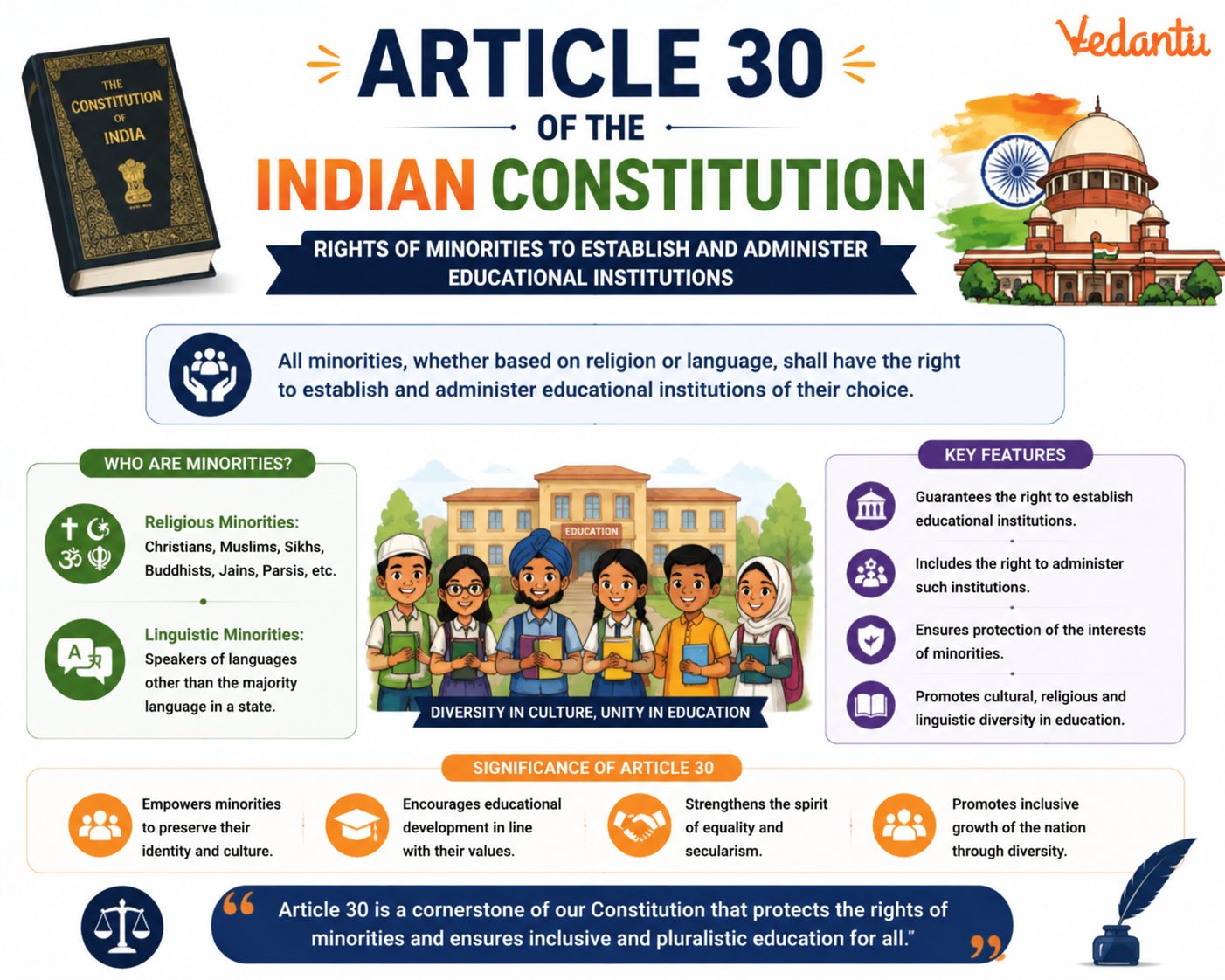
Overview of Article 30
Article 30 is included in Part III of the Indian Constitution, which deals with Fundamental Rights. It specifically focuses on safeguarding the educational rights of minorities, ensuring that they can preserve their language, script, and culture through educational institutions.
Key Provisions of Article 30
| Clause | Provision | Purpose |
|---|---|---|
| Article 30(1) | Right of minorities to establish and administer educational institutions | Protection of minority culture and identity |
| Article 30(1A) | Compensation in case of compulsory acquisition of property of minority institutions | Safeguards institutional autonomy |
| Article 30(2) | No discrimination in granting aid to minority institutions | Ensures equal treatment by the State |
These provisions collectively ensure that minorities can maintain their educational institutions without unfair interference from the State, while still being subject to reasonable regulations for academic standards and public interest.
Who Are Considered Minorities?
The Constitution does not define the term minority. However, minorities are generally identified on the basis of religion or language. The determination of minority status is usually done at the state level, as clarified by the Supreme Court.
- Religious minorities such as Muslims, Christians, Sikhs, Buddhists, Parsis, and Jains
- Linguistic minorities based on the language spoken in a particular state
- Minority status determined in relation to the population of a state, not the entire country
Rights Granted Under Article 30
Article 30 ensures several important rights to minority communities in the field of education.
1. Right to Establish Educational Institutions
Minorities can set up schools, colleges, and other educational institutions to promote their culture, language, and religion. This right ensures freedom in the field of education.
2. Right to Administer Educational Institutions
Administration includes managing staff, admissions, and internal governance. However, this right is not absolute and is subject to reasonable regulations by the State to maintain academic standards and transparency.
3. Protection Against Discrimination in State Aid
The State cannot deny financial aid to educational institutions solely on the ground that they are managed by minorities.
Important Supreme Court Judgments
Several landmark judgments have clarified the scope and meaning of Article 30.
- T.M.A. Pai Foundation v. State of Karnataka (2002) - Clarified the rights of minorities to establish and administer institutions and defined minority status at the state level.
- Islamic Academy of Education v. State of Karnataka (2003) - Addressed issues related to admissions and fee structures in minority institutions.
- P.A. Inamdar v. State of Maharashtra (2005) - Held that the State cannot impose reservation policies on private unaided minority institutions.
Relationship Between Article 29 and Article 30
Article 29 protects the cultural and educational rights of any section of citizens, whereas Article 30 specifically grants rights to minorities. Both Articles work together to preserve India’s diversity.
Difference Between Article 29 and Article 30
| Basis | Article 29 | Article 30 |
|---|---|---|
| Beneficiaries | Any section of citizens | Only religious and linguistic minorities |
| Scope | Protection of culture, language, script | Right to establish and administer educational institutions |
Thus, Article 29 has a broader scope in terms of beneficiaries, while Article 30 specifically focuses on minority educational rights.
Limitations of Article 30
Although Article 30 grants autonomy, it is not absolute. The State can impose reasonable regulations to ensure:
- Maintenance of academic standards
- Fair and transparent admission procedures
- Proper use of public funds if the institution receives government aid
- Prevention of maladministration
Significance of Article 30
Article 30 strengthens India’s secular and democratic framework by ensuring equal educational opportunities and protecting minority identities. It promotes pluralism and harmony in a diverse society. By granting minorities control over their educational institutions, the Constitution ensures that cultural and linguistic diversity is preserved for future generations.
Key Points for Competitive Exams
- Article 30 is part of Fundamental Rights under Part III of the Constitution.
- It applies to both religious and linguistic minorities.
- Minority status is determined at the state level.
- The right to administer does not mean absolute freedom from regulation.
- Closely linked with Article 29.
Conclusion
Article 30 of the Indian Constitution is a cornerstone of minority rights in India. It ensures that religious and linguistic minorities can establish and manage educational institutions to preserve their identity and heritage. While subject to reasonable regulations, the protection offered by this Article reflects the spirit of equality, diversity, and secularism embedded in the Constitution. For students and aspirants, a clear understanding of Article 30 is essential for exams and for appreciating the constitutional safeguards that uphold India’s democratic values.
FAQs on Article 30 of the Indian Constitution and Minority Education Rights
1. What is Article 30 of the Indian Constitution?
Article 30 of the Indian Constitution grants minorities the right to establish and administer educational institutions of their choice. It is a Fundamental Right under Part III of the Constitution.
Key features of Article 30:
• Applies to religious and linguistic minorities
• Ensures protection against discrimination in granting aid
• Safeguards minority identity through education
This provision strengthens minority rights, cultural protection, and educational autonomy in India.
2. Who are considered minorities under Article 30?
Under Article 30, religious and linguistic minorities are recognized based on their population in a particular state. The Constitution does not define “minority,” but courts interpret it contextually.
Minorities include:
• Religious minorities (e.g., Muslims, Christians, Sikhs, Buddhists, Parsis, Jains)
• Linguistic minorities (groups speaking a different language in a state)
The concept relates to minority status, cultural identity, and constitutional protection.
3. What rights are granted to minorities under Article 30?
Article 30 provides minorities the right to establish and administer educational institutions without state interference. This ensures protection of their culture and language.
Rights include:
• Setting up schools and colleges
• Managing administration and governance
• Receiving government aid without discrimination
These rights promote educational freedom, institutional autonomy, and minority protection.
4. Can the government regulate minority educational institutions?
Yes, the government can regulate minority institutions, but it cannot take away their core rights under Article 30. Regulations must be reasonable and in the interest of academic standards.
Government can:
• Ensure educational standards
• Implement public order and health norms
• Apply fair admission procedures
However, it cannot destroy the administrative autonomy of minority institutions.
5. What is Article 30(1A) of the Indian Constitution?
Article 30(1A) protects minority institutions against unfair property acquisition by the state. It was added by the 44th Constitutional Amendment Act, 1978.
It ensures:
• Fair compensation if property is acquired
• Protection of institutional rights
This clause strengthens minority educational rights and constitutional safeguards.
6. Does Article 30 apply to both aided and unaided institutions?
Yes, Article 30 applies to both aided and unaided minority educational institutions. The state cannot discriminate while granting financial assistance.
Important points:
• Aid cannot be denied solely on minority status
• Unaided institutions also enjoy administrative rights
This ensures equal treatment, non-discrimination, and educational freedom.
7. What is the difference between Article 29 and Article 30?
Article 29 protects the cultural and educational rights of any section of citizens, while Article 30 specifically grants rights to minorities to establish educational institutions.
Key differences:
• Article 29: Protects language, script, and culture
• Article 30: Grants institutional rights to minorities
Both articles support cultural diversity and constitutional equality.
8. Which landmark cases are related to Article 30?
Several Supreme Court judgments have clarified Article 30 rights and limitations.
Important cases include:
• St. Xavier’s College v. State of Gujarat (1974)
• T.M.A. Pai Foundation v. State of Karnataka (2002)
• P.A. Inamdar v. State of Maharashtra (2005)
These cases define minority status, admission policies, and institutional autonomy.
9. Is Article 30 a Fundamental Right?
Yes, Article 30 is a Fundamental Right included in Part III of the Indian Constitution. It is enforceable by courts under Article 32 and Article 226.
This means:
• Minorities can approach the Supreme Court or High Court
• Any violation can be legally challenged
It strengthens constitutional remedies and minority protection.
10. Why is Article 30 important in the Indian Constitution?
Article 30 is important because it protects minority identity, cultural diversity, and educational rights in a pluralistic society like India.
Its significance includes:
• Promoting inclusive education
• Preserving language and religion
• Ensuring equality in state support
It reflects India’s commitment to secularism, diversity, and constitutional justice.
