






How Air Taxi Services Work in Modern Cities
An Air Taxi Service is a type of on-demand aviation transport that uses small aircraft or helicopters to carry passengers or cargo between locations. Unlike commercial airlines that operate on fixed schedules and routes, air taxis provide flexible, point-to-point travel services. With advancements in aviation technology, especially electric vertical take-off and landing aircraft - eVTOL, air taxi services are becoming an important part of modern urban mobility. They aim to reduce travel time, ease traffic congestion, and improve connectivity between cities and remote areas.
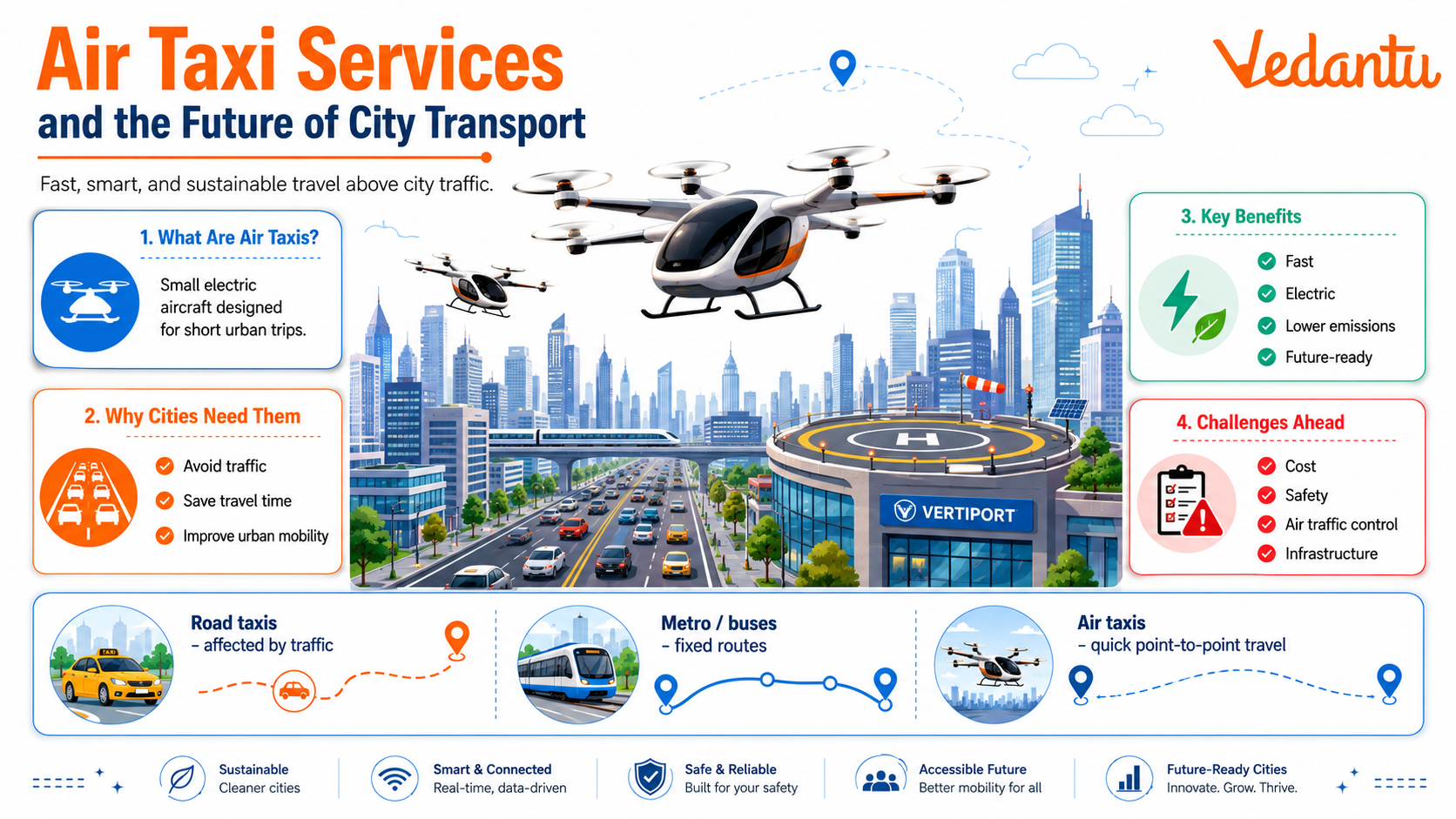
What is an Air Taxi Service?
Air taxi service refers to a charter-based aviation system where small aircraft are hired for short-distance travel. These services operate similarly to road taxis but in the air. Customers can book flights as per their schedule instead of depending on commercial airline timetables.
- On-demand air transportation
- Operates with small planes, helicopters, or eVTOL aircraft
- Suitable for short to medium distances
- Provides faster alternative to road travel
History and Evolution
Air taxi services began with chartered aircraft operations in the early 20th century. Initially, they were mainly used by business executives and wealthy individuals. Over time, improvements in aviation safety, navigation systems, and aircraft design made such services more accessible. In recent years, the development of electric aircraft and urban air mobility concepts has transformed air taxi services into a futuristic mode of transport.
Types of Air Taxi Services
1. Helicopter Air Taxis
Helicopters are commonly used for short urban trips and emergency services. They can land vertically, making them suitable for crowded cities.
2. Fixed-Wing Aircraft Taxis
These use small airplanes and require runways for take-off and landing. They are ideal for inter-city travel.
3. eVTOL Air Taxis
Electric vertical take-off and landing aircraft represent the latest innovation. They are quieter, eco-friendly, and designed for urban air mobility.
Key Features of Air Taxi Service
- Point-to-point connectivity
- Reduced travel time
- Flexible scheduling
- Access to remote or less-connected regions
- Advanced navigation and safety systems
Comparison Between Air Taxi and Commercial Airlines
| Feature | Air Taxi Service | Commercial Airlines |
|---|---|---|
| Schedule | On-demand | Fixed timetable |
| Aircraft Size | Small aircraft | Large passenger planes |
| Route | Flexible routes | Predefined routes |
The table shows that air taxi services focus on flexibility and convenience, while commercial airlines are designed for mass transportation over long distances.
Advantages of Air Taxi Service
- Saves time by avoiding traffic congestion
- Improves regional connectivity
- Useful for emergency medical transport
- Encourages tourism and business growth
Challenges and Limitations
Despite its advantages, air taxi service faces several challenges such as high operational costs, strict aviation regulations, safety concerns, and infrastructure requirements like vertiports and small airstrips. Weather conditions also significantly affect operations.
- Expensive compared to road transport
- Requires trained pilots and maintenance teams
- Limited passenger capacity
- Dependent on weather conditions
Air Taxi Service in Urban Air Mobility
Urban Air Mobility refers to the use of air transportation systems within cities. Air taxi services, especially eVTOL aircraft, play a central role in this concept. Governments and private companies are investing in research and pilot projects to make air taxis a practical option for daily commuting in the future.
Future Prospects
The future of air taxi service looks promising due to advancements in electric propulsion, autonomous flying systems, and digital booking platforms. As technology improves and costs decrease, air taxis may become more affordable and widely used. They are expected to transform urban transport systems and contribute to smarter, faster, and cleaner mobility solutions.
Conclusion
Air Taxi Service is an innovative mode of air transportation that offers flexible, fast, and efficient travel options. From traditional helicopter charters to advanced eVTOL aircraft, the concept is evolving rapidly. While challenges such as cost and regulation remain, continued technological progress and infrastructure development may soon make air taxis a common feature of modern transportation systems.
FAQs on Air Taxi Services and the Future of City Transport
1. What is an Air Taxi Service?
Air Taxi Service is a type of on-demand air transportation that allows passengers to hire small aircraft for short-distance travel.
- Operates like a taxi in the sky with flexible schedules
- Uses small planes, helicopters, or eVTOL aircraft
- Provides point-to-point travel without fixed airline routes
- Ideal for business trips, medical emergencies, and remote areas
2. How does an Air Taxi Service work?
Air Taxi Services work through advance booking systems where customers hire aircraft for specific routes and timings.
- Passengers book via apps, websites, or charter companies
- The operator arranges a licensed pilot and aircraft
- Flights operate from small airports or helipads
- Pricing is based on distance, aircraft type, and duration
3. What are the main features of Air Taxi Services?
Air Taxi Services offer flexibility, speed, and convenience compared to commercial airlines.
- On-demand scheduling
- Access to remote or less crowded airports
- Reduced travel time
- Personalized travel experience
- Advanced aircraft including electric vertical takeoff and landing (eVTOL)
4. What are the advantages of Air Taxi Services?
The main advantage of Air Taxi Services is time-saving and convenience.
- Faster travel compared to road transport
- Avoids heavy traffic congestion
- Provides direct connectivity
- Useful in emergency medical services (air ambulance)
- Supports business executives and VIP travel
5. What are the disadvantages of Air Taxi Services?
Air Taxi Services are expensive and limited in availability compared to regular airlines.
- High operational and fuel costs
- Limited passenger capacity
- Weather-dependent operations
- Requires strict aviation regulations and safety checks
6. What is the difference between Air Taxi and Helicopter Service?
An Air Taxi can use various aircraft types, while helicopter service specifically uses helicopters.
- Air Taxi: May include small airplanes, helicopters, or eVTOL aircraft
- Helicopter Service: Only rotary-wing aircraft
- Air taxis may operate between small airports
- Helicopters can land on helipads and rooftops
7. What is Urban Air Mobility (UAM) in Air Taxi Services?
Urban Air Mobility (UAM) refers to the use of air taxis for transportation within cities.
- Uses electric VTOL aircraft
- Aims to reduce urban traffic congestion
- Focuses on eco-friendly and sustainable aviation
- Supported by companies like Joby Aviation and Archer Aviation
8. Are Air Taxi Services safe?
Air Taxi Services follow strict aviation safety regulations set by national authorities.
- Pilots must hold commercial pilot licenses
- Aircraft undergo regular maintenance checks
- Operated under civil aviation authorities (like DGCA, FAA)
- Advanced navigation and safety systems
9. Where are Air Taxi Services commonly used?
Air Taxi Services are commonly used in developed and remote regions for faster connectivity.
- Business hubs and metropolitan cities
- Tourist destinations
- Remote or island areas
- Medical evacuation zones
10. What is the future of Air Taxi Services?
The future of Air Taxi Services lies in electric and autonomous aircraft for sustainable transport.
- Growth of electric air taxis
- Integration with smart city infrastructure
- Reduced carbon emissions
- Potential for pilotless autonomous flights
