






Functions and Importance of Agricultural Produce Market Committees for Farmers
The Agricultural Produce Market Committee (APMC) is a statutory body established by state governments in India to regulate the buying and selling of agricultural produce. It was created to protect farmers from exploitation by intermediaries and to ensure fair trade practices in agricultural markets. APMC plays a crucial role in maintaining transparency in pricing, standardizing weights and measures, and facilitating smooth marketing of farm products. It is an important topic in General Knowledge, especially for competitive exams related to agriculture, economics, and public administration.
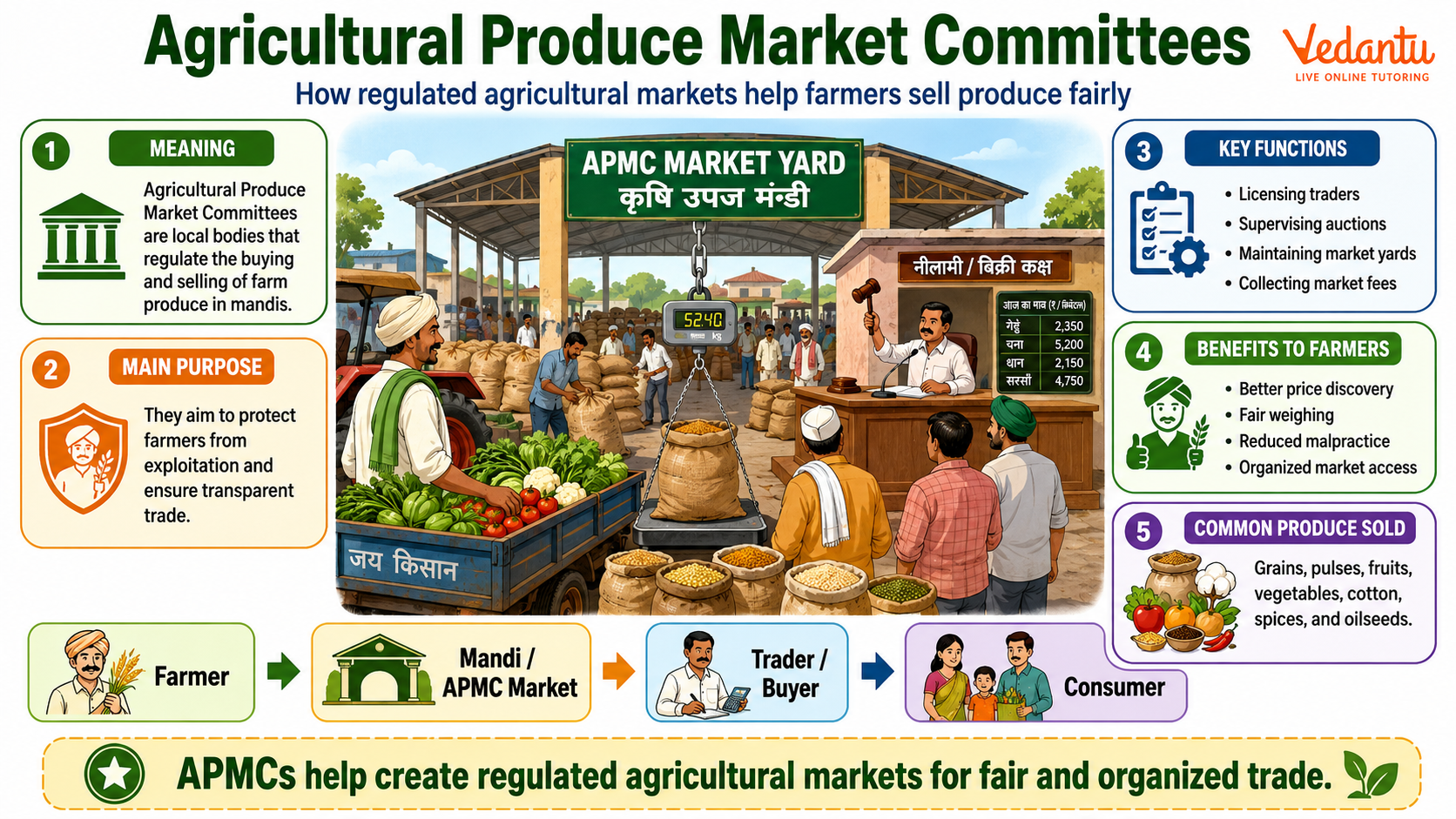
What is Agricultural Produce Market Committee (APMC)?
An Agricultural Produce Market Committee is a government-regulated market system where farmers bring their produce to sell through licensed traders. The primary objective of APMC is to ensure that farmers receive fair prices and are not exploited by middlemen. Each state in India has its own APMC Act that governs the functioning of agricultural markets within the state.
- Regulates buying and selling of agricultural produce
- Ensures fair price discovery through open auctions
- Issues licenses to traders and commission agents
- Maintains market infrastructure such as yards and storage facilities
Objectives of APMC
The establishment of APMC was aimed at protecting farmers and improving agricultural marketing efficiency. Its objectives are centered on ensuring fairness and transparency in trade.
- Prevent exploitation of farmers by intermediaries
- Ensure transparent auction process for price determination
- Standardize weights and measures
- Promote fair trade practices in agricultural markets
- Provide market information to farmers
Structure and Functioning of APMC
APMC operates through regulated market yards where farmers bring their produce for sale. The committee consists of representatives from farmers, traders, local authorities, and government officials. It oversees the functioning of the market and ensures compliance with the rules laid down in the APMC Act.
Key Functions
- Conducting open auctions for price discovery
- Collecting market fees from traders
- Providing infrastructure such as warehouses and cold storage
- Resolving disputes between buyers and sellers
Key Features of APMC System
| Feature | Description | Purpose |
|---|---|---|
| Regulated Markets | Designated market yards for sale | Prevent unregulated trade |
| Licensing System | Traders must obtain licenses | Ensure accountability |
| Market Fee | Fee charged on transactions | Maintain infrastructure |
The APMC system helps in creating an organized marketplace for agricultural commodities. By regulating trade and ensuring transparent price discovery, it aims to protect farmers' interests and maintain market discipline.
Advantages of APMC
- Provides a structured and regulated marketplace
- Ensures fair and competitive pricing through auctions
- Reduces chances of farmer exploitation
- Improves infrastructure and storage facilities
Challenges and Criticism
Despite its objectives, the APMC system has faced criticism over time. Certain limitations have led to calls for reforms in agricultural marketing.
- Limited competition due to restricted market access
- Multiple market fees increase transaction costs
- Dominance of commission agents in some markets
- Inadequate infrastructure in certain regions
Reforms in APMC
To address existing challenges, several reforms have been introduced by the central and state governments. These include promoting electronic trading platforms and allowing farmers to sell outside APMC mandis.
- Introduction of electronic National Agriculture Market (e-NAM)
- Encouraging private markets and direct marketing
- Reduction of market fees in some states
- Model APMC Act amendments for greater flexibility
Importance of APMC in Competitive Exams
APMC is an important topic for various competitive exams such as UPSC, State PSC, SSC, banking exams, and other government recruitment tests. Questions may be asked about its objectives, functions, reforms, and challenges. Understanding the structure and significance of APMC helps candidates grasp broader concepts related to agricultural economics and public policy.
Conclusion
The Agricultural Produce Market Committee plays a vital role in regulating agricultural marketing in India. It was designed to safeguard farmers and ensure transparent trading practices. While the system has provided a structured marketplace, it has also faced criticism and undergone reforms to improve efficiency and competition. A clear understanding of APMC helps in comprehending the dynamics of agricultural trade and policy in India.
FAQs on Agricultural Produce Market Committees (APMC) in India: Meaning and Role
1. What is an Agricultural Produce Market Committee (APMC)?
An Agricultural Produce Market Committee (APMC) is a statutory body that regulates the buying and selling of agricultural produce to protect farmers from exploitation.
• Established under the APMC Act of respective states
• Ensures fair trade practices in mandis (regulated markets)
• Prevents middlemen exploitation
• Promotes transparent auction systems
• Commonly searched as: agricultural market board, mandi system, regulated market
2. What is the main objective of the APMC Act?
The main objective of the APMC Act is to ensure fair pricing and organized marketing of farm produce.
• Protects farmers from distress sales
• Establishes regulated mandis
• Ensures transparent auction processes
• Provides infrastructure like storage and weighing facilities
• Related terms: agricultural marketing reforms, farmer protection laws
3. How does the APMC mandi system work?
The APMC mandi system works through licensed traders who buy agricultural produce via open auctions.
• Farmers bring produce to notified market yards
• Licensed commission agents conduct auctions
• Prices are determined through competitive bidding
• Market fees and commissions are charged
• Also known as: regulated agricultural market system
4. Why was the APMC system introduced in India?
The APMC system was introduced to protect farmers from exploitation by moneylenders and intermediaries.
• Started during the British era to regulate grain trade
• Expanded post-independence for farmer welfare
• Prevented unfair trade practices
• Ensured standardized weights and measures
• Often asked in UPSC, SSC, and state PCS exams
5. What are the advantages of the APMC system?
The advantages of APMC include farmer protection and organized agricultural marketing.
• Assured market access for farmers
• Transparent price discovery mechanism
• Reduction in trader malpractice
• Infrastructure facilities like storage and grading
• Keywords: benefits of mandi system, agricultural price regulation
6. What are the criticisms or drawbacks of APMC?
The drawbacks of APMC include market monopolies and restricted competition.
• Limited number of licensed traders
• High commission charges and market fees
• Cartelization in mandis
• Restricted direct sale to buyers
• Related searches: APMC reforms, problems in mandi system
7. What is the difference between APMC and e-NAM?
The key difference between APMC and e-NAM (National Agriculture Market) lies in their mode of operation.
• APMC: Physical regulated market yards
• e-NAM: Online trading platform integrating mandis
• e-NAM promotes digital price discovery
• Both aim at better farmer income
• Also searched as: difference between mandi and eNAM
8. Who regulates Agricultural Produce Market Committees in India?
The State Governments regulate Agricultural Produce Market Committees under their respective APMC Acts.
• Agriculture is a State Subject under the Constitution
• Each state has its own APMC legislation
• Market committees include elected farmer representatives
• Supervised by State Agricultural Marketing Boards
9. What reforms have been made in the APMC system?
Several APMC reforms have been introduced to increase competition and farmer income.
• Allowing direct marketing and contract farming
• Promoting private market yards
• Integration with e-NAM platform
• Amendment Acts by various states
• Keywords: agricultural marketing reforms, farm laws debate
10. How is APMC important for competitive exams?
The APMC topic is important for competitive exams due to its relevance in Indian economy and agriculture.
• Frequently asked in UPSC, SSC, Banking, and State PCS exams
• Linked to topics like MSP, farm reforms, and rural economy
• Important for General Studies and Economic Development sections
• Common PAA: What is mandi system? What are APMC reforms?
