






Major Environmental Protests and Conservation Movements Across India
The environmental movements in India represent a series of organized efforts by citizens, activists, and communities to protect natural resources such as forests, rivers, land, and wildlife. These movements emerged as responses to deforestation, industrial pollution, displacement, and ecological degradation. From the early forest resistance during the colonial period to modern climate activism, environmental movements in India have shaped public policy, strengthened environmental laws, and increased awareness about sustainable development. Understanding their history is important for students and competitive exam aspirants, as it highlights the connection between environment, society, and governance in India.
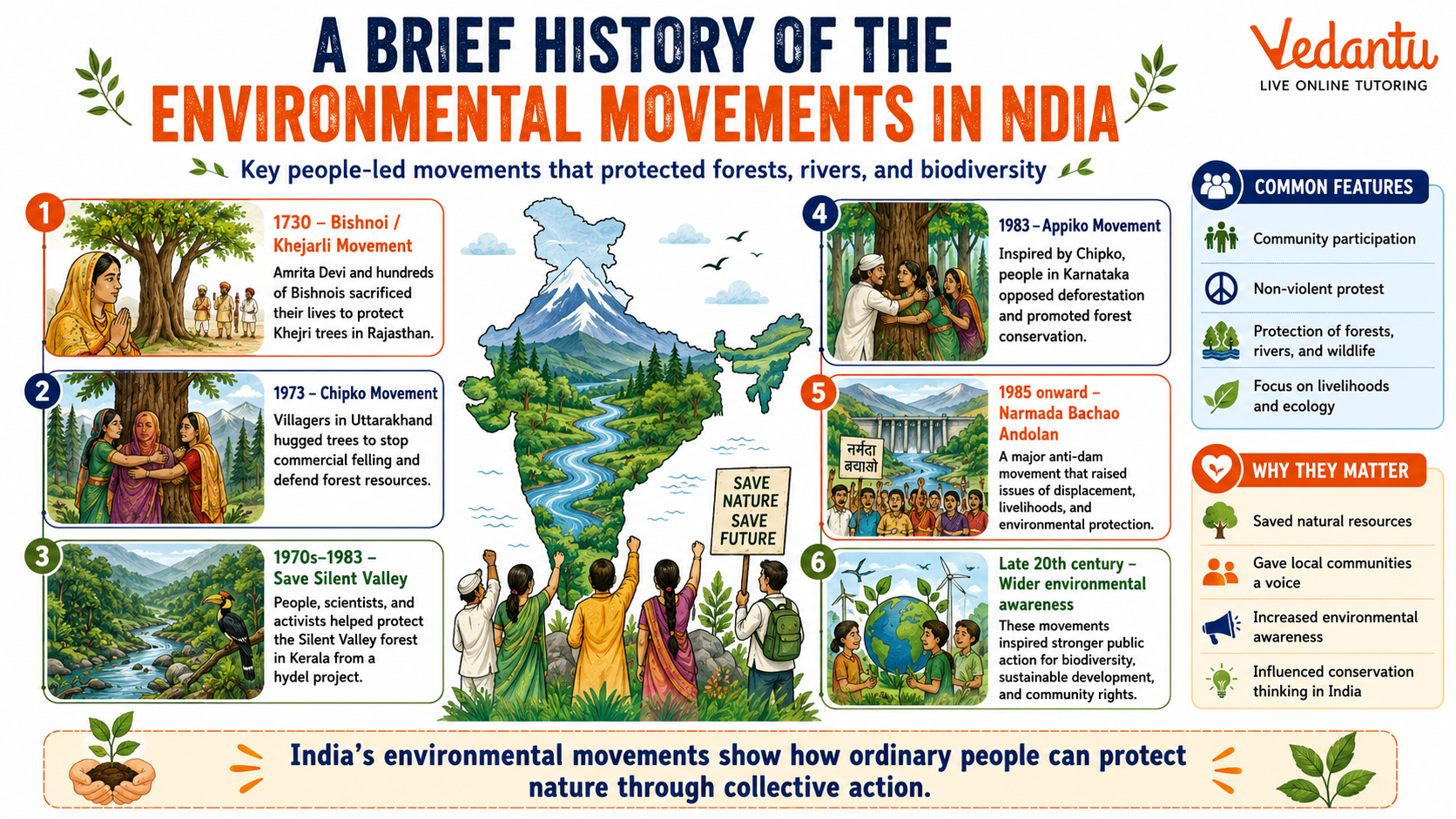
Background of Environmental Movements in India
Environmental concerns in India gained prominence during British rule when forests were exploited for commercial purposes such as railway expansion and shipbuilding. Local communities dependent on forests and natural resources began resisting such policies. After independence, rapid industrialization, large dam construction, mining, and urban expansion further intensified environmental challenges. These developments gave rise to organized environmental movements aimed at protecting livelihoods and ecosystems.
Major Phases of Environmental Movements
1. Pre-Independence Environmental Resistance
During the colonial period, forest laws restricted the traditional rights of local communities. Resistance movements emerged to protect access to forest resources.
- Bishnoi Movement of 1730 led by Amrita Devi to protect Khejri trees in Rajasthan.
- Forest Satyagrahas during the freedom struggle protesting colonial forest policies.
2. Post-Independence Environmental Movements
After independence, development projects such as dams, mining, and industries led to displacement and ecological damage. Grassroots movements gained momentum in the 1970s and 1980s.
- Chipko Movement in Uttarakhand to prevent deforestation.
- Silent Valley Movement in Kerala to protect tropical rainforests.
- Narmada Bachao Andolan against large dam construction.
- Appiko Movement in Karnataka inspired by Chipko.
Major Environmental Movements in India
| Movement | Year and Region | Main Objective |
|---|---|---|
| Bishnoi Movement | 1730, Rajasthan | Protection of Khejri trees |
| Chipko Movement | 1973, Uttarakhand | Prevent deforestation |
| Silent Valley Movement | 1978, Kerala | Stop hydroelectric project |
| Narmada Bachao Andolan | 1985, Madhya Pradesh and Gujarat | Oppose large dams and displacement |
These movements significantly influenced environmental governance in India and led to greater public participation in environmental decision-making.
Key Features of Environmental Movements in India
- Grassroots participation involving local communities and tribal groups.
- Non-violent protest methods inspired by Gandhian principles.
- Focus on sustainable development and conservation of biodiversity.
- Strong involvement of women, especially in forest protection movements.
Impact on Environmental Policies
Environmental movements in India have played a crucial role in shaping environmental laws and policies. Public pressure and activism led to the introduction and strengthening of legislation aimed at environmental protection.
- Enactment of the Environment Protection Act, 1986.
- Forest Conservation Act, 1980 to regulate deforestation.
- Wildlife Protection Act, 1972 for biodiversity conservation.
- Increased role of judiciary through Public Interest Litigation.
Role of Women in Environmental Movements
Women have been at the forefront of several environmental movements in India. In the Chipko Movement, village women hugged trees to prevent them from being cut. Their active involvement highlighted the direct link between environmental degradation and rural livelihoods. Women's participation strengthened community-based conservation efforts across the country.
Contemporary Environmental Activism
In recent decades, environmental activism in India has expanded to include issues such as climate change, air pollution, waste management, and sustainable urban development. Youth-led campaigns, digital awareness initiatives, and legal activism continue to influence environmental governance.
- Movements against coal mining and industrial pollution.
- Campaigns promoting renewable energy and climate justice.
- Public protests for clean air and water conservation.
Importance for General Knowledge and Competitive Exams
Questions related to environmental movements in India are frequently asked in competitive exams such as UPSC, State PSC, SSC, and other government examinations. Students should focus on the year, location, leaders, objectives, and outcomes of major movements. Understanding these movements also helps in essays, interviews, and current affairs preparation.
Conclusion
A brief history of the environmental movements in India reflects the collective struggle of people to protect nature and ensure sustainable development. These movements demonstrate how community participation and peaceful protest can influence national policies and promote ecological balance. They remain a significant part of India's socio-political history and continue to inspire efforts toward environmental conservation.
FAQs on A Brief History of Environmental Movements in India: Key Events and Impact
1. What is the history of environmental movements in India?
The history of environmental movements in India traces grassroots struggles to protect forests, rivers, and livelihoods from colonial to modern times. Key phases include:
- Colonial period – Forest laws restricting local access led to resistance.
- Post-independence era – Development projects triggered protests.
- 1970s–1980s – Major movements like Chipko Movement and Silent Valley Movement.
- Modern environmental activism – Focus on sustainable development, climate change, and tribal rights.
2. What was the Chipko Movement?
The Chipko Movement (1973) was a forest conservation movement where villagers hugged trees to prevent deforestation in Uttarakhand. Its main features were:
- Led by Sunderlal Bahuguna and Gaura Devi.
- Focused on preventing commercial logging.
- Promoted eco-feminism and community forest rights.
- Influenced India’s forest conservation policies.
3. What was the Silent Valley Movement?
The Silent Valley Movement was a campaign to protect the tropical rainforest in Kerala from a hydroelectric project. Key points include:
- Started in the 1970s.
- Opposed the dam on the Kunthipuzha River.
- Supported by scientists, activists, and poets.
- Resulted in the creation of Silent Valley National Park (1984).
4. What is the Narmada Bachao Andolan?
The Narmada Bachao Andolan (NBA) is a movement against large dams on the Narmada River. Its major aspects are:
- Led by Medha Patkar and Baba Amte.
- Opposed displacement of tribal communities.
- Demanded fair rehabilitation and environmental assessment.
- Raised debates on development vs. environment.
5. What role did women play in environmental movements in India?
Women played a central role in India’s environmental protection movements, especially in forest-based protests. Their contributions include:
- Leading the Chipko Movement to protect forests.
- Highlighting links between ecology and livelihood.
- Promoting eco-feminism and sustainable practices.
- Mobilizing rural communities for conservation.
6. How did British forest policies impact environmental movements in India?
British forest policies triggered early environmental resistance by restricting local access to forests. Important impacts were:
- Introduction of the Indian Forest Act (1865, 1878, 1927).
- Commercial exploitation of timber.
- Loss of tribal and community forest rights.
- Rise of forest satyagrahas and local protests.
7. What are some other important environmental movements in India?
Apart from Chipko and Narmada, several key environmental movements shaped India’s ecological history. These include:
- Appiko Movement (Karnataka) – Forest protection.
- Bishnoi Movement (1730) – Early tree conservation led by Amrita Devi.
- Tehri Dam Protest – Opposition to dam construction.
- Save Western Ghats Movement – Biodiversity conservation.
8. How did environmental movements influence Indian laws?
Environmental movements significantly shaped India’s environmental legislation and policies. Their influence led to:
- The Environment Protection Act, 1986.
- Strengthening of the Forest Conservation Act, 1980.
- Improved Environmental Impact Assessment (EIA) norms.
- Greater public participation in decision-making.
9. What is the importance of environmental movements in India today?
Environmental movements remain crucial in addressing modern ecological challenges like climate change and pollution. Their importance includes:
- Promoting sustainable development.
- Protecting tribal and rural livelihoods.
- Raising awareness about climate change and biodiversity loss.
- Encouraging citizen participation in environmental issues.
10. Why are environmental movements important for students and competitive exams?
Environmental movements are important for students as they are frequently asked in GK, UPSC, SSC, and state exams. Key reasons include:
- Understanding major movements like Chipko and Narmada Bachao Andolan.
- Linking history with environmental studies.
- Analyzing development vs. conservation debates.
- Preparing for essay and current affairs topics.
