






Important Legal Rights and Duties Every Indian Student Should Know
India is the world’s largest democracy, and its legal system is designed to protect the rights and freedoms of its citizens. However, many people are unaware of the important laws and rights that directly impact their daily lives. Understanding these rights not only empowers individuals but also helps them act responsibly and confidently in different situations. This General Knowledge page covers 19 important laws and rights that every Indian must know for awareness, competitive exams, and responsible citizenship.
Importance of Knowing Your Legal Rights
Awareness of laws is essential to prevent exploitation, injustice, and misuse of authority. Knowledge of legal rights helps citizens:
- Protect themselves from unfair treatment.
- Take informed decisions in legal matters.
- Understand their duties along with rights.
- Prepare effectively for competitive exams like UPSC, SSC, Banking, and State PSC.
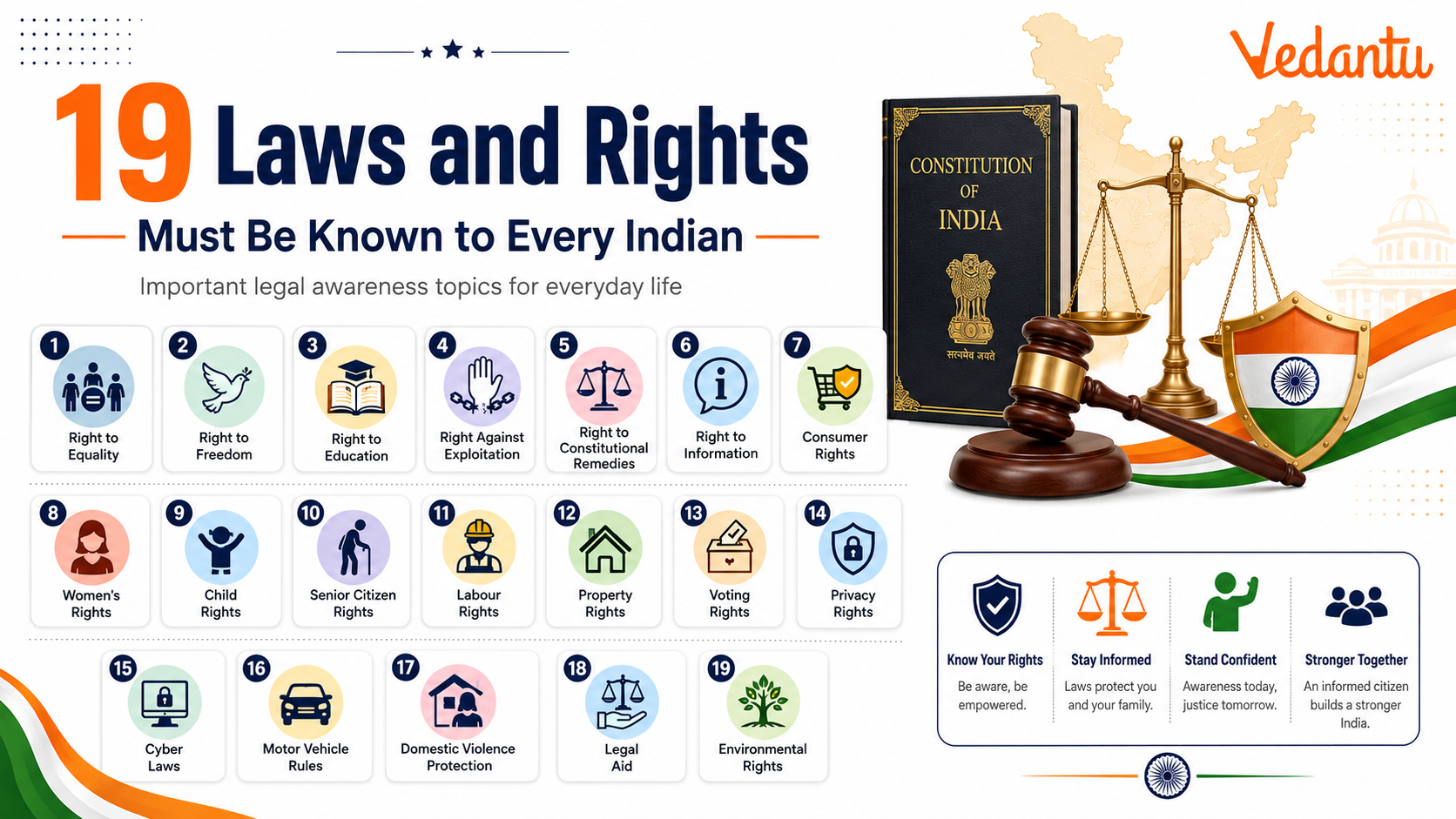
19 Laws And Rights Must Be Known To Every Indian
Fundamental and Constitutional Rights
- Right to Equality (Article 14 to 18) - Guarantees equality before law and prohibits discrimination on grounds of religion, race, caste, sex, or place of birth.
- Right to Freedom (Article 19 to 22) - Includes freedom of speech and expression, assembly, movement, residence, and profession.
- Right Against Exploitation (Article 23 and 24) - Prohibits human trafficking, forced labor, and child labor in hazardous jobs.
- Right to Freedom of Religion (Article 25 to 28) - Ensures freedom to practice, profess, and propagate religion.
- Cultural and Educational Rights (Article 29 and 30) - Protects rights of minorities to conserve culture and establish educational institutions.
- Right to Constitutional Remedies (Article 32) - Empowers citizens to approach the Supreme Court to enforce Fundamental Rights.
Legal Rights Related to Arrest and Police
- Right to Know the Grounds of Arrest - Police must inform the reason for arrest.
- Right to Legal Aid - Free legal aid is available to the poor under Article 39A.
- Right to be Produced Before Magistrate - An arrested person must be presented before a magistrate within 24 hours.
- Right to File FIR - Any person can file a First Information Report at a police station.
Women and Child Protection Laws
- Protection of Women from Domestic Violence Act, 2005 - Provides legal protection against physical, emotional, and economic abuse.
- Sexual Harassment of Women at Workplace Act, 2013 - Ensures safety of women at workplaces.
- POCSO Act, 2012 - Protects children from sexual offences.
- Prohibition of Child Marriage Act, 2006 - Declares child marriage illegal and punishable.
Consumer and Information Rights
- Right to Information Act, 2005 - Enables citizens to seek information from public authorities.
- Consumer Protection Act, 2019 - Protects consumers from unfair trade practices and defective goods.
- Right to Education (Article 21A) - Provides free and compulsory education for children aged 6 to 14 years.
Other Important Legal Rights
- Motor Vehicles Act, 1988 - Grants rights related to compensation in case of road accidents.
- Minimum Wages Act, 1948 - Ensures workers receive minimum wages fixed by the government.
Quick Overview of Key Rights and Laws
| Law or Right | Year or Article | Main Purpose |
|---|---|---|
| Right to Equality | Article 14 to 18 | Equality before law |
| RTI Act | 2005 | Access to government information |
| Consumer Protection Act | 2019 | Protection of consumer interests |
| POCSO Act | 2012 | Child protection from sexual offences |
The above table provides a quick revision snapshot for students preparing for competitive examinations. Knowing the year and purpose of each law is especially important for objective type questions.
How to Prepare This Topic for Competitive Exams
- Memorize important Articles of the Constitution and related rights.
- Focus on years of major Acts such as RTI Act 2005 and Consumer Protection Act 2019.
- Understand the purpose and key provisions of each law.
- Practice multiple choice questions regularly.
Conclusion
Knowledge of important laws and rights is essential for every Indian citizen. It strengthens democracy, promotes justice, and protects individuals from exploitation. These 19 laws and rights form a strong foundation for legal awareness and are frequently asked in competitive examinations. Staying informed about them ensures that citizens can actively participate in society while safeguarding their own rights and responsibilities.
FAQs on 19 Laws and Rights Every Indian Must Understand for Exams and Daily Life
1. What are the Fundamental Rights guaranteed by the Indian Constitution?
The Fundamental Rights are basic human rights guaranteed to every Indian citizen under Part III of the Indian Constitution to ensure equality and freedom.
• Right to Equality (Articles 14–18) – Equal treatment before law
• Right to Freedom (Articles 19–22) – Freedom of speech, movement, and profession
• Right against Exploitation – Prohibits forced labor and child labor
• Right to Freedom of Religion
• Cultural and Educational Rights
• Right to Constitutional Remedies (Article 32) – Right to approach the Supreme Court
These rights protect citizens from discrimination, injustice, and misuse of power.
2. What is the Right to Information (RTI) Act, 2005?
The Right to Information (RTI) Act, 2005 empowers citizens to seek information from public authorities to ensure transparency and accountability.
• Citizens can request official records and documents
• Government must reply within 30 days
• Promotes transparency in governance
• Reduces corruption and misuse of power
RTI strengthens democracy by giving people the power to question the government.
3. What are the rights of a person at the time of arrest in India?
A person arrested in India has legal protections under the Code of Criminal Procedure (CrPC) and Article 22 of the Constitution.
• Right to know the reason for arrest
• Right to consult a lawyer
• Right to be presented before a magistrate within 24 hours
• Right against self-incrimination (Article 20(3))
These safeguards protect individuals from illegal detention and police abuse.
4. What is the Right to Education (RTE) Act, 2009?
The Right to Education (RTE) Act, 2009 makes free and compulsory education a fundamental right for children aged 6 to 14 years.
• Enforced under Article 21A
• Free education in government schools
• 25% reservation in private schools for economically weaker sections
• No child can be denied admission
This law ensures universal elementary education in India.
5. What is the Consumer Protection Act in India?
The Consumer Protection Act, 2019 safeguards consumers against unfair trade practices and defective goods.
• Right to safety and information
• Right to seek compensation
• Establishment of Consumer Courts at district, state, and national levels
• Protection against misleading advertisements
This law empowers buyers to file complaints and seek justice easily.
6. What is the Domestic Violence Act, 2005?
The Protection of Women from Domestic Violence Act, 2005 protects women from physical, emotional, verbal, and economic abuse.
• Covers married and live-in relationships
• Provides protection orders and residence rights
• Ensures financial support and custody relief
• Punishment for offenders
This law aims to ensure safety and dignity for women in households.
7. What is the importance of the Right to Constitutional Remedies?
The Right to Constitutional Remedies (Article 32) allows citizens to move the Supreme Court if their Fundamental Rights are violated.
• Known as the “Heart and Soul of the Constitution” (Dr. B.R. Ambedkar)
• Courts can issue writs like Habeas Corpus, Mandamus, Prohibition, Certiorari, and Quo Warranto
• Ensures enforcement of Fundamental Rights
This right guarantees judicial protection against injustice.
8. What are the legal rights of women in India?
Women in India are protected by several constitutional and legal rights ensuring equality and safety.
• Equal Pay for Equal Work
• Protection under POSH Act, 2013 against workplace harassment
• Maternity benefits under the Maternity Benefit Act, 1961
• Property rights under the Hindu Succession (Amendment) Act, 2005
These laws promote gender equality and women empowerment.
9. What is the Motor Vehicles (Amendment) Act, 2019?
The Motor Vehicles (Amendment) Act, 2019 introduced stricter traffic rules and penalties to improve road safety in India.
• Heavy fines for drunk driving and rash driving
• Mandatory helmet and seatbelt use
• Protection for Good Samaritans
• Digital documentation of licenses and registration
This law aims to reduce road accidents and enforce traffic discipline.
10. Why is it important for every Indian citizen to know their legal rights?
Knowing basic laws and rights in India empowers citizens to protect themselves from injustice and exploitation.
• Prevents misuse of authority
• Promotes awareness of constitutional rights
• Helps in filing complaints and seeking legal remedies
• Strengthens democracy and rule of law
Legal awareness ensures that citizens can demand justice, equality, and transparency.
