








How to Convert Esters to Aldehydes Reaction Mechanism Reagents and Examples
One of the components in synthetic flavours, perfumes and cosmetics is ester. Ester is an organic compound which reacts with water and gives alcohol and acid. RCO2R' is the chemical formula of esters. Aldehydes are another important class of organic compounds which can be used as fungicides, insecticides and germicides in plants and vegetables and also used for the production of polymeric materials. The chemical formula of aldehyde is RCHO. Esters can be reduced to aldehyde.
The ester and aldehyde can also react together. A special type of organic reaction where an alpha halo ester reacts with aldehyde or ketone to give beta hydroxy ester is called the Reformatsky reaction. Beta hydroxy ester has a lot of importance in cosmetics and pharmaceutical industries. In this topic, we are discussing all the details of the Reformatsky reaction, the reaction mechanism and the advantages of the Reformatsky reaction.
What is Reformatsky Reaction?
The Reformatsky reaction was discovered in 1887 by a Russian chemist named Sergey Nikolaevich Reformatsky. The reaction usually takes place between a carbonyl compound and alpha halo ester. The reaction takes place in the presence of zinc metal where inorganic solvents like diethyl ether or THF can be used. This is a condensation reaction and can be adapted to intramolecular aldol condensation. The isolation of organo zinc reagent is not required in a Reformatsky reaction. During the reaction, a new carbon-carbon bond is formed along with the formation of a zinc halide.
Definition of Reformatsky Reaction
Reformatsky reaction is a condensation reaction. Reformatsky reaction can be defined as a reaction between aldehyde or ketones with alpha halo ester and beta hydroxy ester by using zinc metal. Here, zinc helps to produce the organo zinc reagent called Reformatsky enolate. Reformatsky enolate is less reactive compared to the Grignard reagent. Hence, there is no possibility for a nucleophilic addition to the ester group. The reaction is an extended reaction between two carbonyl compounds in the presence of zinc. The solvent used in the reaction is diethyl ether or tetrahydrofuran.
Reaction Mechanism
Formation of zinc enolate: By oxidative addition, zinc metal is inserted to the carbon halogen bond of alpha halo ester.
This compound undergoes dimerisation and rearrangement and forms two zinc enolates.
The oxygen on the aldehyde or ketone coordinates with zinc and a new six-membered transition state is formed.
Zinc moves to the oxygen of aldehyde or ketone and a new carbon-carbon bond is formed.
An acid work up is taken place and zinc is removed by it. Zinc forms Zn(II) salt and we get beta hydroxy ester.
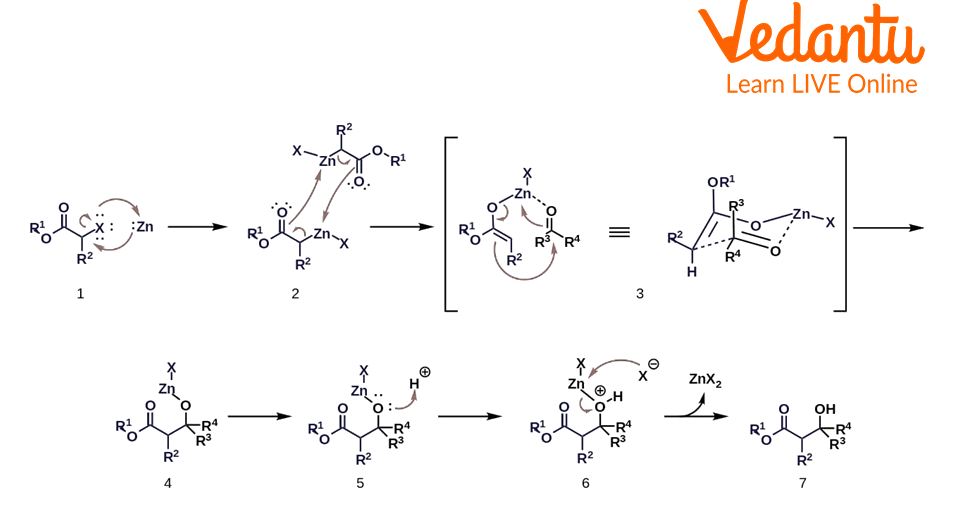
Reformatsky Reaction Mechanism
Advantages of Reformatsky Reaction
Since the Reformatsky enolate is less reactive; hence, the ester group does not undergo nucleophilic addition.
Highly hindered aldehyde or ketones can successfully undergo Reformatsky reaction and nucleophiles can successfully be added to the delta positive carbon of ketones.
The reaction can be adapted to intramolecular aldol condensation very easily.
The organo zinc halide is very stable and it is available in the market.
Reformatsky enolate is an alternative to lithium enolate of ester. Hence, the reaction can be conveniently carried out.
Freshly prepared zinc powder or a heated column of zinc dust can improve the yield of a Reformatsky reaction.
Reformatsky reactions can successfully add carbon nucleophiles to the readily enolizable cyclopentanone ring system.
Uses of Reformatsky Reaction
Reformatsky reaction can be used to produce beta hydroxy ester from alpha halo ester and other carbonyl compounds. The beta hydroxy ester can hydrolysed to produce beta hydroxy acids. Beta hydroxy acids have a large commercial value especially in the cosmetic industry. Beta hydroxy acids can be used in anti-ageing creams and in the pharmaceutical industry.
How Esters can Convert to Aldehyde?
Ester to aldehyde reduction reaction occurs using certain reducing agents. DIBAL-H is the common reducing agent by which ester can be reduced to aldehyde. DIBAL-H is diisobutyl aluminium hydroxide. In order to prevent further reaction of aldehyde, the reaction is carried out at a very low temperature, approximately -780C. Alcohol is a byproduct of this reaction.
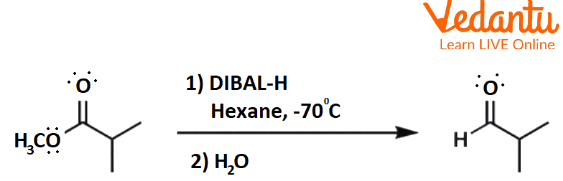
Conversion of Ester to Aldehyde
Interesting Facts
THF complexes of Reformatsky reagents form eight-membered dimers in the solid state.
Various Metals like iron, cobalt, nickel, germanium, cerium, barium, indium, cadmium etc. can be used instead of zinc in the Reformatsky reaction.
Reformatsky reactions of over 500 aldehydes or ketones are identified.
Key Features
Ester can be reduced to aldehyde by using DIBAL-H.
Aldehyde or ketones can react with alpha halo esters and form beta hydroxy esters. This reaction is called the Reformatsky reaction.
Zinc metal is used to generate Reformatsky reagents which are comparatively stable and less reactive than Grignard reagents.


FAQs on Ester to Aldehyde Conversion in Organic Chemistry
1. How can an ester be converted to an aldehyde?
An ester can be converted to an aldehyde by partial reduction using diisobutylaluminium hydride (DIBAL-H) at low temperature. This method stops the reduction at the aldehyde stage instead of forming an alcohol.
- Reagent: DIBAL-H
- Temperature: typically −78°C (to prevent over-reduction)
- Followed by: acidic hydrolysis (H3O+)
RCOOR′ →[DIBAL-H, −78°C][H3O+] RCHO
This is a common laboratory method for selective ester to aldehyde conversion.
2. Which reagent reduces an ester to an aldehyde?
The most commonly used reagent to reduce an ester to an aldehyde is DIBAL-H (diisobutylaluminium hydride). Unlike stronger hydrides, DIBAL-H can stop at the aldehyde stage under controlled conditions.
- Used in non-protic solvents (e.g., toluene)
- Low temperature (−78°C)
- Careful aqueous work-up
3. Why does LiAlH4 not stop at the aldehyde stage when reducing esters?
Lithium aluminium hydride (LiAlH4) does not stop at the aldehyde stage because it is a strong reducing agent that rapidly reduces both esters and the intermediate aldehydes to primary alcohols.
- Step 1: Ester → aldehyde (intermediate)
- Step 2: Aldehyde → primary alcohol (immediate further reduction)
RCOOR′ + 4[H] → RCH2OH + R′OH
Thus, aldehydes cannot be isolated when using LiAlH4.
4. What is the mechanism of ester to aldehyde reduction with DIBAL-H?
The reduction of an ester to an aldehyde with DIBAL-H proceeds via nucleophilic hydride attack followed by elimination and controlled hydrolysis.
- Hydride (H-) attacks the carbonyl carbon of the ester.
- A tetrahedral alkoxide intermediate is formed.
- Alkoxy group (–OR′) leaves, generating an aldehyde–aluminium complex.
- Acidic work-up releases the free aldehyde (RCHO).
5. Can esters be converted to aldehydes by catalytic hydrogenation?
Esters are generally not selectively converted to aldehydes by simple catalytic hydrogenation because hydrogenation usually reduces them further to alcohols.
- Typical catalysts: Pd, Pt, Ni
- Product: primary alcohol (RCH2OH)
6. What is an example of converting an ester to an aldehyde?
A common example is the conversion of methyl benzoate to benzaldehyde using DIBAL-H at low temperature.
- Reactant: C6H5COOCH3 (methyl benzoate)
- Reagent: DIBAL-H (−78°C)
- Work-up: H3O+
C6H5COOCH3 → C6H5CHO
This is a standard laboratory method for preparing benzaldehyde from an ester.
7. What is the difference between reducing an ester to an aldehyde and to an alcohol?
The key difference is the choice of reducing agent: DIBAL-H gives aldehydes, while LiAlH4 gives primary alcohols.
- Ester → Aldehyde: controlled, partial reduction (DIBAL-H, −78°C)
- Ester → Alcohol: complete reduction (LiAlH4)
RCOOR′ →[DIBAL-H] RCHO
RCOOR′ →[LiAlH4] RCH2OH
The difference lies in reaction control and reagent strength.
8. Is ester to aldehyde conversion an oxidation or reduction reaction?
The conversion of an ester to an aldehyde is a reduction reaction because the carbonyl carbon gains hydrogen and decreases in oxidation state.
- Esters have a higher oxidation level than aldehydes.
- Addition of hydride (H-) reduces the carbonyl group.
9. Why is low temperature important in ester to aldehyde reduction with DIBAL-H?
Low temperature (around −78°C) is essential because it prevents over-reduction of the aldehyde to a primary alcohol.
- At higher temperatures, DIBAL-H can continue reducing the aldehyde.
- Cold conditions slow the reaction after aldehyde formation.
10. Can all esters be reduced to aldehydes using DIBAL-H?
Most esters can be reduced to aldehydes using DIBAL-H under controlled conditions, but steric hindrance and functional group sensitivity can affect the yield.
- Simple alkyl and aryl esters work well.
- Bulky esters may react more slowly.
- Other reducible groups (e.g., nitriles) may also react.
