



Explore the Class 8 Social Science Chapter 6 Dynamics of Population Important Questions
The easiest way to find your weak subject spots is to test yourself. Work through the Class 8 Social Science Part 2 Chapter 6 important questions PDF, and you’ll soon know which sections you’ve covered and which you should revisit.
Class 8 Social Science Chapter 6 Important Questions – MCQs
1. What is demography?
(a) The study of natural resources and their distribution
(b) The study of human population and how its characteristics change over time
(c) The study of different types of economic activities
(d) The study of political systems and governments
Answer: (b) The study of human population and how its characteristics change over time
2. Which of the following measures the average number of children a woman is likely to have in her lifetime?
(a) Birth rate
(b) Death rate
(c) Fertility rate
(d) Population growth rate
Answer: (c) Fertility rate
3. Why did the world population grow rapidly after the 1950s?
(a) People stopped migrating between countries.
(b) Birth rates became equal in all countries.
(c) Improvements in healthcare and sanitation reduced deaths.
(d) All countries introduced population control policies.
Answer: (c) Improvements in healthcare and sanitation reduced deaths.
4. A country's population pyramid has a narrow base and a relatively wide upper section. What does this indicate?
(a) A high birth rate and a rapidly growing young population
(b) A large number of children and fewer elderly people
(c) An ageing population with fewer young people
(d) An equal number of people in all age groups
Answer: (c) An ageing population with fewer young people
Class 8 Social Science Chapter 6 Very Short Answer Questions
5. What is a census?
Answer: A census is the official count of people living in a country at a particular time. It collects information about their age, gender, education, occupation and other characteristics. In India, the census is generally conducted every 10 years.
6. What is the replacement-level fertility rate?
Answer: The replacement-level fertility rate is generally about 2.1 children per woman. It is the average number of children needed for one generation to replace itself and maintain a stable population over time, without considering migration.
7. What is sex ratio? State India's sex ratio according to Census 2011.
Answer: Sex ratio is the number of females per 1,000 males in a population. According to the 2011 Census, India's sex ratio was 943 females per 1,000 males.
8. What is child mortality?
Answer: Child mortality refers to deaths among children below five years of age. The child mortality rate measures the number of such deaths per 1,000 live births. It is an important indicator of child health and survival.
Class 8 Social Science Chapter 6 Short Answer Questions
9. How do birth rate, death rate and migration affect the population of a country?
Answer: Birth rate, death rate and migration are three important factors that determine changes in population.
Birth rate: A high birth rate adds more people to the population and contributes to population growth.
Death rate: A lower death rate means more people survive, which can increase the population.
Migration: People moving into a country increase its population, while people moving out reduce its population.
Together, these factors determine whether a country's population grows, declines or remains stable.
10. Explain the three stages of demographic transition.
Answer: Demographic transition explains how birth and death rates change as a country develops.
Stage 1 – High birth and death rates: Both rates are high, so population growth remains slow or stagnant. India experienced this stage during 1901–1921.
Stage 2 – Falling death rate: Better healthcare reduces deaths, but birth rates remain high. This leads to rapid population growth. India experienced rapid growth after 1951.
Stage 3 – Falling birth rate: Death rates remain low, while birth rates begin to fall due to education, urbanisation, higher incomes and greater participation of women in the workforce. Population growth slows down.
India's fertility rate began declining after the mid-1980s and has fallen below the replacement level.
11. Why are fertility rates falling in many countries?
Answer: Several factors have contributed to falling fertility rates in many countries:
Education: Better access to education, especially for girls, has contributed to lower fertility rates.
Women's employment: More women are pursuing formal education and jobs, often marrying later and having fewer children.
Urbanisation: The higher cost of living in cities encourages people to have smaller families.
Changing family size: Many families now prefer to have fewer children than earlier generations.
When fertility rates fall, birth rates also tend to decline. This slows population growth and may eventually lead to a shrinking population.
12. What is a population pyramid? How does its shape help us understand population composition?
Answer: A population pyramid is a graph that shows the population of a country according to age groups and gender.
Its shape helps us understand the population's age structure.
Wide base: Indicates a large number of children and a young, growing population.
Wide middle: Indicates that a large proportion of the population consists of working-age adults.
Wide upper section: Indicates a larger proportion of elderly people and an ageing population.
For example, India's population pyramid has a relatively large working-age group, while Japan's population pyramid shows a greater proportion of elderly people.
Class 8 Social Science Chapter 6 Long Answer Questions
13. How has the population of India and the world changed over time? Explain the main reasons.
Answer: India's and the world's populations have increased considerably over the past several decades. However, the pace of population growth has slowed in recent years.
World population growth:
The world population increased from 2.5 billion in 1950 to about 8.2 billion in 2025.
Improvements in healthcare, vaccination, sanitation and nutrition reduced deaths and helped people live longer.
According to the United Nations projections given in the textbook, the world population is expected to reach 9.7 billion by 2050.
The world population is projected to peak at around 10.3 billion in the mid-2080s before gradually declining as birth rates fall.
India's population growth:
India's population increased from about 361 million in 1951 to an estimated 1.46 billion in 2025.
India surpassed China in 2023 to become the world's most populous country.
Better healthcare and living conditions reduced deaths and contributed to population growth.
India's fertility rate declined from 5.7 in 1950 to an estimated 1.9 in 2025, slowing the pace of population growth.
India's population is still growing, while countries such as Japan, Italy and China are experiencing shrinking or ageing populations.
14. What is demographic dividend? How can India benefit from its large working-age population?
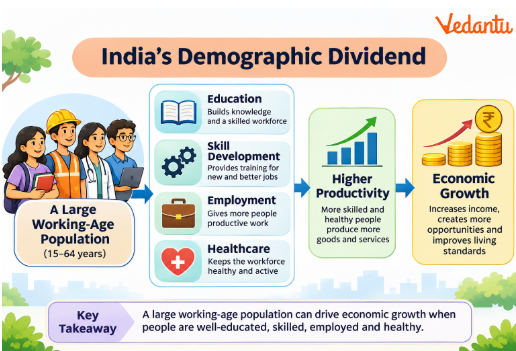
Answer: Demographic dividend is the potential for economic growth that arises when a country has a large proportion of people in its working-age population.
India has a large young population that can contribute to economic growth through employment, production and other economic activities.
Benefits of demographic dividend:
Larger workforce: More people can work in farms, factories, offices and businesses.
Higher production: A larger working population can increase the production of goods and services.
Economic growth: When more people work and earn money, economic activities increase.
Higher tax revenue: The government collects taxes and uses the money to build schools, hospitals, roads and other public facilities.
How India can make use of its demographic dividend:
Provide good education and skill training.
Create employment opportunities for young people.
Improve healthcare and nutrition.
Encourage women's participation in the workforce.
Provide childcare facilities and supportive working conditions.
According to the textbook's projections, India's population will begin moving towards an older age structure after 2050. Therefore, India needs to invest in education, employment and healthcare to make the most of its demographic dividend.
15. What challenges do countries face due to an ageing population? How can they address these challenges?
Answer: An ageing population means that elderly people form an increasing share of the total population. This happens when birth rates fall and people live longer.
Countries such as Japan and Italy are experiencing population ageing.
Challenges of an ageing population:
Shortage of workers: As more people retire, fewer young workers are available to replace them.
Higher healthcare needs: Elderly people often require more healthcare facilities and support.
Pressure on pensions: Governments may face difficulties in providing pensions and other services because there are fewer young taxpayers.
Slower economic growth: A smaller workforce may reduce production and slow economic activity.
Greater need for elderly care: Families and governments need to provide more support and care for older people.
Measures to address these challenges:
Improve healthcare facilities for elderly people.
Use technology and automation to manage labour shortages.
Support older people who wish to continue working.
Provide community centres and services for elderly care.
For example, the textbook explains that Japan has raised the retirement age and uses technology, automation and care assistants to support its ageing population.
16. Why do people migrate from one place to another? Explain the effects of migration on cities and villages.
Answer: Migration refers to the movement of people from one place to another, within a country or across countries, to settle temporarily or permanently.
People migrate for several reasons.
Reasons for migration:
Employment: People move to places where they can find better jobs.
Education: Students and families may move to areas with better educational facilities.
Better opportunities: People may move to places that offer better living conditions and services.
Natural disasters: Floods, droughts and other disasters may force people to leave their homes.
Political instability: Conflicts and unsafe conditions may cause people to migrate.
Effects of migration on cities:
Migration increases the population of cities.
It can increase the availability of workers.
A large population can put pressure on water, air, land and housing.
Overcrowding may increase traffic congestion and strain transport services.
Effects of migration on villages:
Villages may lose young working-age people.
Farms and local businesses may face worker shortages.
Some families may depend on money sent home by members working in cities.
Cities such as Delhi, Mumbai and Bengaluru have experienced significant population growth due to migration.
Migration changes the distribution of population and affects the availability of resources, services and employment opportunities.
Use Vedantu's Solved Questions to Connect Population Trends with Everyday Life
Population changes affect more than a country's total population. They influence the need for schools, employment, hospitals, housing and transport.
Vedantu's Class 8 Social Science Chapter 6 important questions and answers help students connect these changes with textbook examples.
For instance, students can:
Explain why areas with more children need additional schools.
Identify why a large working-age population needs employment opportunities.
Understand why ageing societies require more healthcare and elderly care.
Describe how migration increases the demand for housing and transport in cities.
Compare past population figures with future projections.
Students should attempt the questions independently before checking the answers. The Class 8 Social Science Chapter 6 important questions PDF download is useful for practising these explanations alongside the textbook.
Class 8 Social Science Part 2 Chapter 6 Dynamics of Population Study Materials
Use these resources to study Dynamics of Population and practise chapter questions.
Class 8 Social Science Chapter-Wise Important Questions
Practise questions from other chapters of Exploring Society: India and Beyond.
Additional Study Materials for Class 8 Social Science
FAQs on Important Questions and Answers 2026–27 for Class 8 Social Science (Exploring Society: India and Beyond Part 2) Chapter 6 Dynamics of Population
1. What is the difference between a census and a population projection?
A census counts people living in a country at a particular time. A population projection estimates how the population may change in the future. Governments use census records and demographic trends to prepare these projections.
2. What does median age tell us about a country's population?
Median age divides a population into two equal groups. Half the people are younger than this age, and half are older. The textbook shows India's median age as 28 years and Japan's as 50 years. This helps explain differences in their age structures.
3. How does women's literacy relate to fertility rates in Indian States?
The textbook compares women's literacy and fertility rates across States. In the figures shown, Bihar has a lower female literacy rate and a higher fertility rate than States such as Karnataka and Punjab. Education can influence decisions about marriage and family size.
4. Why do working women sometimes face a double burden?
The double burden means managing responsibilities at work and at home. Many women must balance their jobs with household duties and childcare. The textbook explains that daycare centres, flexible working hours and family support can help women participate in the workforce.
5. How do elderly people contribute to families and society?
Older people share their knowledge, experience and skills with younger generations. They may guide family members, tell stories, pass on cultural traditions and help with community activities. Their contributions remain important even after they retire from regular employment.
6. How does Vedantu help students prepare for Class 8 Social Science Chapter 6 important questions?
Vedantu's Class 8 Social Science Chapter 6 important questions and answers PDF provides solved MCQs, very short answers, short answers and long answers. Students can practise demographic indicators, population trends and graph-based concepts. They can also use Vedantu's NCERT Solutions and revision notes for additional preparation.
