



Class 8 Social Science Chapter 5 Important Questions and Answers on Citizenship: Rights and Duties
The Class 8 Social Science Chapter 5 important questions PDF can help you identify which section of each chapter needs extra attention. Start by solving these questions to see whether you have covered the important sections.
Class 8 Social Science Part 2 Chapter 5 Important Questions – MCQs
1. Which Act sets the rules for gaining or losing Indian citizenship?
(a) Indian Contract Act, 1872
(b) Citizenship Act, 1955
(c) Right to Education Act, 2009
(d) Representation of the People Act, 1951
Answer: (b) Citizenship Act, 1955
2. Which Article of the Indian Constitution guarantees equality before the law?
(a) Article 14
(b) Article 19
(c) Article 21
(d) Article 32
Answer: (a) Article 14
3. Which of the following is a Fundamental Duty of Indian citizens?
(a) To receive free public transport
(b) To protect and improve the natural environment
(c) To choose any government job
(d) To receive free housing
Answer: (b) To protect and improve the natural environment
4. Gaganjit uses a wheelchair but cannot enter an exhibition hall because there is no ramp. Which action would help ensure inclusion?
(a) Asking Gaganjit to visit another exhibition
(b) Allowing Gaganjit to enter only with help from others
(c) Building a ramp to provide equal access
(d) Excluding Gaganjit from exhibition activities
Answer: (c) Building a ramp to provide equal access
5. Which statement correctly explains the relationship between rights and duties?
(a) Citizens can enjoy rights without respecting others.
(b) Rights allow citizens to live with dignity, while duties remind them to use their freedom responsibly.
(c) Duties are important only for government officials.
(d) Rights and duties have no connection with each other.
Answer: (b) Rights allow citizens to live with dignity, while duties remind them to use their freedom responsibly.
6. Which Article provides free and compulsory education for children aged 6 to 14 years?
(a) Article 17
(b) Article 19
(c) Article 21A
(d) Article 32
Answer: (c) Article 21A
Class 8 Social Science Chapter 5 Very Short Answer Questions
7. Who is a citizen?
Answer: A citizen is someone who legally belongs to a country and is a member of its political community. Citizenship gives people rights and duties and allows them to participate in the country's decision-making.
8. What is the Right to Constitutional Remedies?
Answer: The Right to Constitutional Remedies allows citizens to approach the Supreme Court under Article 32 if their Fundamental Rights are violated. It helps protect and enforce these rights.
9. How many Fundamental Duties are listed in the Indian Constitution?
Answer: The Indian Constitution lists 11 Fundamental Duties under Article 51A. Ten duties were added in 1976, and the eleventh was added in 2002
10. What is the difference between equality and equity?
Answer: Equality means providing everyone with the same support. Equity means providing people with the support they need, taking their different circumstances into account.
11. What is invisible discrimination? Give one example.
Answer: Invisible discrimination is unfair treatment that may not be easy to notice. For example, excluding a classmate from a group project because of their economic background is a form of invisible discrimination.
Class 8 Social Science Chapter 5 Short Answer Questions
12. Name the six Fundamental Rights guaranteed by the Indian Constitution.
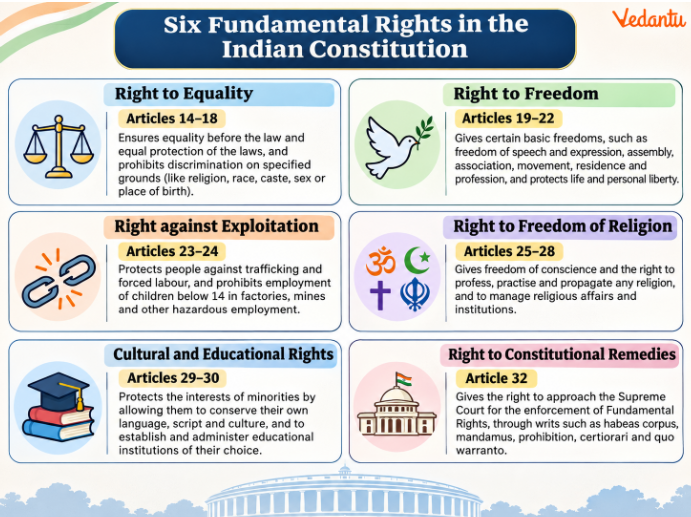
Answer: The Indian Constitution provides six broad categories of Fundamental Rights:
Right to Equality: Articles 14–18
Right to Freedom: Articles 19–22
Right against Exploitation: Articles 23–24
Right to Freedom of Religion: Articles 25–28
Cultural and Educational Rights: Articles 29–30
Right to Constitutional Remedies: Article 32
These rights protect people's freedom, equality and dignity. People can approach the courts for justice if their Fundamental Rights are violated.
13. Why are rights and duties considered two sides of the same coin?
Answer: Rights and duties go together because citizens must respect others' rights while enjoying their own.
Rights allow citizens to live with freedom and dignity.
Duties remind citizens to use their freedom wisely and respectfully.
The right to express opinions comes with the duty to listen to and respect others' views.
The right to receive respect comes with the duty to treat others respectfully.
Fulfilling our duties helps protect everyone's rights and keeps society fair and peaceful.
14. What is exploitation? How does the Right against Exploitation protect children?
Answer: Exploitation means taking unfair advantage of others by denying them basic respect, liberty and rights.
The Right against Exploitation protects children in the following ways:
It prohibits human trafficking and forced labour.
It protects children from unsafe and harmful working conditions.
In general, children below 14 years cannot be employed. However, they may help in non-hazardous family enterprises after school hours or during vacations, as permitted by law.
It prohibits children from working in places such as factories and mines.
These protections help children receive education and enjoy a healthy childhood. Children facing exploitation can seek help through the child helpline 1098.
15. Explain the Right to Freedom of Religion and Cultural and Educational Rights.
Answer: These Fundamental Rights protect India's religious and cultural diversity.
Right to Freedom of Religion:
It allows every person to choose, practise and share their religion freely.
No one can be forced to follow or propagate a particular religion.
State-run or government-aided schools cannot promote a particular religion.
Cultural and Educational Rights:
These rights protect the languages, scripts and traditions of different communities.
Religious and linguistic minorities can establish and manage their own educational institutions.
Students cannot be denied admission to government educational institutions on grounds such as religion, caste, race or language.
These rights protect cultural identity and promote equality and non-discrimination.
16. How does discrimination affect people and society? Explain with examples.
Answer: Discrimination means treating a person or group unfairly because of their caste, religion, gender, disability, physical appearance or economic background.
Discrimination affects people and society in several ways:
Unequal opportunities: Girls may be denied the chance to participate in activities that boys can join.
Exclusion: Students may be left out of group activities because of their social or economic background.
Emotional harm: Teasing or insulting someone because of their appearance can make them feel hurt and unwanted.
Social barriers: Discrimination prevents people from enjoying their rights and participating equally in society.
For example, Sanya's classmates judged her appearance and discouraged her from auditioning for the school play. However, her acting and confidence impressed the teachers, and they selected her for an important role.
Discrimination creates divisions in society. Citizens should stand against unfair treatment and respect others.
Class 8 Social Science Chapter 5 Long Answer Questions
17. What does it mean to be a responsible citizen? Explain how citizens can contribute to society.
Answer: A citizen is someone who legally belongs to a country and has certain rights and duties. Citizenship is both a legal identity and a social responsibility.
A responsible citizen contributes to society in the following ways:
Obeying laws: Citizens should follow the country's laws and respect the Constitution.
Respecting others: They should treat people fairly, regardless of their religion, language, caste or background.
Helping people: They should help those in need and speak against unfair treatment.
Protecting the environment: They should keep their surroundings clean, save natural resources and care for animals.
Participating in community activities: They should take part in activities that improve their neighbourhood and society.
Respecting others' rights: They should enjoy their own rights without harming or denying others' rights.
For example, Sonali and Harshada stopped other students from teasing Kruti because of her accent. They also invited her to join their badminton team so that she would feel welcome and included.
Their actions show that responsible citizens stand against unfair treatment and help others feel respected.
18. Explain the importance of Fundamental Duties. Describe any six Fundamental Duties of Indian citizens.
Answer: Fundamental Duties are the responsibilities that citizens should fulfil towards their country, society and environment. The Constitution lists 11 Fundamental Duties under Article 51A.
Six important Fundamental Duties are:
Respect the Constitution and national symbols: Citizens should respect the Constitution, the National Flag and National Anthem.
Protect India's unity, integrity and sovereignty: Citizens should work towards maintaining national unity and respect people from different communities.
Promote harmony: Citizens should promote harmony among all people and respect the dignity of women.
Preserve culture and heritage: Citizens should protect historical monuments, cultural traditions and India's rich heritage.
Protect the environment: Citizens should protect forests, rivers and wildlife. They should also show compassion towards animals.
Develop scientific temper: Citizens should ask questions, seek knowledge and develop a spirit of inquiry.
Fundamental Duties encourage citizens to maintain unity, protect nature and contribute to the country's progress. They help build a responsible and caring society.
19. Explain equality, equity and inclusion. Why are they important in society?
Answer: Equality, equity and inclusion help create a society where everyone receives fair treatment and has opportunities to participate.
Equality
Equality means treating everyone equally before the law and providing equal opportunities without discrimination.
For example, both boys and girls should have equal opportunities to participate in school debates and competitions.
Equity
Equity means providing people with the support they need according to their circumstances. Giving everyone the same support may not always provide the same benefits.
For example, a student with a visual impairment may need Braille books or a tactile map to participate in classroom activities.
Inclusion
Inclusion means creating an environment where everyone feels welcomed, respected and valued. It also means removing barriers that prevent people from participating.
For example, schools can build ramps for wheelchair users and provide books in different languages.
Importance of equality, equity and inclusion:
Equality protects people from unfair treatment.
Equity helps people overcome existing inequalities.
Inclusion ensures that no one is left out because of their background or abilities.
Together, they provide people with opportunities to learn, work and participate in society.
These principles help build a society where everyone can live with dignity and respect.
20. What can be done in the following situations to protect rights and prevent discrimination?
(a) A school does not allow girls to join a mathematics or science club.
(b) A student has dropped out of school because they are forced to work in a welding shop.
Answer:
(a) A school does not allow girls to join a mathematics or science club.
The school is treating girls unfairly by denying them equal opportunities. The following steps can help:
Students can bring the matter to the attention of their teachers or principal.
They can explain that girls and boys should receive equal opportunities to participate in school activities.
The school should allow girls to join mathematics and science clubs.
Teachers should encourage all students to participate according to their interests and abilities.
These steps support equality and prevent gender-based discrimination.
(b) A student is forced to work in a welding shop instead of attending school.
Forcing a child to work in a hazardous environment can violate the Right against Exploitation and interfere with the Right to Education.
The following steps can help:
Students can inform a trusted teacher or principal about the situation.
They can seek help through the child helpline 1098.
The concerned authorities can investigate the matter and take appropriate action to protect the child.
The child should receive support to return to school and continue their education.
The Constitution protects children from exploitation and provides free and compulsory education for children aged 6 to 14 years under Article 21A.
Protecting children's rights helps them receive education, safety and opportunities for a better future.
Important Topics and Preparation Tips for Class 8 Social Science Part 2 Chapter 5
The Class 8 Social Science Chapter 5 important questions and answers cover the main ideas of citizenship. Learn these topics before practising the solved questions.
Understand Your Rights and Duties the Easy Way with Vedantu
Vedantu's Class 8 Social Science Part 2 Chapter 5 important questions and answers help students understand rights and duties through textbook-based practice.
Different question types develop different skills:
MCQs: Remember important constitutional Articles, Acts and Fundamental Duties.
Very short answers: Write definitions of citizenship, equality, equity and discrimination.
Short answers: Explain Fundamental Rights and how they protect people.
Long answers: Use textbook examples to explain responsible citizenship and inclusion.
Students can use the Social Science Class 8 Chapter 5 question answer collection to practise writing responses in their own words. Vedantu's solved answers help them check the important points.
Class 8 Social Science Part 2 Chapter 5 Citizenship: Rights and Duties Study Materials
Use these study materials to understand Citizenship: Rights and Duties and practise textbook questions.
Class 8 Social Science Chapter-Wise Important Questions
Find more chapter-wise questions from Exploring Society: India and Beyond.
Additional Study Materials for Class 8 Social Science
FAQs on Important Questions and Answers 2026–27 for Class 8 Social Science (Exploring Society: India and Beyond – Part 2) Chapter 5 Citizenship: Rights and Duties
1. What is the difference between visible and invisible discrimination?
Visible discrimination involves unfair treatment that people can easily notice, such as openly mocking someone's appearance. Invisible discrimination is less obvious. It may involve quietly excluding someone because of their social or economic background. Both forms can hurt people and deny them equal opportunities.
2. What is the purpose of the Beti Bachao Beti Padhao campaign?
The Beti Bachao Beti Padhao campaign aims to improve girls' status in society. It promotes awareness about gender equality and supports girls' education. The chapter mentions it as an example of efforts to address existing inequalities.
3. What is the meaning of dharma and rina in the context of duties?
Dharma refers to duties and actions that benefit people and society. Rina means a debt or obligation towards parents, teachers, ancestors, fellow human beings and nature. Both ideas remind people of their responsibilities towards others.
4. Why is developing scientific temper considered a Fundamental Duty?
Developing scientific temper encourages citizens to ask questions, seek evidence and think logically. It helps people examine information instead of accepting everything without questioning it. Article 51A includes the duty to develop scientific temper, humanism and the spirit of inquiry and reform.
5. Why are Fundamental Duties not always enforceable by courts?
Fundamental Duties guide citizens in fulfilling their responsibilities towards society and the country. Unlike Fundamental Rights, courts cannot enforce them directly. However, laws may provide penalties for certain actions that violate these responsibilities.
6. How can Vedantu help students prepare for Class 8 Social Science Chapter 5 school exams?
Vedantu provides Class 8 Social Science Chapter 5 important questions and answers covering Fundamental Rights, Fundamental Duties, discrimination and inclusion. Students can practise solved MCQs, short answers and long answers. They can also use the chapter PDF, NCERT Solutions and revision notes to prepare for school exams.
