



Understand the Role of the Judiciary in Our Society through Class 8 Social Science Part 2 Chapter 4 Questions
The Class 8 Social Science Part 2 Chapter 4 Important Questions PDF helps you revise key topics, practise important questions, and identify areas that need more attention. Use these solved questions to strengthen your understanding of Chapter 4 and prepare confidently for Class 8 Social Science exams.
Class 8 Social Science Chapter 4 Important Questions MCQs
1. The Preamble to the Constitution of India promises all citizens which kinds of justice?
(a) Social, economic and political
(b) Social, religious and cultural
(c) Economic, legal and moral
(d) Political, cultural and legal
Answer: (a) Social, economic and political
2. Under which Article can a citizen file a writ petition directly before the Supreme Court for the enforcement of Fundamental Rights?
(a) Article 131
(b) Article 143
(c) Article 32
(d) Article 226
Answer: (c) Article 32
3. At what age do High Court judges retire?
(a) 60 years
(b) 62 years
(c) 65 years
(d) 70 years
Answer: (b) 62 years
4. A factory is polluting a river. Which tribunal would decide this matter?
(a) National Company Law Tribunal
(b) Central Administrative Tribunal
(c) National Green Tribunal
(d) Appellate Tribunal for Electricity
Answer: (c) National Green Tribunal
5. Which of the following disputes does NOT come under the original jurisdiction of the Supreme Court (Article 131)?
(a) A dispute between the Centre and a State
(b) A river water dispute between two States
(c) A dispute between the Centre and a State on one side and another State on the other side
(d) A dispute between two private companies over a business deal
Answer: (d) A dispute between two private companies over a business deal
Class 8 Social Science Chapter 4 Very Short Answer Questions
6. What is the motto of the Supreme Court of India, and what does it mean?
Answer: The motto is ‘yato dharmastato jayah’, which means ‘Where there is dharma, there is victory.’
7. Who appoints the District Judges in a State?
Answer: The Governor of the State appoints the District Judges in consultation with the High Court (Article 233).
8. Who is a litigant?
Answer: A litigant is a person involved in a legal case. Both the person who sues and the person who gets sued are called litigants.
9. How many judges must hear a case when the President seeks the opinion of the Supreme Court under Article 143?
Answer: A Constitution Bench of at least five judges must hear such cases.
Class 8 Social Science Chapter 4 Short Answer Questions
10. What is the difference between substantive justice and procedural justice?
Answer:
Substantive justice focuses on the final result or outcome. It asks whether the decision is actually fair, just and reasonable.
Procedural justice means that every person involved gets a full opportunity to be heard before the court takes a decision.
As a rule, every person is presumed innocent until proved guilty.
11. Why were many laws from the colonial era repealed after Independence? Give two examples.
Answer:
After Independence, hundreds of laws made during British rule were found to be discriminatory and against the basic principles of a democratic country.
The government reviewed such laws and has repealed over 1500 of them.
Examples:
The Criminal Tribes Act, 1871, which labelled certain communities as criminals by birth.
The Vernacular Press Act, 1878, which restricted the freedom of the press.
12. What is Public Interest Litigation (PIL)? Explain with reference to the first reported PIL case.
Answer:
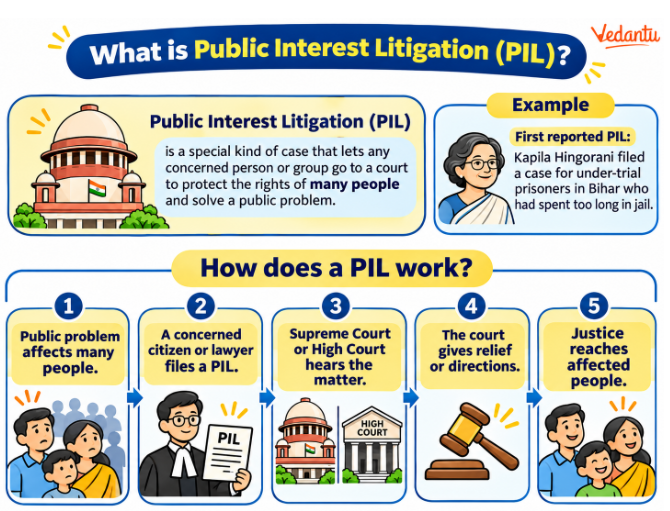
PIL is an innovation introduced by the Supreme Court to address issues of public concern and give meaning to the Right to Life under Article 21. A PIL can be filed under Articles 32 and 226.
The first reported PIL was filed by a lawyer, Mrs Kapila Hingorani. She read in a newspaper that some under-trial prisoners in Bihar had been in jail longer than the punishment they would have received if found guilty.
She filed a writ petition for their release. The Supreme Court immediately ordered their release and issued guidelines to release almost 40,000 under-trial prisoners across India.
13. How is arbitration different from mediation?
Answer:
Class 8 Social Science Chapter 4 Long Answer Questions
14. Describe the structure of the judicial system in India.
Answer:
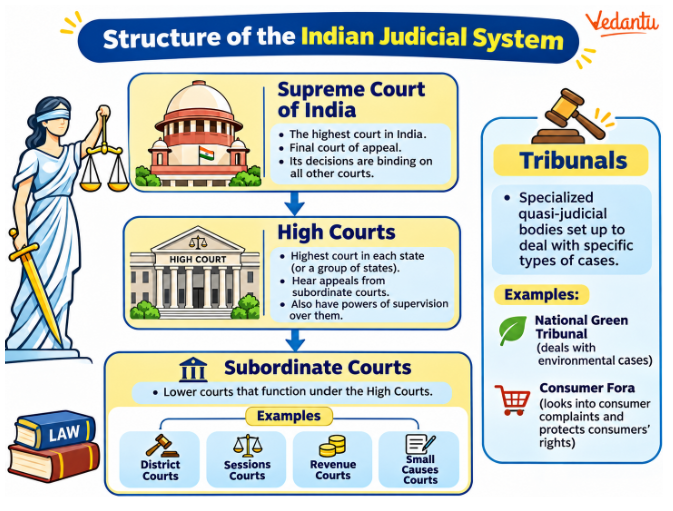
A unified system: The Indian judicial system is a unified system with a hierarchy of courts. The Supreme Court is at the apex level, the High Courts are at the State level, and the Subordinate Courts are at the District level.
Supreme Court: It is the highest court of law in the country. It came into existence on 26 January 1950, when the Constitution came into effect. Article 124 establishes it, and it is seated in New Delhi. It is headed by the Chief Justice of India, and its current strength is 33+1, that is, the Chief Justice of India and 33 judges.
High Courts: A High Court is the highest court at the State level (Article 214). India has 25 High Courts, because some States and Union Territories share a common High Court. For example, the Bombay High Court covers Maharashtra, Goa, and the Union Territory of Dadra & Nagar Haveli and Daman & Diu.
Subordinate Courts: These courts are below the High Courts in each State. Articles 233 to 237 of the Constitution regulate them. They include District Courts, Sessions Courts, Revenue Courts and Small Causes Courts. In these courts, the judiciary comes into close contact with the people.
Tribunals: Apart from the courts, specialised tribunals are set up under various laws. They are quasi-judicial and decide specific categories of disputes. Examples include the National Green Tribunal and the Consumer Fora.
15. Explain the different types of jurisdiction of the Supreme Court of India.
Answer:
Writ jurisdiction (Article 32): A citizen can file a writ petition directly before the Supreme Court to enforce Fundamental Rights when the issue has all-India ramifications.
Original jurisdiction (Article 131): The Supreme Court alone decides disputes between the Centre and a State, between the Centre and a State on one side and another State on the other, and between States, such as river water disputes.
Appellate jurisdiction: The Supreme Court can hear an appeal from any final order of a High Court if the High Court itself certifies that the case involves interpretation of the Constitution or a substantial question of law (Articles 132, 133 and 134A). It can also hear criminal cases involving a death sentence or those certified as fit for appeal (Articles 134 and 134A). It also hears appeals from tribunals like the NGT and NCLAT.
Advisory jurisdiction (Article 143): If the President seeks its opinion on a question of law or fact of public importance, the Supreme Court can give its opinion.
Special Leave Petitions (Article 136): The Supreme Court has an extraordinary discretionary power to grant special leave to appeal from any judgment, decree or order of any court or tribunal in India. It does so where a question of law of general public importance has arisen, or to do substantive justice between the parties.
The law declared by the Supreme Court is binding on all courts in India (Article 141).
16. Courts in India have a very large number of pending cases. How do alternate modes of dispute resolution and digital technology help reduce this burden?
Answer:
Alternate modes of dispute resolution: To reduce the burden on the judiciary, courts encourage litigants to settle disputes through arbitration, mediation, conciliation, negotiation, and Lok Adalats.
Arbitration: The parties refer their dispute to an arbitrator, such as a retired judge, a lawyer or an expert. The decision is final and legally binding.
Mediation: A mediator helps the parties reach a settlement on their own. It is the most common form of alternative dispute resolution.
Lok Adalats: These are people’s courts where disputes are settled amicably. They can resolve cases pending in courts, and in some cases parties can approach them even before going to court. They work under the Legal Services Authorities Act, 1987, and aim to reduce the backlog of cases.
Gram Nyayalayas: These are mobile, village-level courts set up under the Gram Nyayalayas Act, 2008. They follow a simple procedure with no technicalities and reduce the burden on regular courts.
Digital technology:
Litigants can check case details directly instead of relying only on their lawyers.
e-Filing, hybrid hearings, live streaming of court proceedings and translation of judgments into multiple Indian languages make the system more user-friendly.
The National Judicial Data Grid and the Virtual Justice Clock at the Supreme Court give the public free access to real-time judicial data.
Together, these steps make the judicial system more accessible and transparent and help reduce the load on regular courts.
Class 8 Social Science Part 2 Chapter 4 Important Topics and Preparation Tips
Focus on the structure of courts, judicial powers and different ways to seek justice. The table covers the main topics from Class 8 Social Science Chapter 4 important questions and answers.
Preparation Tips for Class 8 Social Science Chapter 4
Start with MCQs: Practise facts about constitutional Articles, courts and tribunals.
Learn the court hierarchy: Remember the roles of the Supreme Court, High Courts and subordinate courts.
Compare concepts: Write differences between substantive and procedural justice, and between arbitration and mediation.
Read textbook cases: Understand Kapila Hingorani's PIL and the examples of discriminatory colonial laws.
Practise long answers: Use headings and points to explain court structure and judicial powers.
Check your answers: Use the Class 8 Social Science Chapter 4 important questions PDF to identify missing facts.
Why Choose Vedantu's Class 8 Social Science Part 2 Chapter 4 Important Questions
Vedantu's Class 8 Social Science Part 2 Chapter 4 important questions and answers cover the main topics of The Role of the Judiciary in Our Society. Students can practise different question types and check their understanding of the chapter.
MCQs help students remember facts and constitutional Articles.
Short answers cover legal terms, justice and important court cases.
Long answers explain judicial powers and methods of dispute resolution.
Solved questions help students organise answers with clear points.
The Class 8 Social Science Chapter 4 important questions and answers PDF supports regular practice alongside the textbook.
Class 8 Social Science Part 2 Chapter 4 The Role of the Judiciary in Our Society Study Materials
Use these resources to understand the chapter and practise additional questions.
Class 8 Social Science Chapter-Wise Important Questions
Practise important questions from other chapters of Exploring Society: India and Beyond.
Additional Study Materials for Class 8 Social Science
FAQs on Important Questions and Answers 2026-2027 for Class 8 Social Science (Exploring Society: India and Beyond, Part 2) Chapter 4 The Role of the Judiciary in Our Society
1. What is the role of the High Court under Article 227 of the Constitution?
Article 227 gives High Courts the power to supervise subordinate courts and tribunals within their territorial jurisdiction. This helps ensure that these courts and tribunals exercise their powers within the limits of the law.
2. What is the difference between a Supreme Court judge and a High Court judge's retirement age?
A Supreme Court judge retires at 65 years, while a High Court judge retires at 62 years. The Constitution provides these retirement ages for judges of the two courts.
3. What is the role of the National Company Law Tribunal (NCLT)?
The National Company Law Tribunal deals with corporate and commercial disputes. It also handles matters related to insolvency and bankruptcy under the relevant laws.
4. What is the importance of Article 142 of the Indian Constitution?
Article 142 allows the Supreme Court to pass orders necessary to do complete justice in cases before it. This power helps the Court provide appropriate relief when deciding a matter.
5. What is the difference between a Consumer Commission and the National Green Tribunal?
Consumer Commissions hear complaints about goods and services, such as disputes between buyers and builders. The National Green Tribunal handles environmental matters, including pollution and environmental protection.
6. How does Vedantu help students prepare for Class 8 Social Science Chapter 4 important questions?
Vedantu provides Class 8 Social Science Chapter 4 important questions and answers in PDF, covering MCQs, very short answers, short answers, and long answers. Students can practise these questions and use Vedantu's NCERT Solutions and revision notes to understand the chapter's important concepts.
