



Practise Class 7 Social Science Part 2 Chapter 2 Questions on India and Her Neighbours
Study how mountains, rivers and seas connect India with neighbouring countries. Practise these solved questions to explain shared traditions, trade links and regional cooperation through clear examples, comparisons and picture-based situations.
Class 7 Social Science Part 2 Chapter 2 Important MCQs with Answers
Q1. Which statement best explains India’s wider neighbourhood?
A. It includes only countries sharing a land border with India.
B. It includes countries connected with India through land and sea.
C. It includes only countries north of the Himalayas.
D. It excludes island countries.
Answer: B. It includes countries connected with India through land and sea.
Q2. Which water body separates India and Sri Lanka?
A. Red Sea
B. Persian Gulf
C. Palk Strait
D. Mediterranean Sea
Answer: C. Palk Strait.
Q3. Which country is known as the “Land of the Thunder Dragon”?
A. Nepal
B. Bhutan
C. Myanmar
D. Thailand
Answer: B. Bhutan.
Q4. Which language connects Bangladesh with the Indian state of West Bengal?
A. Bangla
B. Marathi
C. Punjabi
D. Gujarati
Answer: A. Bangla.
Class 7 Social Science Part 2 Chapter 2 Very Short Answer Questions
Q5. What does regional cooperation mean?
Answer:
Regional cooperation means neighbouring countries working together on shared concerns, such as trade, development, environmental protection and disaster relief.
Q6. Why is Myanmar described as India’s gateway to Southeast Asia?
Answer:
Myanmar connects India’s northeastern region with Southeast Asia. Its location supports land routes, trade and cultural exchanges between these regions.
Q7. What does the name Singapore mean?
Answer:
Singapore derives its name from Singapuram, meaning “lion city”.
Class 7 Social Science Part 2 Chapter 2 Short Answer Questions
Q8. How do the rivers shared by India and Bangladesh connect people’s livelihoods?
Answer:
Agriculture: River water supports crop cultivation.
Fisheries: Fish provide food and income.
Transport: Waterways help move people and goods.
Shared concerns: Flooding, water availability and environmental changes affect communities in both countries.
These connections make cooperation important for people living along the river systems.
Q9. Explain how hydropower supports cooperation between India and Bhutan.
Answer:
Rivers flowing through Bhutan provide opportunities to generate hydroelectricity.
India has supported hydropower projects in Bhutan.
These projects contribute to Bhutan’s economic development.
Electricity supplied to India supports its energy needs.
Hydropower links a natural resource with economic cooperation between the two countries.
Q10. Imagine you are travelling on an ancient ship carrying textiles, spices and Buddhist manuscripts from India. Explain what this journey could carry to other lands besides goods.
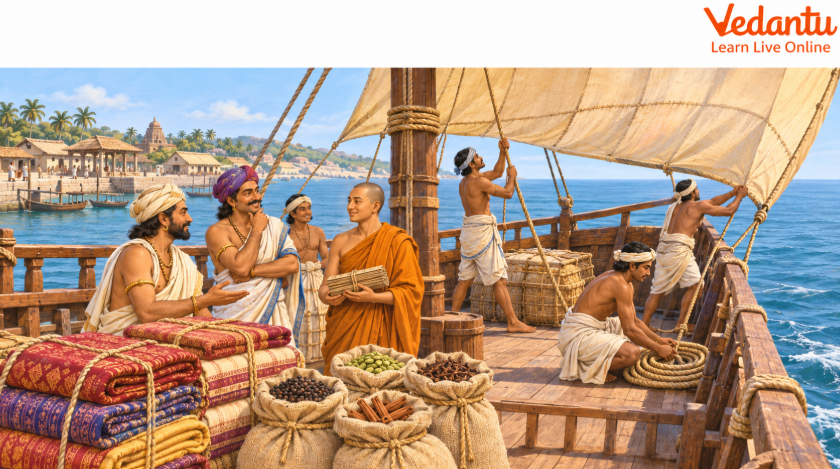
Answer:
Besides goods, the journey could carry:
Religious ideas: Monks shared Buddhist teachings and texts.
Languages and knowledge: Travellers exchanged words, stories and information.
Cultural practices: Contact introduced people to different foods, customs and artistic traditions.
Ports became meeting places where people learned from one another.
Class 7 Social Science Part 2 Chapter 2 Long Answer Questions
Q11. Explain how India’s connections with neighbouring countries take different forms. Present four examples in a table.
Answer:
These examples show that neighbouring relationships develop through knowledge, natural resources, livelihoods and trade—not only through shared borders.
Q12. What evidence shows that Indian cultural traditions travelled to Thailand and Indonesia?
Answer:
Thailand
The name Ayutthaya is connected with Ayodhya.
Buddhism forms an important part of the country’s cultural heritage.
Stories and figures from Indian epics appear in Thai literature, dance and ceremonies.
Indonesia
Performances of the Ramayana show how epic stories became part of local cultural traditions.
The Borobudur Stupa reflects the historical presence of Buddhism.
Long-standing sea routes enabled merchants, scholars and religious travellers to exchange ideas.
People in these regions adapted these influences into their own artistic and cultural traditions.
Q13. Observe the illustration of a coastal warning system. Explain how sharing warnings can help Indian Ocean neighbours prepare for a tsunami.
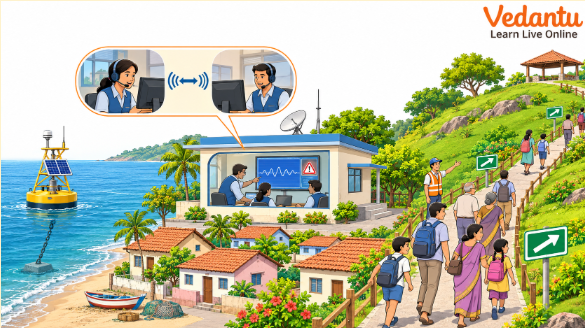
Answer:
The 2004 Indian Ocean tsunami showed that a disaster originating near one country can affect many distant coastlines.
Cooperation helps in several ways:
Monitoring: Sensors and other equipment provide information about earthquakes and sea-level changes.
Sharing information: Warning centres communicate alerts to neighbouring countries.
Local warnings: Authorities inform coastal communities about possible danger.
Preparedness: Clear evacuation routes and public awareness help people respond.
Regional support: Countries can coordinate relief and assistance after a disaster.
The Indian Tsunami Early Warning Centre in Hyderabad contributes to warnings for India and other countries in the region. Early information gives communities valuable time to take protective action.
Strengthen Your India and Her Neighbours Class 7 Questions and Answers
A strong answer explains how a connection works, rather than only naming a country. Use India and Her Neighbours Class 7 extra questions and answers to build these links:
Shared rivers and daily life: Explain how rivers support farming, fishing and transport in India and Bangladesh.
Resources and development: Connect Bhutan’s hydropower projects with electricity supply and economic cooperation.
Trade and cultural exchange: Describe how sea journeys carried languages, beliefs and traditions alongside goods.
Regional safety: Show why sharing tsunami warnings matters to countries around the Indian Ocean.
For longer responses, follow country → connection → example → importance to keep your points clear and relevant.
Practise Social Science Class 7 Chapter 2 Question Answers with Vedantu
Vedantu’s solved questions help you check both factual knowledge and your ability to explain relationships. Use this Social Science Class 7 Chapter 2 Question Answer collection to improve specific skills:
Recall accurately: Answer the MCQs before checking country names, languages and geographical features.
Explain picture clues: Connect the ship’s cargo with trade and the manuscripts with the movement of knowledge.
Compare examples: Use the neighbour-connections table to distinguish cultural, economic and geographical ties.
Complete every part: If a question asks for activities and their effects, include both.
Write independently: Read the solution, close it and explain the idea in your own words.
Class 7 Social Science Part 2 Chapter 2 India and Her Neighbours Study Materials
Class 7 Social Science Chapter-wise Important Questions
Important Study Materials for CBSE Class 7 Social Science
FAQs on Important Questions for Class 7 Social Science (Exploring Society: India and Beyond Part 2) Chapter 2 India and Her Neighbours | 2026-27
1. Which topics should I prepare in Class 7 Social Science Part 2 Chapter 2?
Focus on India’s land and maritime neighbours, shared rivers, cultural connections, trade routes and regional cooperation. Prepare specific examples, such as hydropower cooperation with Bhutan and cultural exchanges with Thailand and Indonesia.
2. What is the difference between a land neighbour and a maritime neighbour?
A land neighbour shares a land boundary with India, such as Nepal or Bhutan. A maritime neighbour is connected with India across the sea, such as Sri Lanka or the Maldives. Some countries, including Myanmar, have both land and maritime connections with India.
3. Why does the chapter include countries that do not share a land border with India?
Seas connect countries through trade, travel and cultural exchange. India’s wider neighbourhood therefore includes countries such as Oman, Thailand and Indonesia, whose connections with India developed through maritime routes.
4. How did Buddhism connect India with neighbouring countries?
Monks, pilgrims and scholars carried Buddhist teachings and texts between regions. Chinese travellers such as Faxian and Xuanzang visited Indian centres of learning, while Buddhism also spread to Sri Lanka, Bhutan, Myanmar and other countries.
5. How are India’s relationships with Nepal and Bhutan different?
India’s relationship with Nepal includes close family ties, shared festivals and cross-border movement. With Bhutan, Buddhist heritage and hydropower cooperation are important connections. Both relationships involve cultural and economic exchanges.
6. Why is the Indian Ocean important for India and her neighbours?
The Indian Ocean connects ports and supports trade and travel. Countries around it also share concerns such as maritime safety, climate change and tsunamis, making communication and cooperation important.
7. How should I write India and Her Neighbours Class 7 long answers?
Choose examples that directly support the question. Name the country, explain the connection and show its importance. For instance, an answer on economic cooperation could explain how Bhutan’s hydropower projects support development and electricity supply.
8. How can Vedantu’s Social Science Class 7 Chapter 2 question answers help me practise?
Use Vedantu’s solved questions to check facts and develop explanations. Attempt the questions independently, compare your points with the answers and use the illustrations to explain how trade, travel and disaster preparedness connect neighbouring countries.
