



Practise Class 7 SST Part 2 Chapter 3 Question Answer
Follow the rise of regional kingdoms and the changes they brought to administration, trade, learning and temple architecture. Practise these solved questions on Empires and Kingdoms: 6th to 10th Century Class 7, to compare rulers, explain historical developments and support your answers with examples.
Class 7 Social Science Part 2 Chapter 3 Empires And Kingdoms: 6th to 10th Centuries MCQs with Answers
Q1. Which ruler prevented Harshavardhana from expanding southwards beyond the Narmada?
A. Dharmapala
B. Pulakeshin II
C. Vijayalaya
D. Gopala
Answer: B. Pulakeshin II.
Q2. Which three dynasties competed for control of Kannauj?
A. Palas, Gurjara-Pratiharas and Rashtrakutas
B. Pallavas, Cholas and Cheras
C. Chalukyas, Pandyas and Varmans
D. Guptas, Mauryas and Kushanas
Answer: A. Palas, Gurjara-Pratiharas and Rashtrakutas.
Q3. Which ruler founded Vikramashila as a major centre of Buddhist learning?
A. Harshavardhana
B. Aditya I
C. Dharmapala
D. Pulakeshin I
Answer: C. Dharmapala.
Q4. An inscription records a ruler’s achievements and the details of a land grant. What kind of historical source is it?
A. Archaeological and written evidence
B. A modern newspaper report
C. An imaginary story
D. An oral account without a written record
Answer: A. Archaeological and written evidence.
Class 7 Social Science Part 2 Chapter 3 empires and kingdoms: 6th to 10th centuries Very Short Answer Questions
Q5. Who wrote the Harshacharita, and whose life does it describe?
Answer:
Banabhatta wrote the Harshacharita. It describes the life of Harshavardhana.
Q6. What does “monolithic” mean in temple architecture?
Answer:
Monolithic means made from a single rock. A monolithic temple is carved from one mass of rock rather than assembled from separate blocks.
Q7. Who were the Alvars and Nayanars?
Answer:
The Alvars were Tamil poet-saints devoted to Vishnu. The Nayanars were Tamil poet-saints devoted to Shiva. Their hymns helped spread Bhakti.
Class 7 Social Science Part 2 Chapter 3 Short Answer Questions
Q8. Why is Xuanzang’s travel account useful for studying the seventh century?
Answer:
Xuanzang travelled through India between 630 and 644 CE.
He recorded information about kingdoms, rulers, religious practices and centres of learning.
His descriptions provide details about places such as Kannauj and Kanchi.
Historians compare his observations with inscriptions and other sources to understand the period.
Q9. How did the Kaveri delta contribute to the growth of the Chola kingdom?
Answer:
The fertile delta supported productive agriculture.
Irrigation helped maintain a steady crop output.
Agricultural prosperity strengthened the kingdom’s economic base.
This supported the growth of its administration, settlements and cultural activities.
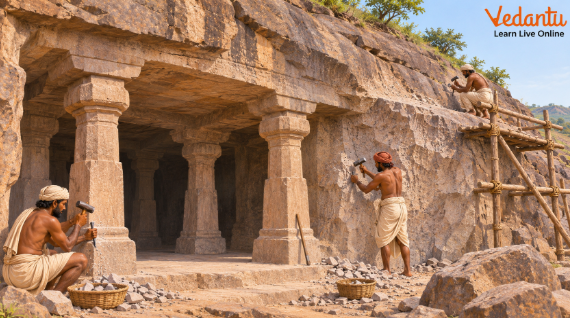
Q10. A sculptor begins with a rocky hillside and gradually creates a temple from it. Which architectural method does this suggest? Explain what the work reveals about the builders’ skills.
Answer:
This suggests rock-cut architecture, in which builders remove rock to create spaces and architectural features.
The work required:
Careful planning of pillars, entrances and interior spaces.
Skilled carving with hand tools.
Coordination among artisans.
Knowledge of the rock so that the structure remained stable.
The Pallavas and Rashtrakutas supported important examples of rock-cut architecture.
Class 7 Social Science Part 2 Chapter 3 Long Answer Questions
Q11. Compare the contributions of the Palas, Rashtrakutas and Pallavas to learning, literature and architecture.
Answer:
These dynasties competed politically, but they also supported scholars, religious communities and skilled artisans. Their achievements show that cultural activity continued across different regions.
Q12. How did irrigation, agriculture, and trade support economic growth between the sixth and tenth centuries?
Answer:
Expansion of cultivation: Land grants helped bring previously uncultivated areas into farming.
Water management: Wells, ponds, tanks and other irrigation works supported agricultural production.
Growth of crafts: Agricultural produce and cash crops supplied materials for crafts and industries.
Local exchange: Traders connected villages with regional markets and towns.
Overseas commerce: Merchants used ports to trade with West Asia, East Africa, Sri Lanka, Southeast Asia and China.
Urban development: Trade centres attracted merchants and craft workers, helping towns grow.
However, the benefits were not shared equally. Powerful landholders and intermediaries could place burdens on peasants.
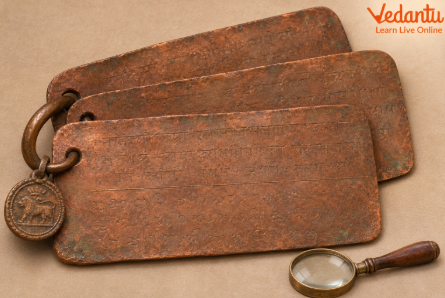
Q13. A copper-plate grant contains a royal seal, a passage praising a dynasty in Sanskrit and details of a land donation in a regional language. What can historians learn from these features?
Answer:
Royal authority: The seal helps identify the authority under which the grant was issued.
Dynastic history: The Sanskrit passage may record the ruler’s ancestry, titles and achievements.
Administrative details: The regional-language section may explain the land donation and its conditions.
Language use: The grant shows that Sanskrit and regional languages could serve different purposes within one record.
Landholding patterns: Such records help historians study donations, ownership and the growth of new landholders.
Historians must read royal praise carefully and compare it with other evidence, because it may exaggerate a ruler’s achievements.
Key Topics for Class 7 Social Science Part 2 Chapter 3 Important Questions
Use these Class 7 Social Science Part 2 Chapter 3 important questions to connect rulers and dynasties with the places, events and achievements that made them significant.
Practise Class 7 Empires And Kingdoms: 6th To 10th Centuries Extra Question Answer with Vedantu
Use Vedantu’s solved questions to turn names, dates and monuments into clear historical explanations.
Compare dynasties on the same points. For the Palas, Rashtrakutas and Pallavas, note the region each ruled and give one example of what they supported or built.
Read an inscription for clues. In the copper-plate question, explain what the royal seal, the Sanskrit passage and the regional-language text each reveal.
Explain how one change led to another. For the Cholas, connect irrigation in the Kaveri delta with steady crop production and a stronger economy.
For a quick self-check, cover the answers and try one comparison or picture question. Then check whether you included a specific example and explained what it shows.
Class 7 Social Science Part 2 Chapter 3 Empires and Kingdoms: 6th to 10th Centuries Study Materials
Class 7 Social Science Chapter-wise Important Questions
Important Study Materials for CBSE Class 7 Social Science
FAQs on Important Questions For Class 7 Social Science (Exploring Society: India and Beyond Part 2) Chapter 3 Empires and Kingdoms: 6th to 10th Centuries | 2026-27
1. What are the key topics in Empires and Kingdoms: 6th to 10th Centuries?
Focus on Harshavardhana’s reign, the Tripartite Struggle for Kannauj, the Pallava–Chalukya rivalry, the rise of the Cholas and the spread of Bhakti. For each dynasty, learn where it ruled and one example of its contribution to learning, architecture or trade.
2. Why did three dynasties compete for Kannauj?
Kannauj was an important political centre in the fertile Ganga plains. Controlling it gave rulers influence in northern India. The Palas, Gurjara-Pratiharas, and Rashtrakutas fought for it, but none secured lasting control.
3. Who were the samantas, and how could they become independent?
Samantas were subordinate rulers who managed local territories and led armies for a more powerful king. When the king’s authority weakened, a samanta could gain independence. The Rashtrakutas, once subordinate to the Chalukyas, eventually overthrew them.
4. How can I remember the difference between Pallava and Rashtrakuta architecture?
Link the Pallavas with the rock-cut monuments at Mamallapuram and the Rashtrakutas with the Kailashanatha Temple at Ellora, commissioned by Krishna I. Use one monument from each dynasty when writing a comparison.
5. How did the Alvars and Nayanars spread Bhakti?
The Alvars sang hymns praising Vishnu, while the Nayanars praised Shiva. Their Tamil hymns expressed personal devotion and helped spread Bhakti among Tamil-speaking communities.
6. What can a copper-plate grant tell us about a kingdom?
A copper-plate grant can tell us who issued it, who received the land and what conditions applied. Some grants used Sanskrit to praise the ruler and a regional language to record the details of the donation.
7. Where can I get Vedantu’s Class 7 Social Science Part 2 Chapter 3 important questions PDF?
Download it from the PDF section on this page. It includes solved MCQs, very short, short and long answer questions on Empires and Kingdoms: 6th to 10th Centuries. Try the dynasty comparison and copper-plate questions before checking the answers.
