




Which of the following is an anhydride ?
(A)
(B)
(C)
(D)
Answer
 Verified
232.8k+ views
Hint : We can define an anhydride compound as a compound that is formed from another compound by dehydration or elimination of water. Anhydrides have functional groups which used to be derivatives of either acid or bases. Basic anhydrides have a different pattern from acid anhydrides. Anhydrides can be organic and inorganic both.
Complete step by step solution:
> In organic chemistry acid anhydrides contain the functional group \[R\left( {CO} \right)O\left( {CO} \right)R'\]. Hence an acid anhydride compound contains two acyl groups bonded to the same oxygen atom. A common example of acid anhydride is carboxylic anhydride whose parent acid is a carboxylic acid. The organic anhydrides introduces the acyl group $(RCO)$ in organic synthesis. Anhydrides reacts with water and produces carboxylic acids.
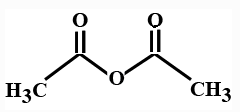
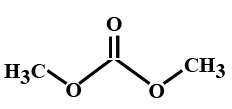
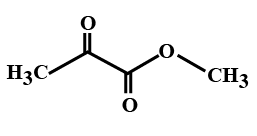
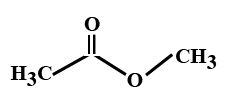
> In the options all are organic compounds. In the given organic compounds we have to identify the functional group \[R\left( {CO} \right)O\left( {CO} \right)R'\]. If in the given compounds we consider $C{H_3} - $ group as $R - $ group then analysis will become easy. In the first option we have found this compound satisfy the formula\[R\left( {CO} \right)O\left( {CO} \right)R'\] of anhydride compounds where $R = R' = C{H_3}$, hence this is a symmetric type of anhydride. The rest of the option does not satisfy the chemical formula of anhydrides so they are not anhydrides.
So here option A is the correct answer to this question. Compound ( A) is acetic anhydride.
Note : Anhydrides produces ester when it reacts with alcohol or phenol and with ammonia and amines it produces amides. Symmetric acid anhydrides can be prepared easily and have a wide range of applications. These are used in synthesis of other useful organic compounds and used as reagents for amines.
Complete step by step solution:
> In organic chemistry acid anhydrides contain the functional group \[R\left( {CO} \right)O\left( {CO} \right)R'\]. Hence an acid anhydride compound contains two acyl groups bonded to the same oxygen atom. A common example of acid anhydride is carboxylic anhydride whose parent acid is a carboxylic acid. The organic anhydrides introduces the acyl group $(RCO)$ in organic synthesis. Anhydrides reacts with water and produces carboxylic acids.
> In the options all are organic compounds. In the given organic compounds we have to identify the functional group \[R\left( {CO} \right)O\left( {CO} \right)R'\]. If in the given compounds we consider $C{H_3} - $ group as $R - $ group then analysis will become easy. In the first option we have found this compound satisfy the formula\[R\left( {CO} \right)O\left( {CO} \right)R'\] of anhydride compounds where $R = R' = C{H_3}$, hence this is a symmetric type of anhydride. The rest of the option does not satisfy the chemical formula of anhydrides so they are not anhydrides.
So here option A is the correct answer to this question. Compound ( A) is acetic anhydride.
Note : Anhydrides produces ester when it reacts with alcohol or phenol and with ammonia and amines it produces amides. Symmetric acid anhydrides can be prepared easily and have a wide range of applications. These are used in synthesis of other useful organic compounds and used as reagents for amines.
Recently Updated Pages
Types of Solutions in Chemistry: Explained Simply

JEE General Topics in Chemistry Important Concepts and Tips
JEE Extractive Metallurgy Important Concepts and Tips for Exam Preparation
JEE Amino Acids and Peptides Important Concepts and Tips for Exam Preparation
JEE Atomic Structure and Chemical Bonding important Concepts and Tips
Electricity and Magnetism Explained: Key Concepts & Applications
Trending doubts
JEE Main 2026: Session 2 Registration Open, City Intimation Slip, Exam Dates, Syllabus & Eligibility
JEE Main 2026 Application Login: Direct Link, Registration, Form Fill, and Steps
JEE Main Marking Scheme 2026- Paper-Wise Marks Distribution and Negative Marking Details
Understanding the Angle of Deviation in a Prism
Hybridisation in Chemistry – Concept, Types & Applications
How to Convert a Galvanometer into an Ammeter or Voltmeter
Other Pages
JEE Advanced Marks vs Ranks 2025: Understanding Category-wise Qualifying Marks and Previous Year Cut-offs
NCERT Solutions For Class 12 Chemistry Chapter 1 Solutions (2025-26)
Solutions Class 12 Chemistry Chapter 1 CBSE Notes - 2025-26
NCERT Solutions For Class 12 Chemistry Chapter 4 The d and f Block Elements (2025-26)
Biomolecules Class 12 Chemistry Chapter 10 CBSE Notes - 2025-26
NCERT Solutions For Class 12 Chemistry Chapter 10 Biomolecules (2025-26)