




Which of the following figure represents the electric field lines due to a single negative change?
A.
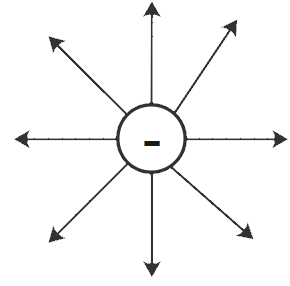
B.
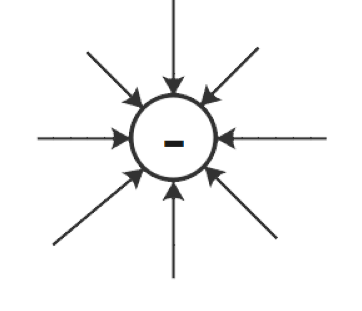
C.
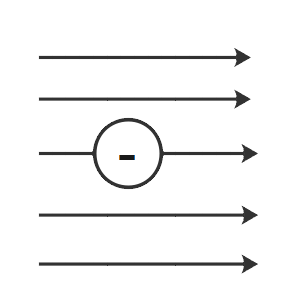
D.
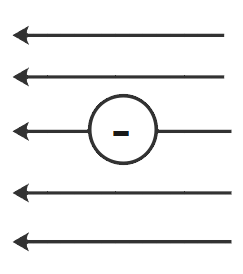
Answer
 Verified
596.1k+ views
Hint: In this question we have been asked to state the accurate representation of the electric field lines due to a negative point charge. Therefore, to answer this question, we shall first discuss why electric field lines are generated. We know that the electric field is a vector quantity. Therefore, it has magnitude as well as direction. So, we are basically asked the direction of electric field due to negative point charge.
Formula used:
\[E=k\dfrac{\left| Q \right|}{{{r}^{2}}}\]
Complete solution:
We know that the electric field is a vector quantity. We know that every vector quantity has a certain magnitude as well as direction.
The 4 important properties of field lines:
a) The field lines never intersect.
b) They are perpendicular to the surface of charge.
c) If the electric field is strong the lines are close to each other and vice versa.
d) The number of field lines is directly proportional to the charge.
Now, from the last property we know that the number of lines is directly proportional to the charge on the surface.
Now, we know that
Magnitude electric field is given by formula,
\[E=k\dfrac{\left| Q \right|}{{{r}^{2}}}\]
Where, \[\left| Q \right|\]is the magnitude of charge.
We know that the electric field flows from the higher potential to lower potential i.e. from positive to negative charge.
Therefore, for a point charge the electric field lines will flow towards the surface.
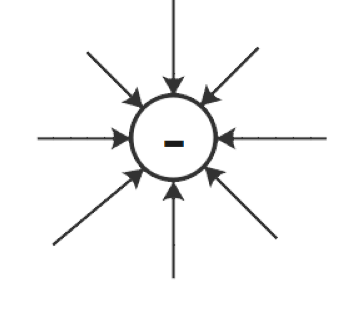
Therefore, the correct answer is option B.
Note:
The electric field lines are the lines that determine the direction and strength of the electric field in a particular region of space. In a uniform electric field, the electric field lines are straight and uniformly spaced. Since, the electric field line can never start and end on the same charge, the field lines can never form a closed loop. We know that the field lines always flow from higher potential to lower potential.
Formula used:
\[E=k\dfrac{\left| Q \right|}{{{r}^{2}}}\]
Complete solution:
We know that the electric field is a vector quantity. We know that every vector quantity has a certain magnitude as well as direction.
The 4 important properties of field lines:
a) The field lines never intersect.
b) They are perpendicular to the surface of charge.
c) If the electric field is strong the lines are close to each other and vice versa.
d) The number of field lines is directly proportional to the charge.
Now, from the last property we know that the number of lines is directly proportional to the charge on the surface.
Now, we know that
Magnitude electric field is given by formula,
\[E=k\dfrac{\left| Q \right|}{{{r}^{2}}}\]
Where, \[\left| Q \right|\]is the magnitude of charge.
We know that the electric field flows from the higher potential to lower potential i.e. from positive to negative charge.
Therefore, for a point charge the electric field lines will flow towards the surface.
Therefore, the correct answer is option B.
Note:
The electric field lines are the lines that determine the direction and strength of the electric field in a particular region of space. In a uniform electric field, the electric field lines are straight and uniformly spaced. Since, the electric field line can never start and end on the same charge, the field lines can never form a closed loop. We know that the field lines always flow from higher potential to lower potential.
Recently Updated Pages
Master Class 12 Economics: Engaging Questions & Answers for Success

Master Class 12 English: Engaging Questions & Answers for Success
Master Class 12 Social Science: Engaging Questions & Answers for Success
Master Class 12 Maths: Engaging Questions & Answers for Success
Master Class 12 Physics: Engaging Questions & Answers for Success
Master Class 9 General Knowledge: Engaging Questions & Answers for Success
Trending doubts
Which are the Top 10 Largest Countries of the World?
Draw a labelled sketch of the human eye class 12 physics CBSE
Differentiate between homogeneous and heterogeneous class 12 chemistry CBSE
Sulphuric acid is known as the king of acids State class 12 chemistry CBSE
Why is the cell called the structural and functional class 12 biology CBSE
A dentist uses a small mirror that gives a magnification class 12 physics CBSE