




What is magnetic meridian?
Answer
 Verified
642.3k+ views
Hint It is a line on the earth’s surface, passing in the direction of the horizontal component of the earth's magnetic field. A compass needle, however, will not be steady in the magnetic meridian because the latitude from east to the west becomes a complete geodesic curve.
Complete step by step answer:
The magnetic meridian is a line joining the magnetic north pole with the magnetic south pole inside the earth. This is the horizontal component of the magnetic force lines along the surface of the earth. The magnetic meridian is parallel with the earth’s magnetic lines of force. The earth acts very much like a bar magnet with the magnetic north pole located south of the geographic north pole which is defined by the earth’s rotational axis. The angle between the line joining the magnetic poles and the geographic poles is around ${11.5^ \circ }$.
The difference between the true and the magnetic meridian on a plane is called magnetic declination which is calculated at every place individually on the geodesic curves. Magnetic declination is expressed in degrees east or west, where a western declination is usually stated as a negative value while an eastern declination is stated as a positive value.
The axial tilt should not be confused in this regard. The axial tilt is the angle between the earth’s rotational and orbital axis. This obliquity, which was formed after an object the size of Mars crashed into the earth around $4.5$ billion years ago. The value of this obliquity is ${23.4^ \circ }$.
The magnetic poles are not fixed in their position but rather their position changes continuously. This happens over long periods of years and scientists predict that this will cause the magnetic poles of the earth to flip.
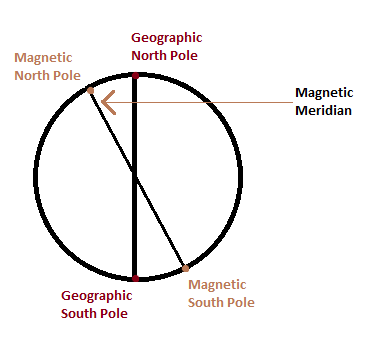
Note A true meridian is a chord that goes from one pole to the other. The true meridian is different from the magnetic meridian in the fact that the magnetic meridian is simply parallel to the compass needle whereas the true meridian is calculated by careful astronomical observations.
Complete step by step answer:
The magnetic meridian is a line joining the magnetic north pole with the magnetic south pole inside the earth. This is the horizontal component of the magnetic force lines along the surface of the earth. The magnetic meridian is parallel with the earth’s magnetic lines of force. The earth acts very much like a bar magnet with the magnetic north pole located south of the geographic north pole which is defined by the earth’s rotational axis. The angle between the line joining the magnetic poles and the geographic poles is around ${11.5^ \circ }$.
The difference between the true and the magnetic meridian on a plane is called magnetic declination which is calculated at every place individually on the geodesic curves. Magnetic declination is expressed in degrees east or west, where a western declination is usually stated as a negative value while an eastern declination is stated as a positive value.
The axial tilt should not be confused in this regard. The axial tilt is the angle between the earth’s rotational and orbital axis. This obliquity, which was formed after an object the size of Mars crashed into the earth around $4.5$ billion years ago. The value of this obliquity is ${23.4^ \circ }$.
The magnetic poles are not fixed in their position but rather their position changes continuously. This happens over long periods of years and scientists predict that this will cause the magnetic poles of the earth to flip.
Note A true meridian is a chord that goes from one pole to the other. The true meridian is different from the magnetic meridian in the fact that the magnetic meridian is simply parallel to the compass needle whereas the true meridian is calculated by careful astronomical observations.
Recently Updated Pages
What is BLO What is the full form of BLO class 8 social science CBSE

Explain the Treaty of Vienna of 1815 class 10 social science CBSE
10 examples of friction in our daily life
Draw a diagram of nephron and explain its structur class 11 biology CBSE
Write structures of the following compounds i 2 Chloro3methylpentane class 11 chemistry CBSE
A Paragraph on Pollution in about 100-150 Words
Trending doubts
Draw a labelled sketch of the human eye class 12 physics CBSE
Which are the Top 10 Largest Countries of the World?
Differentiate between homogeneous and heterogeneous class 12 chemistry CBSE
Draw ray diagrams each showing i myopic eye and ii class 12 physics CBSE
Which is the correct genotypic ratio of mendel dihybrid class 12 biology CBSE
What is the Full Form of PVC, PET, HDPE, LDPE, PP and PS ?