




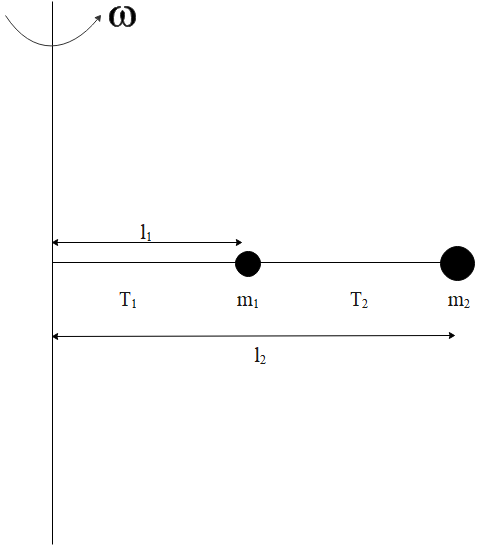
The whole set up shown in the figure is rotating with constant angular velocity $\omega $ on a horizontal frictionless table then the ratio of tensions $\dfrac{{{T_1}}}{{{T_2}}}$ is (Given $\dfrac{{{l_1}}}{{{l_2}}} = \dfrac{2}{1}$)
(A) $\dfrac{{{m_1}}}{{{m_2}}}$
(B) $\dfrac{{({m_1} + 2{m_g})}}{{2{m_2}}}$
(C) $\dfrac{{{m_2}}}{{{m_1}}}$
(D) $\dfrac{{({m_2} + {m_1})}}{{{m_2}}}$
Answer
 Verified
232.8k+ views
Hint: To answer this question we have to find the expression of ${T_1}$ and ${T_2}$. Once we have the expressions we have to find the ratio of $\dfrac{{{T_1}}}{{{T_2}}}$, and put the values of the expressions. After evaluating the expressions, we will have the answer to the required question.
Complete step by step answer:
First we need to find the value of ${T_2}$. So the value of ${T_2}$is as follows:
${T_2} = {m_2}{w^2}{l_2}$
Now we have to find the value of ${T_1}$. So the value of ${T_1}$is as follows:
${T_1} = {m_2}{w^2}{l_2} + {m_2}{w^2}{l_1}$
We know that we have to find the value of the ratio between ${T_1}$ and ${T_2}$. So here is the ratio between them:
$T = mg$$\dfrac{{{T_1}}}{{{T_2}}} = \dfrac{{{m_2}{w^2}{l_1} + {m_2}{w^2}{l_2}}}{{{m_2}{w^2}{l_2}}}$
After the ratio is evaluated then we can get the expression as:
$\dfrac{{{T_1}}}{{{T_2}}} = \dfrac{{[{m_1} + {m_2}\dfrac{{{l_2}}}{{{l_1}}}]{l_2}}}{{{m_2}{l_2}}} = \dfrac{{({m_1} + 2{m_2})}}{{2{m_2}}}$
Hence we can say that the $\dfrac{{{T_1}}}{{{T_2}}}$is $\dfrac{{({m_1} + 2{m_g})}}{{2{m_2}}}$.
So the correct answer is option B.
Note: We should be aware of the meaning of angular velocity. By definition, angular velocity signifies how much fast a body can rotate or revolve relative to that of the other body point. This means how fasts the angular position of the orientation of a body will vary with the time.
We should also be knowing the definition of the term tension for better understanding. By tension we mean that it is the pulling force that is transmitted axially from a cable, which is usually a one dimensional body, or even by each end from a three dimensional body. Tension is formulated as being similar to the mass of the object multiplied with the gravitational force, also described as the subtraction or addition of the mass multiplied by acceleration.
The formula of tension is given as:
$T = mg$.
Complete step by step answer:
First we need to find the value of ${T_2}$. So the value of ${T_2}$is as follows:
${T_2} = {m_2}{w^2}{l_2}$
Now we have to find the value of ${T_1}$. So the value of ${T_1}$is as follows:
${T_1} = {m_2}{w^2}{l_2} + {m_2}{w^2}{l_1}$
We know that we have to find the value of the ratio between ${T_1}$ and ${T_2}$. So here is the ratio between them:
$T = mg$$\dfrac{{{T_1}}}{{{T_2}}} = \dfrac{{{m_2}{w^2}{l_1} + {m_2}{w^2}{l_2}}}{{{m_2}{w^2}{l_2}}}$
After the ratio is evaluated then we can get the expression as:
$\dfrac{{{T_1}}}{{{T_2}}} = \dfrac{{[{m_1} + {m_2}\dfrac{{{l_2}}}{{{l_1}}}]{l_2}}}{{{m_2}{l_2}}} = \dfrac{{({m_1} + 2{m_2})}}{{2{m_2}}}$
Hence we can say that the $\dfrac{{{T_1}}}{{{T_2}}}$is $\dfrac{{({m_1} + 2{m_g})}}{{2{m_2}}}$.
So the correct answer is option B.
Note: We should be aware of the meaning of angular velocity. By definition, angular velocity signifies how much fast a body can rotate or revolve relative to that of the other body point. This means how fasts the angular position of the orientation of a body will vary with the time.
We should also be knowing the definition of the term tension for better understanding. By tension we mean that it is the pulling force that is transmitted axially from a cable, which is usually a one dimensional body, or even by each end from a three dimensional body. Tension is formulated as being similar to the mass of the object multiplied with the gravitational force, also described as the subtraction or addition of the mass multiplied by acceleration.
The formula of tension is given as:
$T = mg$.
Recently Updated Pages
Dimensions of Charge: Dimensional Formula, Derivation, SI Units & Examples

How to Calculate Moment of Inertia: Step-by-Step Guide & Formulas
Circuit Switching vs Packet Switching: Key Differences Explained
Dimensions of Pressure in Physics: Formula, Derivation & SI Unit
JEE General Topics in Chemistry Important Concepts and Tips
JEE Extractive Metallurgy Important Concepts and Tips for Exam Preparation
Trending doubts
JEE Main 2026: Session 2 Registration Open, City Intimation Slip, Exam Dates, Syllabus & Eligibility
JEE Main 2026 Application Login: Direct Link, Registration, Form Fill, and Steps
JEE Main Marking Scheme 2026- Paper-Wise Marks Distribution and Negative Marking Details
Understanding the Angle of Deviation in a Prism
Hybridisation in Chemistry – Concept, Types & Applications
How to Convert a Galvanometer into an Ammeter or Voltmeter
Other Pages
JEE Advanced Marks vs Ranks 2025: Understanding Category-wise Qualifying Marks and Previous Year Cut-offs
Laws of Motion Class 11 Physics Chapter 4 CBSE Notes - 2025-26
Waves Class 11 Physics Chapter 14 CBSE Notes - 2025-26
Mechanical Properties of Fluids Class 11 Physics Chapter 9 CBSE Notes - 2025-26
Thermodynamics Class 11 Physics Chapter 11 CBSE Notes - 2025-26
Units And Measurements Class 11 Physics Chapter 1 CBSE Notes - 2025-26