




The resultant of $\vec A$ and $\vec B$ is perpendicular to $\vec A$. What is the angle between $\vec A$ and $\vec B$?
A) ${\cos ^{ - 1}}\left( {\dfrac{A}{B}} \right)$
B) ${\cos ^{ - 1}}\left( { - \dfrac{A}{B}} \right)$
C) ${\sin ^{ - 1}}\left( {\dfrac{A}{B}} \right)$
D) ${\sin ^{ - 1}}\left( { - \dfrac{A}{B}} \right)$
Answer
 Verified
306.9k+ views
Hint: The resultant of two vectors is the vector addition of two vectors. Vectors can be added following two rules of addition: triangle law of addition or parallelogram law of addition. We can draw the vectors with co-initial points to illustrate the parallelogram law of vectors.
Formulae used:
The formula for the angle between resultant vector $\left( {\vec A + \vec B} \right)$ and a vector $\vec A$ is
$\tan \alpha = \dfrac{{b\sin \theta }}{{a + b\cos \theta }}$
Where $\alpha $ is the angle between resultant and the original vector and $\theta $ is the angle between the two vectors.
Complete step by step solution:
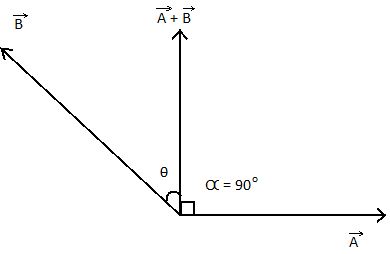
In the question it is given that the angle between resultant vector $\left( {\vec A + \vec B} \right)$ and a vector $\vec A$ is ${90^\circ }$ , that is, the resultant vector is perpendicular to the original vector.
$ \Rightarrow \alpha = {90^\circ }$
This means that
$\tan {90^\circ } = \dfrac{{B\sin \theta }}{{A + B\cos \theta }}$
As $\tan {90^\circ } \approx \infty $, for a fraction to approach infinity, the denominator of the fraction has to be zero
$A + B\cos \theta = 0$
$ \Rightarrow \cos \theta = - \dfrac{B}{A}$
$ \Rightarrow \cos \theta = - \dfrac{B}{A}$
$ \Rightarrow \theta = {\cos ^{ - 1}}( - \dfrac{B}{A})$
So the angle between the vectors is (B), ${\cos ^{ - 1}}\left( { - \dfrac{A}{B}} \right)$.
Additional information:
To derive the formula for the angle between the vectors we use the parallelogram law of vector addition. If $\vec A$ and $\vec B$ are vectors acting simultaneously from a point, representing both the magnitude and direction of the vectors, and $\theta $ is the angle between them then, then the diagonal of the parallelogram passing through the common vertices is the resultant. The angle between resultant and base is found by extending the base until a right angled triangle is formed and using Pythagoras and basic trigonometry to find the formula
Note: To solve such questions, we can also look at it from the point of view of triangle addition of vectors but that would make the formula more complicated. In parallelogram law of additions, both vectors and resultant share a common origin point, hence making the angle between the vectors more evident.
Formulae used:
The formula for the angle between resultant vector $\left( {\vec A + \vec B} \right)$ and a vector $\vec A$ is
$\tan \alpha = \dfrac{{b\sin \theta }}{{a + b\cos \theta }}$
Where $\alpha $ is the angle between resultant and the original vector and $\theta $ is the angle between the two vectors.
Complete step by step solution:
In the question it is given that the angle between resultant vector $\left( {\vec A + \vec B} \right)$ and a vector $\vec A$ is ${90^\circ }$ , that is, the resultant vector is perpendicular to the original vector.
$ \Rightarrow \alpha = {90^\circ }$
This means that
$\tan {90^\circ } = \dfrac{{B\sin \theta }}{{A + B\cos \theta }}$
As $\tan {90^\circ } \approx \infty $, for a fraction to approach infinity, the denominator of the fraction has to be zero
$A + B\cos \theta = 0$
$ \Rightarrow \cos \theta = - \dfrac{B}{A}$
$ \Rightarrow \cos \theta = - \dfrac{B}{A}$
$ \Rightarrow \theta = {\cos ^{ - 1}}( - \dfrac{B}{A})$
So the angle between the vectors is (B), ${\cos ^{ - 1}}\left( { - \dfrac{A}{B}} \right)$.
Additional information:
To derive the formula for the angle between the vectors we use the parallelogram law of vector addition. If $\vec A$ and $\vec B$ are vectors acting simultaneously from a point, representing both the magnitude and direction of the vectors, and $\theta $ is the angle between them then, then the diagonal of the parallelogram passing through the common vertices is the resultant. The angle between resultant and base is found by extending the base until a right angled triangle is formed and using Pythagoras and basic trigonometry to find the formula
Note: To solve such questions, we can also look at it from the point of view of triangle addition of vectors but that would make the formula more complicated. In parallelogram law of additions, both vectors and resultant share a common origin point, hence making the angle between the vectors more evident.
Recently Updated Pages
Four persons A B C and D initially at the corners of class 11 physics JEE_Main

What is the difference between Conduction and conv class 11 physics JEE_Main
Moment of inertia of solid sphere about its diameter class 11 physics JEE_Main
If a piece of ice floating on the surface of water class 11 physics JEE_Main
At what temperature speed of sound in air will be doubled class 11 physics JEE_Main
A closed organ pipe and an open organ pipe are tuned class 11 physics JEE_Main
Trending doubts
JEE Main 2026: Exam Dates, Session 2 Updates, City Slip, Admit Card & Latest News
Understanding the Electric Field of a Uniformly Charged Ring
Derivation of Equation of Trajectory Explained for Students
Understanding Atomic Structure for Beginners
How to Convert a Galvanometer into an Ammeter or Voltmeter
Hybridisation in Chemistry – Concept, Types & Applications
Other Pages
CBSE Notes Class 11 Physics Chapter 1 - Units And Measurements - 2026-27 PDF Download (Login Required)
NCERT Solutions For Class 11 Physics Chapter 1 Units And Measurements - 2026-27 Free PDF Download (Login Required)
NCERT Solutions For Class 11 Physics Chapter 2 Motion In A Straight Line - 2026-27 Free PDF Download (Login Required)
Important Questions For Class 11 Physics Chapter 1 Units and Measurement - 2026-27 Free PDF Download (Sign-in Required)
CBSE Notes Class 11 Physics Chapter 2 - Motion in a Straight Line - 2026-27 PDF Download (Login Required)
NCERT Solutions For Class 11 Physics Chapter 3 Motion In A Plane - 2026-27 Free PDF Download (Sign-in Required)
CBSE Notes Class 11 Physics Chapter 1 - Units And Measurements - 2026-27 PDF Download (Login Required)
NCERT Solutions For Class 11 Physics Chapter 1 Units And Measurements - 2026-27 Free PDF Download (Login Required)
NCERT Solutions For Class 11 Physics Chapter 2 Motion In A Straight Line - 2026-27 Free PDF Download (Login Required)