




The primary reservoir of loa-loa worms are
A. Humans
B. Monkeys
C. Dogs
D. Cats
Answer
 Verified
610.5k+ views
Hint: Loa loa filariasis is a disease of the skin and eye caused by the Loa loa nematode worm. It is from the sting of a deer fly or mango fly (Chrysops spp), the vectors for Loa loa that humans develop this disease.
Complete answer: The main source for Loa loa is people. Other small possible sources, such as hippopotamus, wild ruminants (e.g. buffalo), rats, and lizards, have been identified in numerous fly-biting behavior tests.
In monkeys and apes, a similar form of loiasis occurs but it is transmitted by Chrysops langi.
There is no overlap between the human and simian forms of the disease. A similar moth, Chrysops langi, was isolated as a vector of simian loiasis but this form hunts within the forest and has not yet been infected with human infection.
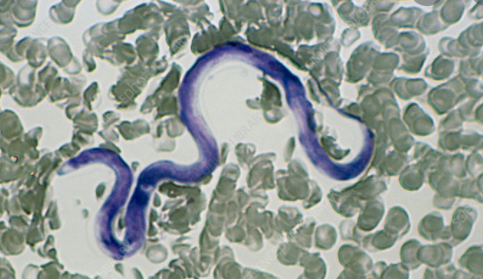
Fig. loa-loa in blood smear
The adult filarial worm of Loa loa migrates across human subcutaneous tissues, sometimes passing into sub-conjunctive eye tissues where it can be readily detected.
Loa-loa worms normally don't impair one 's vision but can be uncomfortable when passing across the eyeball or over the nose bridge.
So, option (A) is correct
Note: The disease can cause wheezing red under the skin called "Calabar swellings." The disease is treated with the diethylcarbamazine (DEC) drug, and surgical methods may be used to remove adult worms from the conjunctiva where appropriate.
Loiasis is a member of the so-called neglected epidemic.
Complete answer: The main source for Loa loa is people. Other small possible sources, such as hippopotamus, wild ruminants (e.g. buffalo), rats, and lizards, have been identified in numerous fly-biting behavior tests.
In monkeys and apes, a similar form of loiasis occurs but it is transmitted by Chrysops langi.
There is no overlap between the human and simian forms of the disease. A similar moth, Chrysops langi, was isolated as a vector of simian loiasis but this form hunts within the forest and has not yet been infected with human infection.
Fig. loa-loa in blood smear
The adult filarial worm of Loa loa migrates across human subcutaneous tissues, sometimes passing into sub-conjunctive eye tissues where it can be readily detected.
Loa-loa worms normally don't impair one 's vision but can be uncomfortable when passing across the eyeball or over the nose bridge.
So, option (A) is correct
Note: The disease can cause wheezing red under the skin called "Calabar swellings." The disease is treated with the diethylcarbamazine (DEC) drug, and surgical methods may be used to remove adult worms from the conjunctiva where appropriate.
Loiasis is a member of the so-called neglected epidemic.
Recently Updated Pages
Master Class 12 Social Science: Engaging Questions & Answers for Success

Master Class 12 Physics: Engaging Questions & Answers for Success
Master Class 12 Maths: Engaging Questions & Answers for Success
Master Class 12 Economics: Engaging Questions & Answers for Success
Master Class 12 Chemistry: Engaging Questions & Answers for Success
Master Class 12 Business Studies: Engaging Questions & Answers for Success
Trending doubts
Which are the Top 10 Largest Countries of the World?
Draw a labelled sketch of the human eye class 12 physics CBSE
Explain the structure of megasporangium class 12 biology CBSE
What are the major means of transport Explain each class 12 social science CBSE
How many chromosomes are found in human ovum a 46 b class 12 biology CBSE
The diagram of the section of a maize grain is given class 12 biology CBSE