




The number of circles touching the line $y-x=0$ and the $y$ axis is
A. Zero
B. One
C. Two
D. Infinite
Answer
 Verified
233.1k+ views
Hint: The group of points whose separation from a fixed point has a constant value are represented by a circle. The radius of the circle, abbreviated $r$, is a constant that describes this fixed point, which is known as the circle's centre. The formula for a circle$\left(\mathrm{x}-\mathrm{x}_{1}\right)^{2}+\left(\mathrm{y}-\mathrm{y}_{1}\right)^{2}=\mathrm{r}^{2}$ whose centre is at $\left(\mathrm{x}_{1}, \mathrm{y}_{1}\right)$
Complete step by step solution:
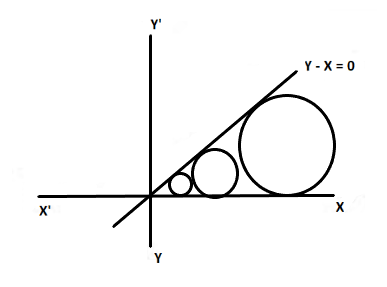
The location of a circle in the Cartesian plane is represented by a circle equation. We can write the equation for a circle if we know the location of the circle's center and how long its radius is. All of the points on the circle's circumference are represented by the circle equation.
The line $y-x=0$ and the $y$-axis are both touched by an unlimited number of circles.
Then there are infinite number of circles
Option ‘D’ is correct
Additional Information:
The radius of a circle is the length of the straight line that connects the center to any point on its circumference. Because a circle's circumference can contain an endless number of points, a circle can have more than one radius. This indicates that a circle has an endless number of radii and that each radius is equally spaced from the circle's center. When the radius's length varies, the circle's size also changes.
Note: If the radius is r, the center's coordinates are $(h,k),$and any point on the circle is$(x, y)$, the center of the circle formula is as follows:
$(x-h)^{2}+(y-k)^{2}=r^{2}$
Complete step by step solution:
The location of a circle in the Cartesian plane is represented by a circle equation. We can write the equation for a circle if we know the location of the circle's center and how long its radius is. All of the points on the circle's circumference are represented by the circle equation.
The line $y-x=0$ and the $y$-axis are both touched by an unlimited number of circles.
Then there are infinite number of circles
Option ‘D’ is correct
Additional Information:
The radius of a circle is the length of the straight line that connects the center to any point on its circumference. Because a circle's circumference can contain an endless number of points, a circle can have more than one radius. This indicates that a circle has an endless number of radii and that each radius is equally spaced from the circle's center. When the radius's length varies, the circle's size also changes.
Note: If the radius is r, the center's coordinates are $(h,k),$and any point on the circle is$(x, y)$, the center of the circle formula is as follows:
$(x-h)^{2}+(y-k)^{2}=r^{2}$
Recently Updated Pages
JEE Main 2023 April 6 Shift 1 Question Paper with Answer Key

JEE Main 2023 April 6 Shift 2 Question Paper with Answer Key
JEE Main 2023 (January 31 Evening Shift) Question Paper with Solutions [PDF]
JEE Main 2023 January 30 Shift 2 Question Paper with Answer Key
JEE Main 2023 January 25 Shift 1 Question Paper with Answer Key
JEE Main 2023 January 24 Shift 2 Question Paper with Answer Key
Trending doubts
JEE Main 2026: Session 2 Registration Open, City Intimation Slip, Exam Dates, Syllabus & Eligibility
JEE Main 2026 Application Login: Direct Link, Registration, Form Fill, and Steps
JEE Main Marking Scheme 2026- Paper-Wise Marks Distribution and Negative Marking Details
Understanding the Angle of Deviation in a Prism
Hybridisation in Chemistry – Concept, Types & Applications
How to Convert a Galvanometer into an Ammeter or Voltmeter
Other Pages
JEE Advanced Marks vs Ranks 2025: Understanding Category-wise Qualifying Marks and Previous Year Cut-offs
Understanding Electromagnetic Waves and Their Importance
Understanding the Electric Field of a Uniformly Charged Ring
JEE Advanced Weightage 2025 Chapter-Wise for Physics, Maths and Chemistry
Derivation of Equation of Trajectory Explained for Students
Understanding How a Current Loop Acts as a Magnetic Dipole