




The maximum number of NO2 group that can introduce by nitration of benzene is usually
A. 4
B. 2
C. 3
D. 6
Answer
 Verified
233.1k+ views
Hint: Group NO2 is electrophile and thus, during the nitration of benzene this group will attach at the position where there electron density is more. There are three positions in benzene, ortho, meta, and para. Ortho is 1,2 relation, meta is 1,3 relation and para is 1,4 relation as per numbering. Find no. of electron rich positions to get the maximum number of NO2 groups to introduce.
Complete Step by Step Solution:
To know that how much NO2 group will attach on benzene it is required to draw resonating structures of nitrobenzene which firstly form after the first nitration such as
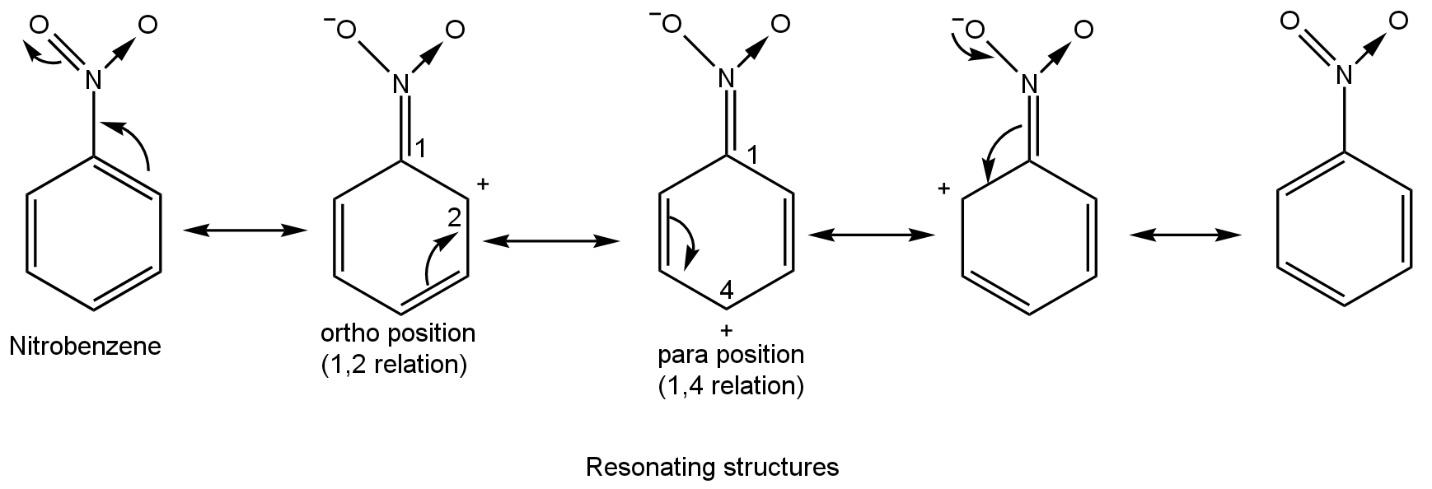
From all resonating structures of nitrobenzene, positive charge resides on ortho and para position with respect to carbon number 1 which is directly attached to the nitro group. Thus, electron density at ortho and para will be less and at meta will be relatively more. Thus, further nitration leads to attaching the NO2 group at meta position.
So, NO2 can attach to meta position with respect to carbon 1 (directly attached to NO2 group). As there are two meta positions thus two NO2 groups can join at this position. Altogether three NO2 groups can be introduced by nitration of benzene.
Thus, the correct option is B.
Note: After nitration of benzene, HNO2 group is attached directly to the ring. As nitrogen is attached to the benzene ring and also directly attached to the oxygen atom, this group will behave as an electron withdrawing group and attract the whole electron density of the ring towards itself.
Complete Step by Step Solution:
To know that how much NO2 group will attach on benzene it is required to draw resonating structures of nitrobenzene which firstly form after the first nitration such as
From all resonating structures of nitrobenzene, positive charge resides on ortho and para position with respect to carbon number 1 which is directly attached to the nitro group. Thus, electron density at ortho and para will be less and at meta will be relatively more. Thus, further nitration leads to attaching the NO2 group at meta position.
So, NO2 can attach to meta position with respect to carbon 1 (directly attached to NO2 group). As there are two meta positions thus two NO2 groups can join at this position. Altogether three NO2 groups can be introduced by nitration of benzene.
Thus, the correct option is B.
Note: After nitration of benzene, HNO2 group is attached directly to the ring. As nitrogen is attached to the benzene ring and also directly attached to the oxygen atom, this group will behave as an electron withdrawing group and attract the whole electron density of the ring towards itself.
Recently Updated Pages
JEE Main 2023 April 6 Shift 1 Question Paper with Answer Key

JEE Main 2023 April 6 Shift 2 Question Paper with Answer Key
JEE Main 2023 (January 31 Evening Shift) Question Paper with Solutions [PDF]
JEE Main 2023 January 30 Shift 2 Question Paper with Answer Key
JEE Main 2023 January 25 Shift 1 Question Paper with Answer Key
JEE Main 2023 January 24 Shift 2 Question Paper with Answer Key
Trending doubts
JEE Main 2026: Session 2 Registration Open, City Intimation Slip, Exam Dates, Syllabus & Eligibility
JEE Main 2026 Application Login: Direct Link, Registration, Form Fill, and Steps
Understanding the Angle of Deviation in a Prism
Hybridisation in Chemistry – Concept, Types & Applications
How to Convert a Galvanometer into an Ammeter or Voltmeter
Understanding the Electric Field of a Uniformly Charged Ring
Other Pages
JEE Advanced Marks vs Ranks 2025: Understanding Category-wise Qualifying Marks and Previous Year Cut-offs
NCERT Solutions For Class 12 Chemistry Chapter 1 Solutions (2025-26)
Solutions Class 12 Chemistry Chapter 1 CBSE Notes - 2025-26
NCERT Solutions For Class 12 Chemistry Chapter 4 The d and f Block Elements (2025-26)
Biomolecules Class 12 Chemistry Chapter 10 CBSE Notes - 2025-26
NCERT Solutions For Class 12 Chemistry Chapter 10 Biomolecules (2025-26)