




The hormone responsible for changes in female at puberty is
(A) Estrogen and progesterone
(B) Progesterone
(C) Testosterone
(D) Oxytocin
Answer
 Verified
623.4k+ views
Hint: Puberty is a sequence of events during adolescent period in both males and females in which physical changes occur regulated by changes in the levels of hormones that are produced by the pituitary gland.
Complete answer: Just after birth, the levels of these hormones are high, but they gradually decrease within a few months and still remain low until puberty.
During the onset of puberty, levels of luteinizing hormone and follicle-stimulating hormone increase drastically, which in turn stimulates the production of sex hormones.
The rise in the levels of these sex hormones (primarily estrogen) results in bringing various physical changes, including maturation of the breasts, ovaries, uterus, and the vagina.
The two primary female sex hormones are estrogen and progesterone.
Estrogen is the major female hormone which is largely produced by the ovaries, but certain small amounts are also produced in the adrenal glands and fat cells.
Progesterone is produced by the ovaries after ovulation and also some amount is secreted by the placenta during pregnancy.
The role of progesterone is to mainly prepare the lining of the uterus for a fertilized egg, support pregnancy, and also to suppress estrogen production after ovulation by negative feedback mechanism.
1. The first physical change that a female undergoes during pregnancy is usually the start of breast development.
2. Eventually, pubic hair and underarm hair begins to grow and along with that the percentage of body fat increases and accumulates in the hips and thigh areas.
3. This change usually occurs at around the age group 8 to 13.
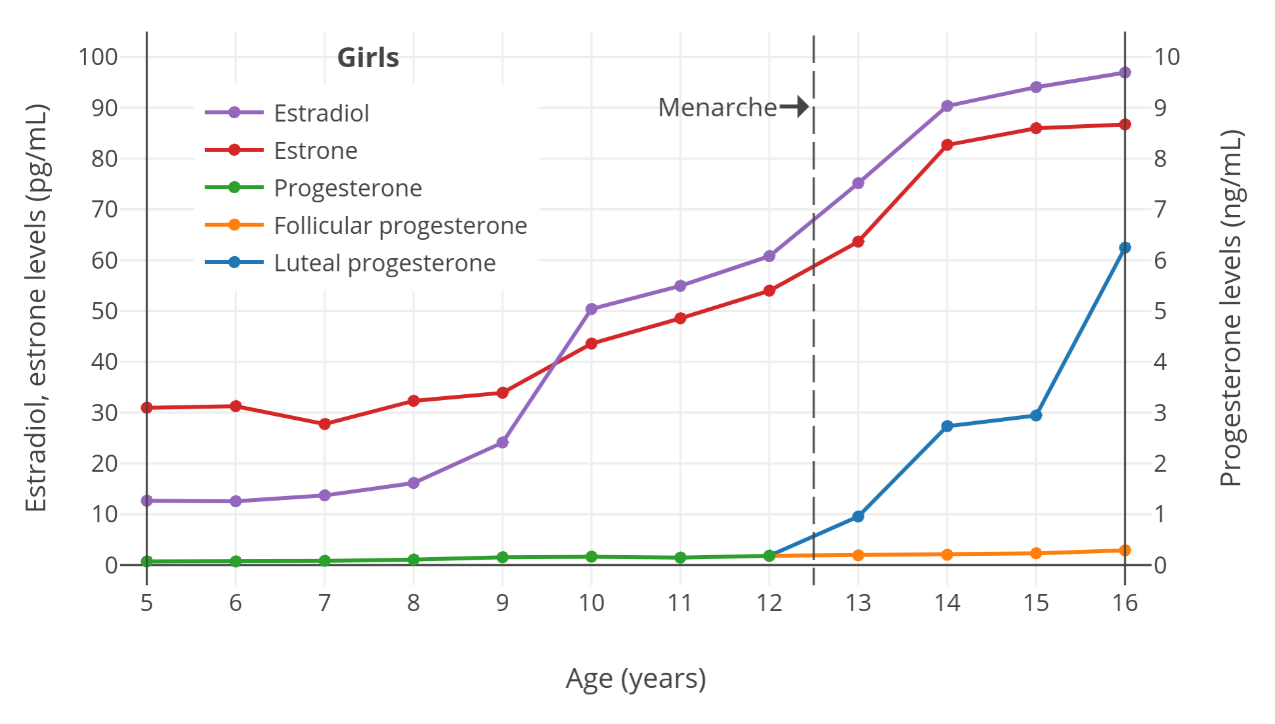
4. Most females have their first period (menstrual cycle) when they are almost 13, but there is a wide range (approximately between ages 10 to 16 years).
5. The graph given below shows the variations in levels of these hormones:
So, the correct answer is A. Estrogen and progesterone.
Note: Although testosterone is considered a male hormone, females also produce and need a small amount of this hormone.
Complete answer: Just after birth, the levels of these hormones are high, but they gradually decrease within a few months and still remain low until puberty.
During the onset of puberty, levels of luteinizing hormone and follicle-stimulating hormone increase drastically, which in turn stimulates the production of sex hormones.
The rise in the levels of these sex hormones (primarily estrogen) results in bringing various physical changes, including maturation of the breasts, ovaries, uterus, and the vagina.
The two primary female sex hormones are estrogen and progesterone.
Estrogen is the major female hormone which is largely produced by the ovaries, but certain small amounts are also produced in the adrenal glands and fat cells.
Progesterone is produced by the ovaries after ovulation and also some amount is secreted by the placenta during pregnancy.
The role of progesterone is to mainly prepare the lining of the uterus for a fertilized egg, support pregnancy, and also to suppress estrogen production after ovulation by negative feedback mechanism.
1. The first physical change that a female undergoes during pregnancy is usually the start of breast development.
2. Eventually, pubic hair and underarm hair begins to grow and along with that the percentage of body fat increases and accumulates in the hips and thigh areas.
3. This change usually occurs at around the age group 8 to 13.
4. Most females have their first period (menstrual cycle) when they are almost 13, but there is a wide range (approximately between ages 10 to 16 years).
5. The graph given below shows the variations in levels of these hormones:
So, the correct answer is A. Estrogen and progesterone.
Note: Although testosterone is considered a male hormone, females also produce and need a small amount of this hormone.
Recently Updated Pages
Master Class 12 Business Studies: Engaging Questions & Answers for Success

Master Class 12 Chemistry: Engaging Questions & Answers for Success
Master Class 12 Biology: Engaging Questions & Answers for Success
Class 12 Question and Answer - Your Ultimate Solutions Guide
Master Class 9 General Knowledge: Engaging Questions & Answers for Success
Master Class 9 Maths: Engaging Questions & Answers for Success
Trending doubts
Which are the Top 10 Largest Countries of the World?
Draw a labelled sketch of the human eye class 12 physics CBSE
Differentiate between homogeneous and heterogeneous class 12 chemistry CBSE
Sulphuric acid is known as the king of acids State class 12 chemistry CBSE
Why is the cell called the structural and functional class 12 biology CBSE
A dentist uses a small mirror that gives a magnification class 12 physics CBSE