




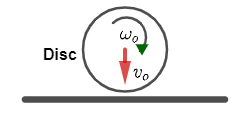
The figure shown is just before collision, the velocity of the centre of uniform disc is ${v_0}$ vertically downward & ${\omega _0}$ is the angular velocity as shown. If it is found that collision is elastic and after collision disc stops rotating then if coefficient of friction is \[\left( {\dfrac{1}{P}} \right)\] then the value of P is? If ${v_0} = R{\omega _0}$ . (R is radius of disc)
Answer
 Verified
233.1k+ views
Hint:The friction coefficient is the ratio of the normal force pressing two surfaces together to the frictional force preventing motion between them. Typically, it is represented by the Greek letter mu ( $\mu $ ). In terms of maths, it is equal to $\mu = \dfrac{F}{N}$ , where F stands for frictional force and N for normal force.
Formula Used:
Velocity of uniform disc, ${v_0} = R{\omega _0}$
Linear Momentum, $p = mv$
Angular Momentum, $L = mvr$
Complete step by step solution:
As we know that, because we have to find the velocity of the disc, firstly we calculate the change in linear momentum. Substitute the mass, beginning, and end velocities into the equation above to get the change in momentum,
Change in Momentum $ = 2m{v_0}$
As from above equation, we get the value of change in momentum, by which we can easily find the value of Angular Impulse,
Angular impulse $ = R \times \text{Linear impulse} \times \mu (friction)$
Angular impulse $ = 2m{v_0}R \times \mu $
As in the above equation, $2m{v_0}R$ is the change in angular momentum as we can also calculate it with the help of his formula which is given above.
Now, we know that,
$2m{v_0}R\mu = I{\omega _0}$
As according to the question, by making changes in the above equation as we know that,
$\dfrac{{2m{v_0}R}}{P} = \dfrac{{m{R^2}}}{2}{\omega _0}$
As, according to the question, we need the value of P so,
$P = \dfrac{{4{v_0}}}{{R{\omega _0}}}$
As we know that, ${v_0} = R{\omega _0}$ out form this making suitable changes in above equation we get,
$P = 4$
Therefore, the correct answer for the coefficient of friction is $P = 4$.
Note: An elastic collision is one in which the system does not experience a net loss of kinetic energy as a result of the collision. In elastic collisions, momentum and kinetic energy are both conserved. There is no net conversion of kinetic energy into other forms, such as heat, noise, or potential energy, in an ideal, fully elastic collision.
Formula Used:
Velocity of uniform disc, ${v_0} = R{\omega _0}$
Linear Momentum, $p = mv$
Angular Momentum, $L = mvr$
Complete step by step solution:
As we know that, because we have to find the velocity of the disc, firstly we calculate the change in linear momentum. Substitute the mass, beginning, and end velocities into the equation above to get the change in momentum,
Change in Momentum $ = 2m{v_0}$
As from above equation, we get the value of change in momentum, by which we can easily find the value of Angular Impulse,
Angular impulse $ = R \times \text{Linear impulse} \times \mu (friction)$
Angular impulse $ = 2m{v_0}R \times \mu $
As in the above equation, $2m{v_0}R$ is the change in angular momentum as we can also calculate it with the help of his formula which is given above.
Now, we know that,
$2m{v_0}R\mu = I{\omega _0}$
As according to the question, by making changes in the above equation as we know that,
$\dfrac{{2m{v_0}R}}{P} = \dfrac{{m{R^2}}}{2}{\omega _0}$
As, according to the question, we need the value of P so,
$P = \dfrac{{4{v_0}}}{{R{\omega _0}}}$
As we know that, ${v_0} = R{\omega _0}$ out form this making suitable changes in above equation we get,
$P = 4$
Therefore, the correct answer for the coefficient of friction is $P = 4$.
Note: An elastic collision is one in which the system does not experience a net loss of kinetic energy as a result of the collision. In elastic collisions, momentum and kinetic energy are both conserved. There is no net conversion of kinetic energy into other forms, such as heat, noise, or potential energy, in an ideal, fully elastic collision.
Recently Updated Pages
Dimensions of Charge: Dimensional Formula, Derivation, SI Units & Examples

How to Calculate Moment of Inertia: Step-by-Step Guide & Formulas
Circuit Switching vs Packet Switching: Key Differences Explained
Dimensions of Pressure in Physics: Formula, Derivation & SI Unit
JEE General Topics in Chemistry Important Concepts and Tips
JEE Extractive Metallurgy Important Concepts and Tips for Exam Preparation
Trending doubts
JEE Main 2026: Session 2 Registration Open, City Intimation Slip, Exam Dates, Syllabus & Eligibility
JEE Main 2026 Application Login: Direct Link, Registration, Form Fill, and Steps
JEE Main Marking Scheme 2026- Paper-Wise Marks Distribution and Negative Marking Details
Understanding the Angle of Deviation in a Prism
Hybridisation in Chemistry – Concept, Types & Applications
How to Convert a Galvanometer into an Ammeter or Voltmeter
Other Pages
JEE Advanced Marks vs Ranks 2025: Understanding Category-wise Qualifying Marks and Previous Year Cut-offs
Laws of Motion Class 11 Physics Chapter 4 CBSE Notes - 2025-26
Waves Class 11 Physics Chapter 14 CBSE Notes - 2025-26
Mechanical Properties of Fluids Class 11 Physics Chapter 9 CBSE Notes - 2025-26
Thermodynamics Class 11 Physics Chapter 11 CBSE Notes - 2025-26
Units And Measurements Class 11 Physics Chapter 1 CBSE Notes - 2025-26