




Sodium acetate reacts with acetyl chloride to form:
A. Acetone
B. Acetic anhydride
C. Sodium formate
D. Acetic acid
Answer
 Verified
233.1k+ views
Hint: Acetyl chloride belongs to the class of acyl chloride that we get from acetic acid. Acetyl chloride also belongs to the group of acid halides. It has no colour. It is a liquid of volatile nature. And it is a corrosive substance. Acetyl chloride also belongs to the group of acid halides. It has no colour. It is a liquid of volatile nature. And it is a corrosive substance.
Complete step by step answer:
Let's first draw the structure of acetyl chloride.
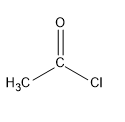
Image: Acetyl chloride
Sodium acetate is an organic compound that is a derivative of carboxylic acid. In sodium acetate, the H atom of OH group of a carboxylic group is replaced by a sodium atom. The formula of sodium acetate is,\[{\rm{C}}{{\rm{H}}_{\rm{3}}}{\rm{COONa}}\] .
Now, we have to understand the reaction of sodium acetate and acetyl chloride. When sodium acetate undergoes a reaction with acetyl chloride, the formation of acetic anhydride takes place. In this reaction, a molecule of Sodium chloride (NaCl) is extracted. The chemical reaction is as follows:
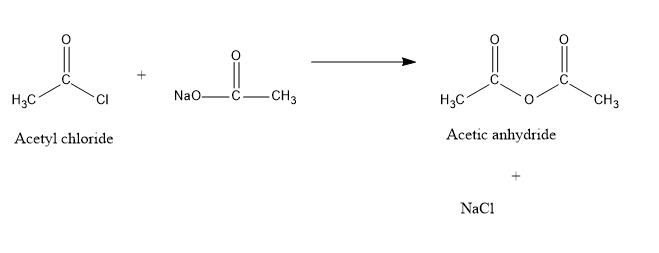
Image: Formation of acetic anhydride due to the reaction of sodium acetate and acetyl chloride
Hence, the product formed due to the reaction of acetyl chloride and sodium acetate is acetic anhydride.
Note: Acetic anhydride is a liquid of no colour possessing a sharp odour. It is useful in the manufacture of drugs, dyes, perfumes etc. It is extremely corrosive in nature. It becomes dangerous when it comes in contact. So, it is banned by the authorities.
Complete step by step answer:
Let's first draw the structure of acetyl chloride.
Image: Acetyl chloride
Sodium acetate is an organic compound that is a derivative of carboxylic acid. In sodium acetate, the H atom of OH group of a carboxylic group is replaced by a sodium atom. The formula of sodium acetate is,\[{\rm{C}}{{\rm{H}}_{\rm{3}}}{\rm{COONa}}\] .
Now, we have to understand the reaction of sodium acetate and acetyl chloride. When sodium acetate undergoes a reaction with acetyl chloride, the formation of acetic anhydride takes place. In this reaction, a molecule of Sodium chloride (NaCl) is extracted. The chemical reaction is as follows:
Image: Formation of acetic anhydride due to the reaction of sodium acetate and acetyl chloride
Hence, the product formed due to the reaction of acetyl chloride and sodium acetate is acetic anhydride.
Note: Acetic anhydride is a liquid of no colour possessing a sharp odour. It is useful in the manufacture of drugs, dyes, perfumes etc. It is extremely corrosive in nature. It becomes dangerous when it comes in contact. So, it is banned by the authorities.
Recently Updated Pages
JEE Main 2023 April 6 Shift 1 Question Paper with Answer Key

JEE Main 2023 April 6 Shift 2 Question Paper with Answer Key
JEE Main 2023 (January 31 Evening Shift) Question Paper with Solutions [PDF]
JEE Main 2023 January 30 Shift 2 Question Paper with Answer Key
JEE Main 2023 January 25 Shift 1 Question Paper with Answer Key
JEE Main 2023 January 24 Shift 2 Question Paper with Answer Key
Trending doubts
JEE Main 2026: Session 2 Registration Open, City Intimation Slip, Exam Dates, Syllabus & Eligibility
JEE Main 2026 Application Login: Direct Link, Registration, Form Fill, and Steps
Understanding the Angle of Deviation in a Prism
Hybridisation in Chemistry – Concept, Types & Applications
How to Convert a Galvanometer into an Ammeter or Voltmeter
Understanding the Electric Field of a Uniformly Charged Ring
Other Pages
JEE Advanced Marks vs Ranks 2025: Understanding Category-wise Qualifying Marks and Previous Year Cut-offs
NCERT Solutions For Class 12 Chemistry Chapter 1 Solutions (2025-26)
Solutions Class 12 Chemistry Chapter 1 CBSE Notes - 2025-26
NCERT Solutions For Class 12 Chemistry Chapter 4 The d and f Block Elements (2025-26)
Biomolecules Class 12 Chemistry Chapter 10 CBSE Notes - 2025-26
NCERT Solutions For Class 12 Chemistry Chapter 10 Biomolecules (2025-26)