




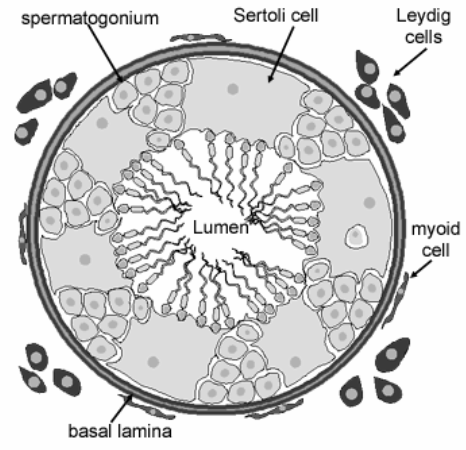
Sketch and label seminiferous tubules in the TS of testis.
Answer
 Verified
631.2k+ views
Hint: Seminiferous tubules are found inside the testes and are the basic location of meiosis and the subsequent development of male gametes, namely sperm cells.
Complete answer:
In the germinal epithelium of the seminiferous tubules, spermatozoa is formed and released into the lumina of these conduits. The germinal epithelium includes Sertoli cells as well as spermatocytes that form. Sertoli cells spread from the germinal epithelium's basement membrane to the tubule lumen. These cells surround the sperm cells that form. They are connected by junctional complexes and form the barrier of blood tests. There are clumps of darker eosinophilic cells in the interstitial space. They are the Leydig cells that create testosterone and release it. Myoid cells cover the tubules and trigger sperm and fluid rhythmic contractions.
Additional information:
Extremely convoluted tubes containing two distinct cell populations are seminiferous tubules. They are rich in spermatogenic and sertoli cells. The average length of these tubules is thirty centimeters and they rarely communicate with each other. In many mammals, the tubules are grouped into lobules separated by connective tissue septa or walls. The arrangement allows a large amount of germinal epithelium to be packed in a small space. In immature males and in adult males between breeding seasons, the tubules are inconspicuous and the epithelium is inactive; in some species, however, spermatogenesis or sperm production is variable throughout the year. Active epithelium may be present at all stages of sperm development.
Note: Seminiferous tubules may start at tunic or outermost layers of tissue and move on to the center and become tortuous before they are emptied into a system where the rete testis are collected.
Complete answer:
In the germinal epithelium of the seminiferous tubules, spermatozoa is formed and released into the lumina of these conduits. The germinal epithelium includes Sertoli cells as well as spermatocytes that form. Sertoli cells spread from the germinal epithelium's basement membrane to the tubule lumen. These cells surround the sperm cells that form. They are connected by junctional complexes and form the barrier of blood tests. There are clumps of darker eosinophilic cells in the interstitial space. They are the Leydig cells that create testosterone and release it. Myoid cells cover the tubules and trigger sperm and fluid rhythmic contractions.
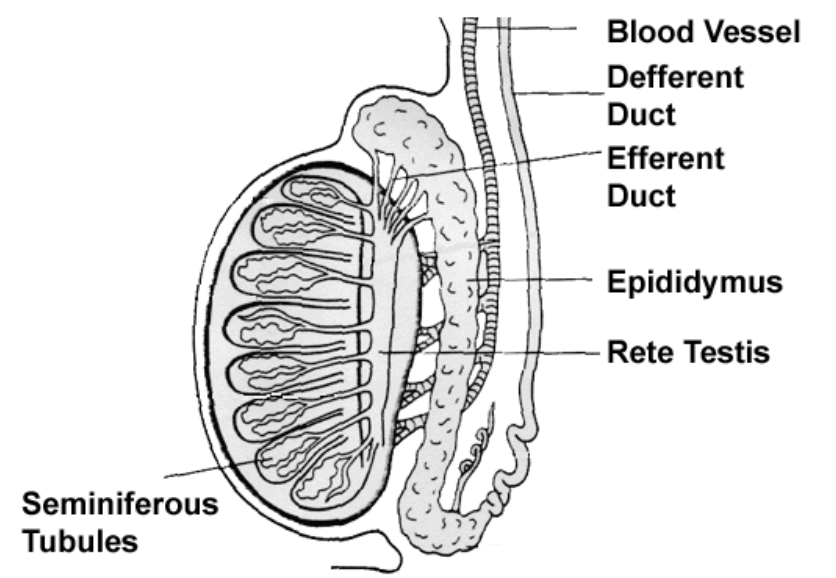
| 
|
Additional information:
Extremely convoluted tubes containing two distinct cell populations are seminiferous tubules. They are rich in spermatogenic and sertoli cells. The average length of these tubules is thirty centimeters and they rarely communicate with each other. In many mammals, the tubules are grouped into lobules separated by connective tissue septa or walls. The arrangement allows a large amount of germinal epithelium to be packed in a small space. In immature males and in adult males between breeding seasons, the tubules are inconspicuous and the epithelium is inactive; in some species, however, spermatogenesis or sperm production is variable throughout the year. Active epithelium may be present at all stages of sperm development.
Note: Seminiferous tubules may start at tunic or outermost layers of tissue and move on to the center and become tortuous before they are emptied into a system where the rete testis are collected.
Recently Updated Pages
Master Class 12 Business Studies: Engaging Questions & Answers for Success

Master Class 12 Chemistry: Engaging Questions & Answers for Success
Master Class 12 Biology: Engaging Questions & Answers for Success
Class 12 Question and Answer - Your Ultimate Solutions Guide
Master Class 11 English: Engaging Questions & Answers for Success
Master Class 11 Social Science: Engaging Questions & Answers for Success
Trending doubts
Which are the Top 10 Largest Countries of the World?
Draw a labelled sketch of the human eye class 12 physics CBSE
The end of compass needle which points towards north class 12 physics CBSE
Differentiate between homogeneous and heterogeneous class 12 chemistry CBSE
In order to find out the different types of gametes class 12 biology NEET_UG
Why is the cell called the structural and functional class 12 biology CBSE