




Show diagrammatically the behavior of magnetic field lines in the presence of
$(i)$ paramagnetic and
$(ii)$ diamagnetic substances. How does one explain this distinguishing feature?
Answer
 Verified
612k+ views
Hint: Paramagnetic substances are substances which when placed in a magnetic field are weakly attracted towards the magnet. On the other hand, when diamagnetic substances are placed in a magnetic field dipole is induced in them in the opposite direction as that of the magnetic field. A paramagnetic tends to move from weaker to stronger regions of the magnetic field while diamagnetic materials tend to move from stronger to weaker regions of magnetic field.
Complete step by step solution:
$(i)$ Paramagnetic substances are weakly attracted to magnets. The atoms in these substances contain electrons, the majority of which spin in the same direction as that of the magnetic field but not all. Due this opposite direction spin, the atoms have some polarity. These substances are only weakly influenced by a magnetic field and since some of the atoms can be turned to point their poles in the same direction, these metals can become very weak magnets.
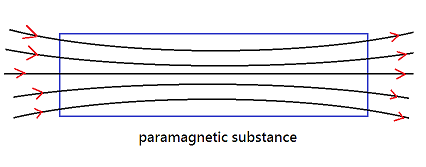
Clearly, magnetic field lines move towards the stronger region, this is towards poles.
$(ii)$ In case of diamagnetic substances: These substances include almost everything such as plants, water, soil, wood and even human skin. Diamagnetic substances show no visible reaction to the presence of a magnetic field, because the electrons in their atoms are spinning in equal numbers in opposite directions which ultimately cancels the dipole of the substance. Diamagnetic substances tend to move from stronger to weaker regions when placed in a magnetic field.
Diagrammatically the behavior of magnetic field lines in the presence of paramagnetic substance and diamagnetic substance can be shown as:
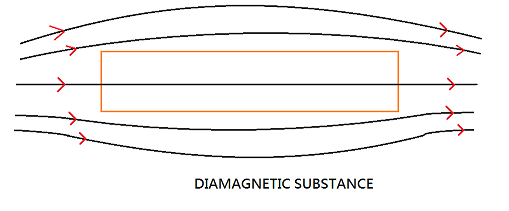
Here, magnetic field lines move away from the pole, that is away from the strong region.
Note: Remember that in case of paramagnetic substance the number of magnetic fields passing through the substance increases. In case of diamagnetic substances, the number of magnetic field lines passing through the substance decreases. The relative permeability of paramagnetic substances is greater than one while for diamagnetic substances it is one.
Complete step by step solution:
$(i)$ Paramagnetic substances are weakly attracted to magnets. The atoms in these substances contain electrons, the majority of which spin in the same direction as that of the magnetic field but not all. Due this opposite direction spin, the atoms have some polarity. These substances are only weakly influenced by a magnetic field and since some of the atoms can be turned to point their poles in the same direction, these metals can become very weak magnets.
Clearly, magnetic field lines move towards the stronger region, this is towards poles.
$(ii)$ In case of diamagnetic substances: These substances include almost everything such as plants, water, soil, wood and even human skin. Diamagnetic substances show no visible reaction to the presence of a magnetic field, because the electrons in their atoms are spinning in equal numbers in opposite directions which ultimately cancels the dipole of the substance. Diamagnetic substances tend to move from stronger to weaker regions when placed in a magnetic field.
Diagrammatically the behavior of magnetic field lines in the presence of paramagnetic substance and diamagnetic substance can be shown as:
Here, magnetic field lines move away from the pole, that is away from the strong region.
Note: Remember that in case of paramagnetic substance the number of magnetic fields passing through the substance increases. In case of diamagnetic substances, the number of magnetic field lines passing through the substance decreases. The relative permeability of paramagnetic substances is greater than one while for diamagnetic substances it is one.
Recently Updated Pages
Master Class 12 Business Studies: Engaging Questions & Answers for Success

Master Class 12 Chemistry: Engaging Questions & Answers for Success
Master Class 12 Biology: Engaging Questions & Answers for Success
Class 12 Question and Answer - Your Ultimate Solutions Guide
Master Class 11 English: Engaging Questions & Answers for Success
Master Class 11 Social Science: Engaging Questions & Answers for Success
Trending doubts
Which are the Top 10 Largest Countries of the World?
Draw a labelled sketch of the human eye class 12 physics CBSE
The end of compass needle which points towards north class 12 physics CBSE
Differentiate between homogeneous and heterogeneous class 12 chemistry CBSE
In order to find out the different types of gametes class 12 biology NEET_UG
Why is the cell called the structural and functional class 12 biology CBSE