




What is the range of the characteristic impedance of a coaxial cable?
(A) Between $150\,\Omega $ to $600\,\Omega $
(B) Between $50\,\Omega $ to $70\,\Omega $
(C) Between $0\,\Omega $ to $50\,\Omega $
(D) Between $100\,\Omega $ to $150\,\Omega $
Answer
 Verified
581.1k+ views
Hint: The coaxial cable is the kind of the cable that carries the electrical signal. These cables have very less losses when compared to the other cables and are commonly used domestically. By coming to its structure it is made of four layers.
Complete step by step solution:
The part of this cable consists of an inner conductor that carries the current which is surrounded by the conducting shield that is made of copper separated by the insulating dielectric material. Above these layers of materials, there will be outer jackets for protection from the external environment. The signal to be carried is provided to the inner conductor of the coaxial cable and the ground potential is given to the shield that protects the conductor.
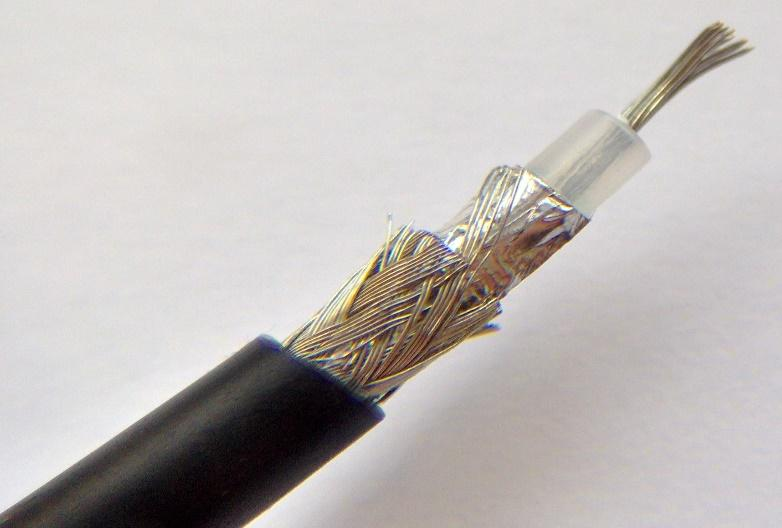
Due to this well constructed structure, the influence of the electric and the magnetic field outside the cable does not happen, and hence result in very low losses. They are suitable for both weak and the strong signals. Since the weak signal needs the well separated circuit from the external environment to prevent losses, the strong signals are not allowed to radiate into the nearby circuits. They have the impedance of the range between $50\,\Omega $ two $70\,\Omega $ and it is the standard value that can be achieved by changing the outer and inner diameter of the cable.
Thus the option (B) is correct.
Note: These coaxial cables are mainly used for carrying the electrical signals that are of high frequency and also it has only low losses. Due to their importance, they are used in telephonic lines, radio transmitters and receivers, television signals cables etc.
Complete step by step solution:
The part of this cable consists of an inner conductor that carries the current which is surrounded by the conducting shield that is made of copper separated by the insulating dielectric material. Above these layers of materials, there will be outer jackets for protection from the external environment. The signal to be carried is provided to the inner conductor of the coaxial cable and the ground potential is given to the shield that protects the conductor.
Due to this well constructed structure, the influence of the electric and the magnetic field outside the cable does not happen, and hence result in very low losses. They are suitable for both weak and the strong signals. Since the weak signal needs the well separated circuit from the external environment to prevent losses, the strong signals are not allowed to radiate into the nearby circuits. They have the impedance of the range between $50\,\Omega $ two $70\,\Omega $ and it is the standard value that can be achieved by changing the outer and inner diameter of the cable.
Thus the option (B) is correct.
Note: These coaxial cables are mainly used for carrying the electrical signals that are of high frequency and also it has only low losses. Due to their importance, they are used in telephonic lines, radio transmitters and receivers, television signals cables etc.
Recently Updated Pages
Basicity of sulphurous acid and sulphuric acid are

Master Class 12 English: Engaging Questions & Answers for Success
Master Class 12 Social Science: Engaging Questions & Answers for Success
Master Class 12 Maths: Engaging Questions & Answers for Success
Master Class 12 Economics: Engaging Questions & Answers for Success
Master Class 12 Physics: Engaging Questions & Answers for Success
Trending doubts
Which are the Top 10 Largest Countries of the World?
Draw a labelled sketch of the human eye class 12 physics CBSE
Draw ray diagrams each showing i myopic eye and ii class 12 physics CBSE
Giving reasons state the signs positive or negative class 12 physics CBSE
Explain esterification reaction with the help of a class 12 chemistry CBSE
What is defined as a solenoid Depict a diagram with class 12 physics CBSE