




Prove that locus of the midpoint of a normal chord of the parabola \[{{y}^{2}}=4ax\] is \[{{y}^{4}}-2a(x-2a){{y}^{2}}+8{{a}^{4}}=0\]
Answer
 Verified
303.9k+ views
Hint: Write the equation of the normal chord of the parabola in parametric form and apply the condition which relates the coordinates of the points at which the normal intersects the parabola. Find the midpoint of the points of intersection of normal to the parabola and solve it to get the locus of the parabola.
Complete step by step answer:
Let us consider a parabola \[{{y}^{2}}=4ax\]
We want to find the locus of midpoint of the normal chord of the parabola.
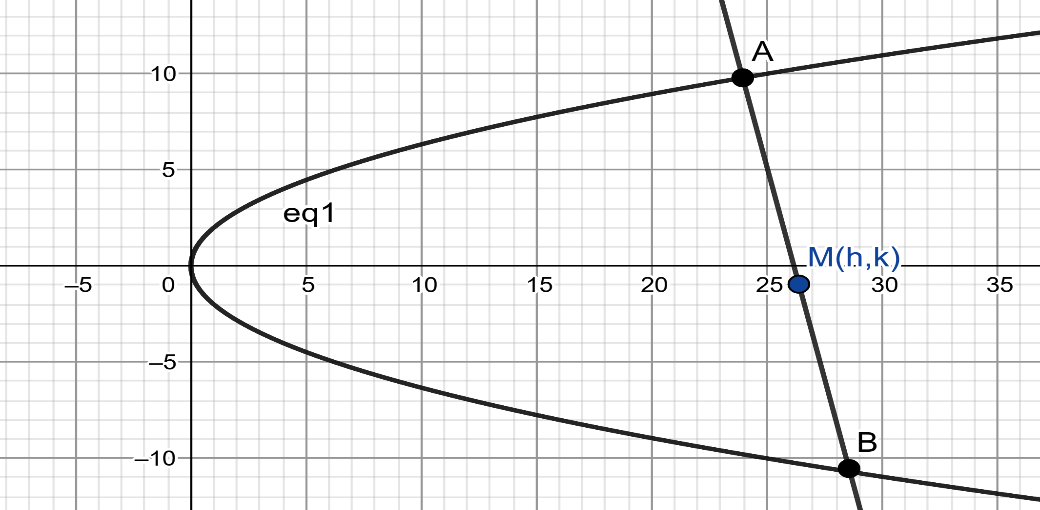
Let us consider the chord \[AB\] whose coordinates are of the form \[A(at_{1}^{2},2a{{t}_{1}})\] and \[B(at_{2}^{2},2a{{t}_{2}})\] , where \[{{t}_{1}}\] and \[{{t}_{2}}\] are parameters.
When a chord intersects normally to the parabola then the relation between the parameters of intersection points is \[{{t}_{2}}=-\dfrac{2}{{{t}_{1}}}-{{t}_{1}}\] .
Substituting the above equation in the coordinates of point \[B(at_{2}^{2},2a{{t}_{2}})\] , we get \[B\left( a{{\left( -\dfrac{2}{{{t}_{1}}}-{{t}_{1}} \right)}^{2}},2a\left( -\dfrac{2}{{{t}_{1}}}-{{t}_{1}} \right) \right)\] .
We know that the midpoint of any two points of the form \[\left( {{x}_{1}},{{y}_{1}} \right)\] and \[\left( {{x}_{2}},{{y}_{2}} \right)\] is \[\left( \dfrac{{{x}_{1}}+{{x}_{2}}}{2},\dfrac{{{y}_{1}}+{{y}_{2}}}{2} \right)\] .
Substituting \[{{x}_{1}}=at_{1}^{2},{{y}_{1}}=2a{{t}_{1}},{{x}_{2}}=at_{2}^{2},{{y}_{2}}=2a{{t}_{2}}\] in the above equation, we get \[\left( \dfrac{at_{1}^{2}+a{{\left( -\dfrac{2}{{{t}_{1}}}-{{t}_{1}} \right)}^{2}}}{2},\dfrac{2a{{t}_{1}}+2a\left( -\dfrac{2}{{{t}_{1}}}-{{t}_{1}} \right)}{2} \right)\] as the midpoint of chord \[AB\] .
Let’s assume that the midpoint of the chord \[AB\] is of the form \[\left( x,y \right)\] .
Thus, we have \[x=\dfrac{at_{1}^{2}+a{{\left( -\dfrac{2}{{{t}_{1}}}-{{t}_{1}} \right)}^{2}}}{2},y=\dfrac{2a{{t}_{1}}+2a\left( -\dfrac{2}{{{t}_{1}}}-{{t}_{1}} \right)}{2}\] .
Solving the above equation, we have \[x=\dfrac{a}{2}\left( t_{1}^{2}+\dfrac{4}{t_{1}^{2}}+t_{1}^{2}+4 \right)\] and \[y=\dfrac{2a}{2}\left( {{t}_{1}}-\dfrac{2}{{{t}_{1}}}-{{t}_{1}} \right)\] .
Thus, we have \[y=\dfrac{2a}{2}\left( {{t}_{1}}-\dfrac{2}{{{t}_{1}}}-{{t}_{1}} \right)=\dfrac{-2a}{{{t}_{1}}}\] .
Rewriting the above equation, we have \[{{t}_{1}}=-\dfrac{2a}{y}\] .
Substituting the value \[{{t}_{1}}=-\dfrac{2a}{y}\] in the equation \[x=\dfrac{a}{2}\left( t_{1}^{2}+\dfrac{4}{t_{1}^{2}}+t_{1}^{2}+4 \right)\] , we have \[x=\dfrac{a}{2}\left( {{\left( -\dfrac{2a}{y} \right)}^{2}}+\dfrac{4}{{{\left( -\dfrac{2a}{y} \right)}^{2}}}+{{\left( -\dfrac{2a}{y} \right)}^{2}}+4 \right)\] .
Further simplifying the equation, we get \[x=\dfrac{a}{2}\left( \dfrac{4{{a}^{2}}}{{{y}^{2}}}+\dfrac{4}{\dfrac{4{{a}^{2}}}{{{y}^{2}}}}+\dfrac{4{{a}^{2}}}{{{y}^{2}}}+4 \right)\] .
By taking LCM and simplifying the terms, we get \[x=\left( \dfrac{4{{a}^{3}}}{{{y}^{2}}}+\dfrac{{{y}^{2}}}{2a}+2a \right)\]
\[\Rightarrow x=\dfrac{8{{a}^{4}}+{{y}^{4}}+4{{a}^{2}}{{y}^{2}}}{2a{{y}^{2}}}\]
\[\Rightarrow 2ax{{y}^{2}}=8{{a}^{4}}+{{y}^{4}}+4{{a}^{2}}{{y}^{2}}\]
\[\Rightarrow 8{{a}^{4}}+{{y}^{4}}+4{{a}^{2}}{{y}^{2}}-2ax{{y}^{2}}=0\]
\[\Rightarrow {{y}^{4}}-2a\left( x-2a \right){{y}^{2}}+8{{a}^{4}}=0\]
Hence, the locus of midpoint of normal chord of the parabola is \[{{y}^{4}}-2a\left( x-2a \right){{y}^{2}}+8{{a}^{4}}=0\] .
Note: We can write the equation of normal of the parabola in slope form and find the point of intersection of normal with the parabola and find the midpoint to get the locus of the parabola.
Complete step by step answer:
Let us consider a parabola \[{{y}^{2}}=4ax\]
We want to find the locus of midpoint of the normal chord of the parabola.
Let us consider the chord \[AB\] whose coordinates are of the form \[A(at_{1}^{2},2a{{t}_{1}})\] and \[B(at_{2}^{2},2a{{t}_{2}})\] , where \[{{t}_{1}}\] and \[{{t}_{2}}\] are parameters.
When a chord intersects normally to the parabola then the relation between the parameters of intersection points is \[{{t}_{2}}=-\dfrac{2}{{{t}_{1}}}-{{t}_{1}}\] .
Substituting the above equation in the coordinates of point \[B(at_{2}^{2},2a{{t}_{2}})\] , we get \[B\left( a{{\left( -\dfrac{2}{{{t}_{1}}}-{{t}_{1}} \right)}^{2}},2a\left( -\dfrac{2}{{{t}_{1}}}-{{t}_{1}} \right) \right)\] .
We know that the midpoint of any two points of the form \[\left( {{x}_{1}},{{y}_{1}} \right)\] and \[\left( {{x}_{2}},{{y}_{2}} \right)\] is \[\left( \dfrac{{{x}_{1}}+{{x}_{2}}}{2},\dfrac{{{y}_{1}}+{{y}_{2}}}{2} \right)\] .
Substituting \[{{x}_{1}}=at_{1}^{2},{{y}_{1}}=2a{{t}_{1}},{{x}_{2}}=at_{2}^{2},{{y}_{2}}=2a{{t}_{2}}\] in the above equation, we get \[\left( \dfrac{at_{1}^{2}+a{{\left( -\dfrac{2}{{{t}_{1}}}-{{t}_{1}} \right)}^{2}}}{2},\dfrac{2a{{t}_{1}}+2a\left( -\dfrac{2}{{{t}_{1}}}-{{t}_{1}} \right)}{2} \right)\] as the midpoint of chord \[AB\] .
Let’s assume that the midpoint of the chord \[AB\] is of the form \[\left( x,y \right)\] .
Thus, we have \[x=\dfrac{at_{1}^{2}+a{{\left( -\dfrac{2}{{{t}_{1}}}-{{t}_{1}} \right)}^{2}}}{2},y=\dfrac{2a{{t}_{1}}+2a\left( -\dfrac{2}{{{t}_{1}}}-{{t}_{1}} \right)}{2}\] .
Solving the above equation, we have \[x=\dfrac{a}{2}\left( t_{1}^{2}+\dfrac{4}{t_{1}^{2}}+t_{1}^{2}+4 \right)\] and \[y=\dfrac{2a}{2}\left( {{t}_{1}}-\dfrac{2}{{{t}_{1}}}-{{t}_{1}} \right)\] .
Thus, we have \[y=\dfrac{2a}{2}\left( {{t}_{1}}-\dfrac{2}{{{t}_{1}}}-{{t}_{1}} \right)=\dfrac{-2a}{{{t}_{1}}}\] .
Rewriting the above equation, we have \[{{t}_{1}}=-\dfrac{2a}{y}\] .
Substituting the value \[{{t}_{1}}=-\dfrac{2a}{y}\] in the equation \[x=\dfrac{a}{2}\left( t_{1}^{2}+\dfrac{4}{t_{1}^{2}}+t_{1}^{2}+4 \right)\] , we have \[x=\dfrac{a}{2}\left( {{\left( -\dfrac{2a}{y} \right)}^{2}}+\dfrac{4}{{{\left( -\dfrac{2a}{y} \right)}^{2}}}+{{\left( -\dfrac{2a}{y} \right)}^{2}}+4 \right)\] .
Further simplifying the equation, we get \[x=\dfrac{a}{2}\left( \dfrac{4{{a}^{2}}}{{{y}^{2}}}+\dfrac{4}{\dfrac{4{{a}^{2}}}{{{y}^{2}}}}+\dfrac{4{{a}^{2}}}{{{y}^{2}}}+4 \right)\] .
By taking LCM and simplifying the terms, we get \[x=\left( \dfrac{4{{a}^{3}}}{{{y}^{2}}}+\dfrac{{{y}^{2}}}{2a}+2a \right)\]
\[\Rightarrow x=\dfrac{8{{a}^{4}}+{{y}^{4}}+4{{a}^{2}}{{y}^{2}}}{2a{{y}^{2}}}\]
\[\Rightarrow 2ax{{y}^{2}}=8{{a}^{4}}+{{y}^{4}}+4{{a}^{2}}{{y}^{2}}\]
\[\Rightarrow 8{{a}^{4}}+{{y}^{4}}+4{{a}^{2}}{{y}^{2}}-2ax{{y}^{2}}=0\]
\[\Rightarrow {{y}^{4}}-2a\left( x-2a \right){{y}^{2}}+8{{a}^{4}}=0\]
Hence, the locus of midpoint of normal chord of the parabola is \[{{y}^{4}}-2a\left( x-2a \right){{y}^{2}}+8{{a}^{4}}=0\] .
Note: We can write the equation of normal of the parabola in slope form and find the point of intersection of normal with the parabola and find the midpoint to get the locus of the parabola.
Recently Updated Pages
If a parabola whose length of latus rectum is 4a touches class 11 maths JEE_Main

Find the cubic polynomial whose zeroes are 3 5 and class 11 maths JEE_Main
During the sale colour pencils were being sold in -class-11-maths-JEE_Main
A man on the top of a vertical observation tower o-class-11-maths-JEE_Main
In a class of 60 students 25 students play cricket class 11 maths JEE_Main
A regular polygon has 20 sides How many triangles can class 11 maths JEE_Main
Trending doubts
JEE Main 2026: Exam Dates, Session 2 Updates, City Slip, Admit Card & Latest News
Understanding the Electric Field of a Uniformly Charged Ring
Derivation of Equation of Trajectory Explained for Students
Understanding Atomic Structure for Beginners
How to Convert a Galvanometer into an Ammeter or Voltmeter
Electron Gain Enthalpy and Electron Affinity Explained
Other Pages
NCERT Solutions For Class 11 Maths Chapter 6 Permutations And Combinations - 2026-27 Free PDF Download (Login Required)
JEE Advanced Percentile vs Marks 2026: JEE Main Cutoff, AIR & IIT Admission Guide
NCERT Solutions For Class 11 Maths Chapter 8 Sequences And Series - 2026-27 Free PDF Download (Login Required)
NCERT Solutions For Class 11 Maths Chapter 9 Straight Lines - 2026-27 Free PDF Download (Sign-in Required)
NCERT Solutions For Class 11 Maths Chapter 4 Complex Numbers And Quadratic Equations - 2026-27 Free PDF Download (Login Required)
JEE Advanced 2026 Notification Out with Exam Date, Registration (Extended), Syllabus and More
NCERT Solutions For Class 11 Maths Chapter 6 Permutations And Combinations - 2026-27 Free PDF Download (Login Required)
JEE Advanced Percentile vs Marks 2026: JEE Main Cutoff, AIR & IIT Admission Guide
NCERT Solutions For Class 11 Maths Chapter 8 Sequences And Series - 2026-27 Free PDF Download (Login Required)